John Deere Mower Repair in Port Charlotte, FL
John Deere mowers are common around Port Charlotte for a reason: they start as dependable yard machines, parts are usually findable, and the 100 Series and S100 family fit a lot of local lawns. They still need a mechanic who knows the difference between a fuel problem, a deck problem, and a tired hydro that has simply done a lot of Florida work. We service John Deere lawn tractors and mowers with the same rule every time: diagnose it, explain it plainly, quote it before work starts.
Independent repair shop. Not affiliated with or authorized by John Deere; the name is used only to describe the machines we service.
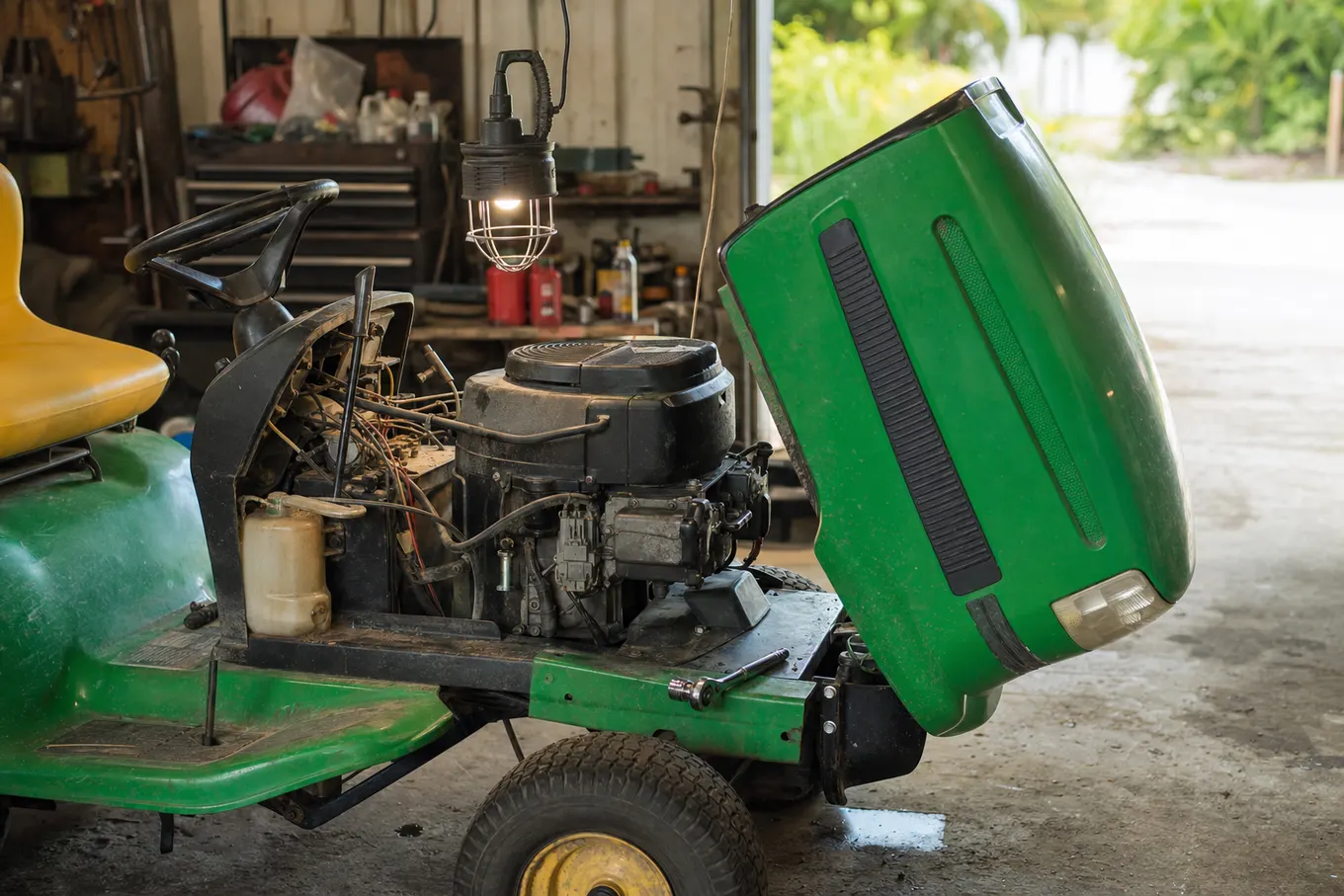
Need John Deere mower repair in Port Charlotte? We work on John Deere riding mowers, lawn tractors, residential zero turns, push mowers, decks, belts, blades, batteries, starters, charging issues, carburetors, fuel systems, and mower engines. We are an independent mowers-only shop, not a dealer, so factory warranty work belongs with the dealer. For everyday repair and service, we keep it simple: tell us what the mower is doing, we inspect it, you approve the quote before work begins, and pickup may be available around Port Charlotte, Punta Gorda, North Port, Englewood, and nearby Charlotte County areas. Call or text the shop.
What a bench mechanic actually knows about John Deere mowers
John Deere is one of those brands where the name on the hood only tells part of the story. A green riding mower can be a basic residential lawn tractor from a big box store, a heavier dealer-line machine, or a zero turn with a very different deck and drive layout. That matters because the right diagnosis changes with the platform. The same complaint, like slow travel or an uneven cut, can point to very different repairs depending on whether the machine is a 100 Series style lawn tractor, an S100 family mower, or a residential zero turn.
A good John Deere inspection starts with the obvious stuff and then keeps going. Fuel age, battery voltage, belt routing, deck height, spindle feel, blade condition, safety switches, hydro drive behavior, and the way the engine sounds under load all tell a story. Owners usually notice the symptom at the worst possible time, halfway through a wet-season lawn that has already grown too tall. On the bench, we have to sort out what failed, what caused it, and whether fixing one part without addressing the cause would just send the mower back home with a timer on it.
Platform and series realities
The 100 Series and S100 style John Deere lawn tractors are everywhere in Southwest Florida neighborhoods because they make sense for residential lots. They are comfortable, familiar, and parts support is usually strong. They are not commercial mowers. Treating them like commercial equipment is how decks get hammered, hydros get hot, and belts start living short, dramatic lives.
Most of the machines we see fall into predictable groups. Lawn tractors are built around a front engine, steering wheel, mower deck, belt drive, and hydrostatic transaxle. Residential zero turns are quicker around obstacles, but they have different drive components and deck stress points. Walk-behind John Deere mowers bring their own fuel, cable, wheel drive, and blade issues. That is why a broad lawn mower repair mindset matters more than chasing one magic Deere problem.
For a homeowner, the useful question is not whether the machine is good or bad. The useful question is whether the mower is being used within the work it was built to handle. A lawn tractor cutting a normal Port Charlotte yard every week is in its lane. The same tractor pulling heavy loads, mowing over exposed roots, chewing through sandy lots, and sitting with old fuel all summer is having a very different life.
Watch-points we check first
John Deere complaints often arrive as one sentence: it will not start, it will not move right, it cuts crooked, it dies when the blades come on, or it keeps throwing the belt. Those phrases are useful, but they are not a diagnosis. The first job is separating engine trouble from deck trouble, electrical trouble from fuel trouble, and operator-control issues from worn parts.
- Fuel system: old E10 gas can leave varnish in the carburetor, swell soft parts, and make the engine run only on choke.
- Battery and charging: a weak battery may click the solenoid, spin slowly, or hide a charging problem until the next mow.
- Deck drive: a stretched belt, rough idler, seized spindle, or bent bracket can make a good mower cut badly.
- Hydro drive: hot, weak, or noisy travel can point to linkage, belt, pulley, brake, or transaxle wear.
- Safety circuit: seat, brake, blade engagement, and reverse circuits can stop the mower without any engine failure.
The part that matters is order. Guessing gets expensive. Testing in a sensible sequence keeps the repair honest. If the float bowl holds enough fuel to fire for a few seconds, that means something. If the starter draw is high but the battery passes, that means something else. Deere machines are common enough that patterns help, but each mower still earns its own diagnosis.
Build-quality truths without the sales pitch
John Deere has a strong name, and some of that reputation is earned. The parts ecosystem is one of the best things about the brand. Blades, belts, filters, spindles, pulleys, cables, switches, and many common engine parts are usually easier to source than they are on mystery-label mowers. That does not make every green mower heavy duty. It means the machine is often worth evaluating carefully before anyone talks about replacement.
The big-box residential machines have limits. They can do excellent homeowner work when the deck is kept clean, blades are sharp, belts are aligned, and fuel is fresh. They get unhappy when asked to mow wet Bahia like a brush cutter or drag loads that belong behind a utility tractor. Dealer-line machines may have heavier components, but they still suffer from old gas, heat, corrosion, and neglect.
We avoid the two lazy opinions. One is pretending every John Deere is built like a commercial mower. It is not. The other is trashing residential Deere machines because they are sold to homeowners. That is not fair either. The right view is practical: match the repair to the machine, the yard, the age, and the owner's plans. That is the same thinking we use on riding lawn mower repair, no matter what brand is on the hood.
Parts availability is a real advantage
Good parts support does not make repair automatic, but it gives a John Deere owner options. A mower with a common deck spindle, belt, switch, cable, starter solenoid, carburetor part, or engine service item is usually easier to quote than a mower where every piece is a treasure hunt. That matters when your grass grows twelve months a year and the mower is not a toy sitting in the garage for fun.
Parts availability also helps with honest decision making. If a needed part is obtainable, the question becomes whether the labor and parts make sense for the mower's condition. If the deck shell is solid, the engine has good compression, the tires hold air, and the hydro still drives well, a normal wear repair may be a smart move. If the deck is rotten, the drive is weak, the engine smokes badly, and the wiring has been patched by three previous owners, the green paint does not rescue the math.
For engine-side work, many John Deere residential mowers use widely supported small engines. That is why small engine repair knowledge matters alongside brand knowledge. Carburetor behavior, valve adjustment symptoms, ignition testing, charging output, oil leaks, and cooling airflow are not solved by the hood decal. They are solved by basic mechanical testing.
How John Deere mowers age in Southwest Florida
Florida is hard on mowers in a quiet way. There is no long winter break for the machine to rest. The yard keeps growing, the air stays humid, and sandy soil keeps finding its way into belts, spindle bearings, pulleys, and blade sails. A John Deere that would feel lightly used in a northern garage can rack up steady hours here because Port Charlotte lawns do not take much of a vacation.
Heat changes the way problems show up. A hydrostatic drive may feel acceptable cold and get weak after twenty minutes. A marginal ignition coil may run until it is heat soaked, then quit like someone turned the key off. A battery can test barely acceptable in the morning and fail after repeated hot starts. Salt air near the coast adds another layer, especially on connectors, deck hardware, cable ends, and exposed fasteners.
Sand is the other local tax. It dulls blades, thins cutting edges, wears deck baffles, and turns a normal belt area into a little abrasive cabinet. If a Deere starts leaving stringy grass, shaking under the deck, or squealing during blade engagement, the fix may be more than sharpening. We check spindle play, idler movement, deck level, blade condition, belt tracking, and debris buildup before calling it done. Residential zero turns get the same local inspection, but their drive and deck layouts make zero-turn mower repair a separate conversation.
The good news is that these machines usually give warnings. The trick is not ignoring them until a small part takes three other parts with it. A belt chirp, hot-start problem, slow crank, weak reverse, uneven cut, or little fuel leak is the mower asking for attention before it gets dramatic.
The John Deere symptoms that roll through our door
Most John Deere repairs start with an owner description, not a part number. That is how it should be. You know what the mower did in the yard: clicked, cranked, surged, bogged, smoked, squealed, cut low on one side, refused to move, or died when the blades came on. Our job is to translate that symptom into a real inspection without guessing at your expense.
It cranks, coughs, or only runs on choke
The owner version is usually simple: the Deere ran last time, sat for a while, and now it cranks but will not stay running. Sometimes it fires for two seconds and quits. Sometimes it runs with the choke on, then dies as soon as the choke opens. On local mowers, stale E10 fuel and carburetor varnish are common suspects, especially after a snowbird season or a stretch where the mower sat with fuel in the bowl.
We do not start by throwing parts at it. We check fuel quality, flow to the carburetor, air filter condition, spark, plug condition, compression clues, and whether the engine is actually getting clean fuel at the right time. If the carburetor is dirty but serviceable, cleaning may solve it. If soft parts are swollen, passages are damaged, or the carb is too far gone, replacement can be the better repair. Prevention is boring but effective: fresh fuel, running the mower regularly, and not letting old gas sit until it turns into green mower syrup. For deeper no-start work, see lawn mower wont start repair and lawn mower carburetor repair.
It leaves ridges, stragglers, or a lopsided cut
A bad cut on a John Deere often gets blamed on the blades first, and plenty of times the blades deserve it. Sugar sand and sandy Bahia grass can round over a cutting edge faster than people expect. But a crooked or ragged cut can also come from a deck that is not level, a bent blade, a worn spindle, a loose pulley, a stretched belt, low tire pressure, or packed debris under the deck changing airflow.
Our cut-quality inspection starts where the grass ends. We look at blade condition, blade match, deck pitch, spindle movement, belt engagement, idler action, tire pressure, hanger points, and whether the deck shell is loaded with wet clippings. Then we fix the cause, not just the edge. A sharpened blade on a loose spindle is a temporary apology. Prevention is regular blade service, rinsing or scraping packed decks when appropriate, avoiding rocks and roots, and not mowing wet growth when the deck is already struggling.
It slows down, will not pull, or keeps eating deck belts
On lawn tractors, owners often describe this as the mower feeling tired. It starts and cuts, but travel is weak, reverse is poor, hills feel worse than they used to, or the belt squeals under load. With K46 style hydrostatic transaxles and similar residential drives, heat, age, belt condition, pulley wear, linkage adjustment, brake drag, and actual internal transaxle wear all have to be separated before anyone gives useful advice.
Deck belt complaints are a different branch of the same tree. A belt that jumps off may be the wrong belt, but it may also be a bent guide, rough idler, bad spindle bearing, weak tensioner, debris packed into the pulley path, or a deck that has taken a hard hit. We check routing, pulley alignment, bearing feel, spring tension, guards, and deck movement. The repair might be a belt and idler. It might be a spindle job. It might be an honest conversation about the drive's age. For that side of the mower, lawn mower belt and deck repair is where the details matter.
It clicks, quits hot, or acts like the key is haunted
Electrical problems make owners suspicious because the mower can behave differently from one day to the next. A John Deere might click once and do nothing, crank slowly, blow a fuse, die when the blades engage, refuse to crank unless the brake pedal is just right, or stop after it gets hot. The cause can be as simple as a weak battery or corroded cable. It can also be a failing solenoid, starter draw issue, charging problem, ignition coil, seat switch, brake switch, PTO switch, or damaged wiring.
We test voltage, connections, grounds, safety switch behavior, charging output, and starter draw before calling the part. Heat-related failures get special attention because Florida makes weak electrical parts show their hand. Prevention is mostly cleanliness and timing: keep battery terminals tight, do not ignore slow cranking, fix chafed wiring before it shorts, and replace weak batteries before they punish the starter system. For this category, lawn mower electrical repair beats guessing.
Repair versus replace on a John Deere should be decided with the mower in front of us, not by brand loyalty or panic. If the engine is sound, the deck is solid, parts are available, and the repair fits the machine's age and workload, fixing it can be the practical move. If the mower has stacked-up problems, a weak drive, serious corrosion, and a tired engine, we will say that plainly before you spend money chasing one symptom at a time.
What We Service on John Deere Machines
Full diagnosis and repair
Any symptom, tracked to its actual cause before a single part goes on.
Full guideTune ups
Oil, plug, filters, blades and a complete go-over on the Florida schedule.
Full guideCarburetors and fuel
Ethanol varnish is brand-agnostic. Cleaning, rebuilds and replacements.
Full guideElectrical systems
Batteries, starters, solenoids, charging and safety switches.
Full guideBelts, decks and spindles
Cut quality lives under the machine. We keep it true.
Full guidePickup and delivery
Dead machines ride free of drama. We come get them.
Full guideJohn Deere Owners Across Four Counties
Based in Port Charlotte, serving the whole 30 mile circle. See the full service area.
Asked at the Counter
Is a John Deere lawn tractor worth repairing?
Often, yes, but the mower has to earn the repair. A John Deere with a healthy engine, solid deck, available parts, and a drive system that still behaves is usually worth a real diagnosis. If the hydro is weak, the deck is badly worn, wiring is brittle, and the engine is tired, we will explain that before you approve work.
Can I get John Deere mower service without going to a dealer?
Yes for normal maintenance and repair. We are an independent mowers-only shop, so we can service common John Deere mower problems like no-starts, carburetors, belts, blades, decks, batteries, starters, switches, and tune-up items. Factory warranty work is different. If the mower is under factory warranty, that belongs with the dealer.
Why does my John Deere mower only run with the choke on?
That symptom usually points toward a fuel delivery problem, often a dirty carburetor or restricted fuel path after old E10 gas sits in the mower. The engine is asking for extra fuel through the choke because the normal circuit is not feeding correctly. We check fuel quality, flow, air filter condition, spark, and carburetor condition before recommending cleaning or replacement.
Why does my John Deere riding mower cut unevenly?
Start with the simple suspects: tire pressure, blade condition, and deck level. If those are not the issue, we look for bent blades, loose spindle bearings, worn deck hangers, stretched belts, idler trouble, packed grass under the deck, or pulley alignment problems. On sandy Southwest Florida yards, blades and spindle bearings can wear faster than owners expect.
Do John Deere mower parts take a long time to get?
Parts availability is one of the better things about John Deere ownership. Common residential mower parts are often easier to source than parts for off-brand machines, especially belts, blades, filters, switches, spindles, pulleys, and engine service parts. Availability still depends on the exact mower, part, and supplier stock, so we confirm before promising a repair timeline.
What is a common problem with John Deere 100 Series or S100 mowers?
The common problems are not mysterious: stale fuel, dirty carburetors, weak batteries, worn deck belts, dull blades, spindle wear, safety switch issues, and residential hydro drives that get tired after a lot of hot mowing. The mistake is assuming every symptom is the famous one. A slow mower may have a belt issue, linkage issue, brake drag, or actual drive wear.
Can you pick up a John Deere mower that will not start?
Pickup may be available around Port Charlotte and nearby service areas. That is useful with riding mowers and lawn tractors because a no-start machine is not exactly fun to push across the driveway. Call or text the shop, tell us the mower type and what it is doing, and we will let you know the practical next step.
How old is too old to repair a John Deere mower?
Age by itself is not the deciding factor. We care more about condition, parts availability, engine health, deck condition, drive behavior, and how you plan to use the mower. An older Deere that has been maintained can be a sensible repair. A newer mower that has been abused by sand, old fuel, corrosion, and neglect may be a poor candidate.
Get Your John Deere Back on the Lawn
Describe the symptom and we will give you the straight answer: what it likely is, what it costs, and how fast.
- Quotes approved by you before any work
- Pickup and delivery available
- Or call now: (941) 555-0123