Riding Lawn Mower Repair in Port Charlotte, FL
A riding mower earns its keep on a big Florida lot, and it always quits in the least convenient week of the growing season. We repair the entire machine, engine to axle: transmissions, decks, steering, wiring and everything bolted between. You approve a firm price before a wrench touches it, and if you have no way to haul it, our trailer does.
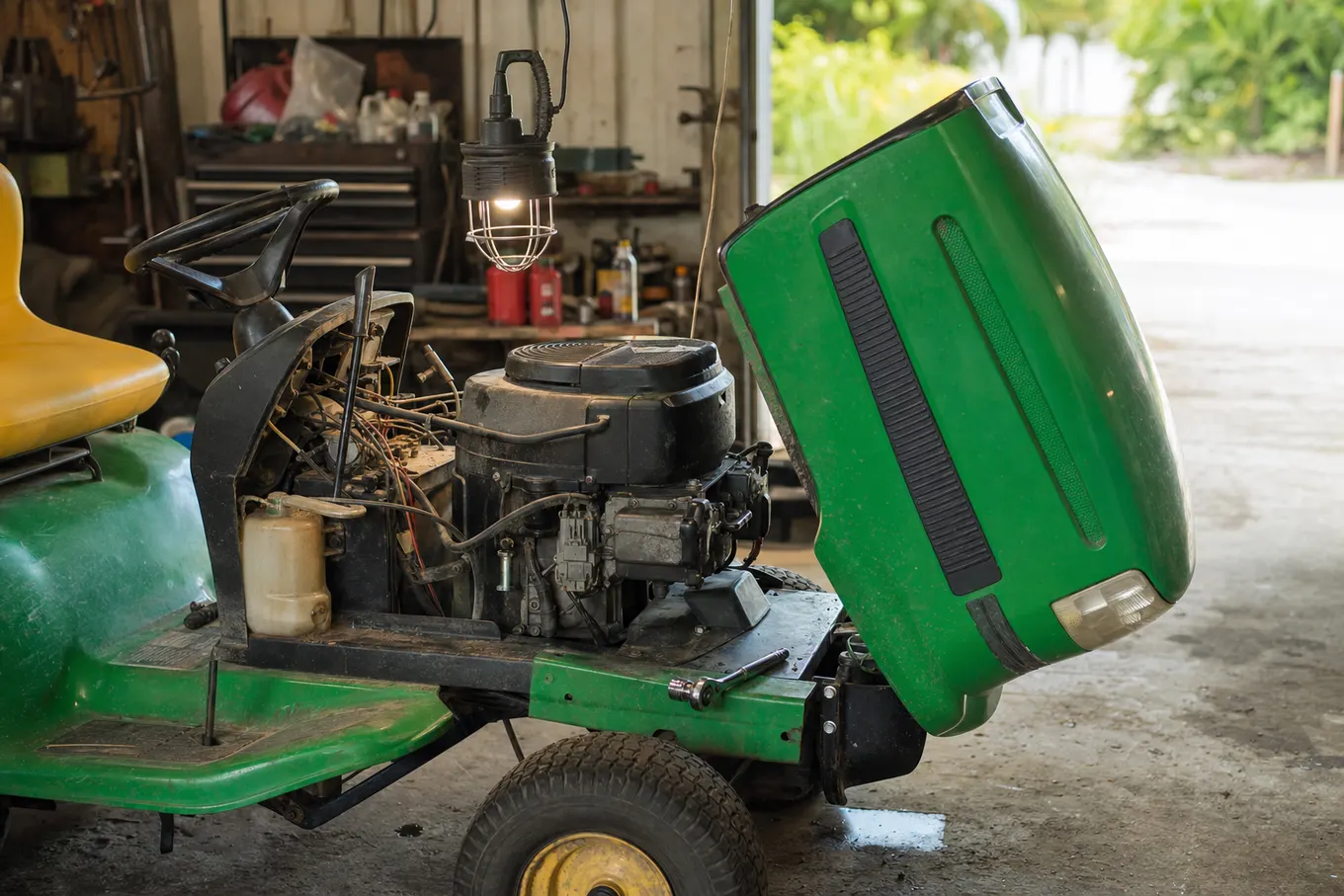
Lawn tractor or riding mower down near Port Charlotte? Joe’s Small Engine Repair services every system on a rider: hydrostatic and gear transmissions, mower decks, steering and front ends, starting and charging circuits, and the Briggs & Stratton, Kohler and Kawasaki engines behind them all. Diagnosis comes first, your approval comes second, repairs come third, in that order every time. Pickup and delivery covers the 30 miles around our shop. Call or text (941) 555-0123.
One Shop for Every System on Your Rider
A riding mower is really five machines sharing one frame: an engine, a transmission, a cutting deck, a steering system and an electrical system. Any one of them can put the whole rig out of work. We repair all five under one roof, which is exactly why riders are the machines we see most. Walk behinds have their own page, and lap bar machines are covered under zero turn repair.
Hydrostatic and gear drives
Weak on hills, dead on one side, jerky takeoff, will not move at all. Fluid service where the transaxle allows it, replacement where it does not. The deep dive is just below.
Deck systems
Belts, idlers, spindles, engagement problems and deck leveling, so a 42 to 54 inch deck cuts the way it did on delivery day.
DetailsSteering and front end
Sector gears, tie rods, bushings and wheel spindles that sugar sand wears loose. We take the wander and the clunk back out.
Batteries, starters, charging
No crank, a click and nothing, or a battery that dies every other Saturday. The full electrical story lives on its own page.
DetailsEngines, single and twin
Compression, valves, carburetion and cooling on the air cooled singles and V-twins that power every rider in this county.
DetailsPickup for stranded machines
No trailer? We collect riding mowers across our whole service area and bring them home running.
DetailsRiding Mower Symptoms and Where We Look First
Riders fail in recognizable patterns, and knowing the pattern before you call makes the whole conversation faster. Find yours below, along with the first places our diagnosis goes and the guide that covers it in depth.
| What you notice | Where we look first | Go deeper |
|---|---|---|
| Turns over slowly, or not at all, after sitting | Battery health, terminal corrosion, ground strap | Electrical guide |
| Fires up, runs a minute, dies on the way to the grass | Fuel cap vent, sour fuel, carburetor bowl | Carburetor guide |
| Blades come on with a shriek | Deck belt tension, idler bearings, clutch air gap | Deck hardware guide |
| Cut looks stepped, waved or striped with tall grass | Deck level, spindle play, tire pressures | Blades and cut quality |
| Engine sounds fine but the machine will not roll | Bypass lever, drive belt, transaxle linkage | We can come get it |
| Strong for the first pass, weak up slopes once warm | Hydro oil condition, cooling fan, belt glaze | Maintenance service |
| Dies instantly when you rise off the seat, blades on | Nothing. That is the seat interlock doing its job | How interlocks work |
| Backfires through the muffler at shutdown | Anti afterfire solenoid, idle speed, shutdown habit | Engine service |
| Eats a new battery every single season | Charging output, regulator, parasitic drain | Charging diagnosis |
| Gas smell in the garage overnight | Float needle, fuel shutoff valve, aged lines | Fuel system repair |
If your rider cranks strong and refuses to fire no matter what, skip straight to the won't start guide, which walks the whole diagnosis in order.
Hydrostatic and Gear Transmission Repair on Riding Mowers
The transmission is the part of a rider owners understand least and fear most, because the word sounds expensive. Sometimes it is. More often the problem is a belt, a linkage or tired fluid pretending to be a dead transaxle. Here is how these systems actually work, how they fail in our climate, and how we sort the cheap fixes from the real ones.
How a hydrostatic drive actually works
Press the pedal on a hydrostatic tractor and no gears change anywhere. The engine spins a small hydraulic pump inside the transaxle, and that pump pushes oil against a hydraulic motor geared to the axle. The pedal or lever tilts a plate inside the pump, called a swashplate, which changes how much oil moves per revolution. More tilt, more flow, more ground speed, in either direction, with no clutch and no shifting.
The elegant part is also the vulnerable part: the oil is the whole show. It transmits every ounce of driving force, lubricates the rotating group and carries away the heat of doing both jobs at once. When that oil overheats, thins out or wears down, the pump cannot build pressure, and the machine gets weak long before it gets dead. A hydro rarely fails with a bang. It fades, first on hills, then on warm afternoons, then everywhere.
That fade pattern matters for diagnosis. A drive that weakens as the machine warms up points at oil condition and internal wear. A drive that is equally gutless cold and hot points somewhere else entirely, usually at the belt feeding the transaxle. We test for exactly that difference before anyone spends transmission money.
Gear drive and variable speed tractors: simpler, tougher, still mortal
Plenty of lawn tractors around Charlotte County still shift through a real gearbox: pick a gear, ease off the clutch brake pedal, and go. Older Craftsman, Murray and Troy-Bilt machines often add a variable speed pulley, a clever double sheave that slides apart and together to change ratio on the move. These drivetrains are mechanically honest. There is no oil pressure to lose, so when something goes wrong you can usually hear it or feel it.
What fails is the hardware around the gears. Shift keys round off and the tractor jumps out of gear on rough ground. The variator pulley bushings wear oval and the speed control turns vague. Clutch and brake linkages stretch, rust and seize, especially on machines parked in open carports a mile from salt water. Internal gear failures do happen, usually announced by a grinding you will not mistake for anything else.
The good news: parts for these transmissions are plentiful and the work is straightforward, which keeps repairs firmly on the sensible side of the repair or replace line. A gear drive tractor with a healthy engine is one of the cheapest machines per mowed acre you can own here, and we like keeping them alive.
The drive belt: always the first suspect when a rider will not move
Between the engine and any riding mower transmission sits a long rubber belt, and that belt lives a hard life in Florida. Heat bakes it, wet season grass loads strain it, and sand dust works into every pulley groove it touches. A worn drive belt produces symptoms that sound exactly like transmission failure: sluggish takeoff, no power up inclines, a machine that creeps when it used to march.
The tells are subtle but real. Belt problems usually get worse under load and smell faintly of hot rubber after a long mow. You might hear a flutter or slap at idle as a stretched belt hunts around its pulleys. Glazing, the shiny hardened sidewall a slipping belt develops, shows up under a flashlight in thirty seconds once the machine is on our lift.
This is why the belt run is step one of every drive complaint we take in: belt condition, idler pulley bearings, tensioner spring, belt guides, pulley alignment. A drive belt and a pair of idlers cost a small fraction of any transaxle work. Finding out the expensive way, by replacing the transmission first, is the mistake we are here to keep you from making.
Whining, jerking and the warm weather fade: reading hydro symptoms
Hydrostatic transaxles talk before they die, and each noise means something. A high whine that rises with pedal input usually means the pump is working oil that is low, aerated or worn thin. A jerky, grabby takeoff often traces to the control linkage and its damper rather than the hydraulics themselves, which is a much friendlier invoice. A machine that rolls backward on a slope while the pedal is neutral has internal leakage past the rotating group.
The most common story we hear on the phone goes like this: it mows fine for twenty or thirty minutes, then it slows down and will not climb the swale by the road. That is heat fade. As the oil gets hot it thins, worn clearances leak more, and pressure falls off. Cooling matters here too: most transaxles wear a plastic fan on the input pulley, and a fan with broken blades lets the unit cook itself a little more every mow.
When you call, describe when the weakness shows up, not just that it is weak. Cold or hot, uphill or everywhere, one wheel or both. Those details steer the first hour of diagnosis and frequently save you money.
Serviceable or sealed: what your transaxle allows
Flip through the manuals of ten lawn tractors and you will find two philosophies. Heavier machines use transaxles with a drain plug, a fill port and sometimes a filter, built with the assumption that oil gets changed. Lighter duty tractors, especially the entry models sold by the big box stores, use compact units the factory calls maintenance free and does not intend anyone to open.
Maintenance free deserves translation. It means the unit is designed to reach the end of its intended design life on the factory fill, mowing a modest lawn in a moderate climate. A one acre Bahia lot in Southwest Florida, mowed year round, is not that duty cycle. The two names you will find cast into most transaxles, Hydro-Gear and Tuff Torq, both make everything from light duty sealed units to serious serviceable gear, and the model tag under your seat tells us exactly which one you own.
Where a fluid service is possible, it is some of the best money a big lot owner can spend, and we will tell you the honest interval for your machine and your acreage. Where the unit is genuinely sealed, we say that too, and the conversation becomes about extending what you have: belt condition, cooling fan, load habits, and a realistic plan for the day it fades.
Heat and towing: the two habits that kill transaxles early
Almost every premature transaxle death we see traces to temperature, load or both. Temperature first: hydraulic oil that runs hot ages fast, and Southwest Florida gives it every excuse. Mowing at two in the afternoon in August, tall wet grass dragging the ground speed down, a cooling fan missing half its blades, clippings packed around the transaxle housing like insulation. None of those alone kills a unit. Stacked up, season after season, they do.
Then load. A lawn tractor looks like a small tractor, so people treat it like one: dump carts full of wet sand, lawn rollers, box grading in the fill dirt after a pool install. Every transaxle has a tow rating, and the light duty units in entry tractors have a low one. Exceeding it does not fail the unit today. It shortens every day after.
The habits that help cost nothing. Mow earlier in the day during the wet season, keep the fan and housing clean when you blow off the deck, split a heavy hauling job into two lighter trips, and give the machine ten easy minutes to cool before shutdown after a brutal mow. Machines treated that way come through our door years later than the ones that were not.
What a transmission job looks like at our bench
Every drive complaint starts the same way: we operate the machine ourselves and confirm exactly what you described, because a symptom seen firsthand is worth three described over the phone. Then the cheap layers come off one at a time. Bypass lever position, because a bumped lever strands more riders than anyone admits. Belt, idlers, tensioner. Control linkage and damper. Oil level and condition where the unit has a way to check it.
Only after all of that passes do we condemn the transaxle itself, and then the conversation is about your machine, not a script. Some units are worth opening for a seal or a rebuild. Many are engineered so that a complete replacement transaxle is cheaper than the labor of surgery on the old one, which sounds wasteful until you compare the invoices. Either way you get one number, the reasoning behind it, and an honest read on whether the tractor deserves it before anything happens.
Deck Repair on Riders: Belts, Spindles, Engagement and Level
The deck does the actual mowing, and on a rider it is a serious piece of rotating machinery: two or three blades, several bearings, a belt moving fast enough to blur, and an engagement system strong enough to spin all of it in wet grass. Most cut quality complaints live down here, not in the engine.
Belts and idlers: where most deck trouble starts
A riding mower deck belt snakes around the engine pulley, one or more idlers, a tensioner and every spindle on the deck. Each of those is a wear point, and the belt is only as good as the worst pulley it touches. An idler bearing that has gone dry and gravelly chews the belt's back face. A tensioner arm with a fatigued spring lets the belt slip in heavy grass, glazing it a little more each time. A misrouted belt after a driveway repair, and we see plenty, runs at an angle that peels it apart in weeks.
Our deck belt work is never just a belt. Every pulley gets spun by hand and rocked for play, the tensioner gets checked through its travel, the belt guides get set to spec, and the routing gets verified against the diagram rather than memory. That is the difference between a belt that lasts seasons and one that lasts a month, and it is why belt and deck work has its own page and its own discipline here.
Spindles: the bearings that carry the whole cut
Each blade bolts to a spindle, a short shaft riding on bearings inside a housing on the deck shell. Spindles live inches from a sandblaster: every pass fires grit at their seals, and Florida's wet grass wraps them in damp clippings that hold moisture against the housing overnight. Bearings give up gradually. First a hum you notice from the seat, then a howl, then heat you can feel through the deck after mowing, and finally wobble that lets the blade tip carve waves into your lawn.
Catch a spindle at the hum stage and it is a modest bearing or spindle assembly job. Ignore it until the wobble stage and it can take the belt, the blade adapter and occasionally the deck housing thread with it. If your deck has grease fittings, they want attention a few times a season here, not once a year. If it has sealed spindles, the schedule is simpler: listen, and act on what you hear.
Engagement: manual levers and electric PTO clutches
Older and simpler tractors engage the blades with a lever and cable that physically shove an idler against the belt. The failure modes are mechanical and visible: stretched cables, rusted pivots, a spring hanging on by optimism. Most modern riders instead use an electric PTO clutch on the engine crankshaft. Flip the switch, the coil energizes, plates lock together and the deck spins.
Electric clutches fail in three distinct ways, and each has a signature. A worn air gap engages late, slips under load and smells hot. A weak battery or corroded connector starves the coil, so blades drop out in thick grass and re-engage on the turn, which owners often misread as a belt problem. And a shorted coil pops fuses the moment you hit the switch. We measure coil resistance, supply voltage and air gap before anyone buys a clutch, because two of those three problems do not need one.
Leveling and rake: why sharp blades can still cut ugly
A deck is supposed to hang level side to side and slightly lower at the front, a stance called rake that lets each blade cut once instead of dragging twice. Deck hangers stretch, adjustment nuts wander, and one low tire quietly tilts the whole cutting plane. The result is stair stepping between blade paths, a lawn that looks combed in one direction, or an unexplained strip of taller grass down every pass.
Sharpening alone cannot fix geometry, which is why our blade sharpening service on riders includes checking how the deck actually hangs. We set tire pressures first, since they are the foundation the deck references, then bring the shell level on a flat floor and set the rake to the maker's spec. Five minutes on a level deck beats an hour of arguing with a crooked one.
Blade hardware: spacers, cups and the bolts that matter
Under a rider's deck, each blade hangs on more than a bolt. Spacers set the cutting height relationship between blades, anti scalp cups stiffen the center and shrug off ground strikes, star or keyed hubs index the blade to its spindle shaft, and the bolt itself carries a torque spec that is not a suggestion. When any of that stack goes back together wrong after a driveway sharpening, the deck develops mysteries: one blade cutting a shade lower than its neighbors, a vibration nobody can locate, a bolt that loosens every few mows.
Ground strikes write their history here too. A rider that hit a root or a hidden pipe can round out the star hub, wallow the blade's center hole or tweak the spindle shaft, and the machine will mostly mow fine while the damage quietly spreads. After any serious strike, the right move is a look: blades off, hubs inspected, spindles spun and rocked. It is quick, it is cheap, and it is how a fifty cent washer problem avoids becoming a spindle assembly problem. We check the whole stack any time blades come off in this shop, because half of blade balance is everything the blade bolts to.
Deck shells and rust: when we save it, when we say stop
Deck shells here fight two enemies at once: humidity from below and packed wet clippings from within. A layer of old grass against steel is a poultice that never dries, and near the coast the salt in our air joins in. Surface scale is normal and harmless. What matters is structure: the spindle mounting areas, the trail edge where clippings sit, and the reinforcement around the deck hangers.
We patch and reinforce where the steel is honest and tell you frankly when it is not. On riders, unlike walk behinds, a dead shell is not always the end of the story, because replacement deck shells and even complete deck assemblies exist for common models at a price that can make sense on a machine with a strong engine and drive. That math changes model by model, and we run it with you rather than for you. Keeping the underside scraped clean, especially before storage, is the cheapest deck repair there is.
Steering and Front End Repair on Lawn Tractors
Nobody buys a lawn tractor for its steering feel, but there is a difference between honest simplicity and a machine you have to saw back and forth just to hold a line. Most riders steer through a sector and pinion: a small gear on the steering shaft driving a curved tooth segment, which swings a drag link, which pushes tie rods, which pivot the front wheels on their spindles. Every joint in that chain is a wear point, and there are a lot of joints.
Our sand is the accelerant. Fine grit sifts into the sector teeth, the flange bushings, the tie rod ends and the wheel spindle bores, and then it grinds every time you turn. Add the vibration of mowing rough Bahia pasture and fasteners back off, wear goes oval, and slack stacks up joint by joint until half a turn of the wheel disappears into the mechanism before anything reaches the tires.
- Wander on straightaways. Constant correction to mow a straight line usually means sector mesh and bushing wear, not your imagination.
- Clunks over bumps. Loose tie rod ends and worn spindle bushings knock when the front axle works over rough ground.
- Steering that binds or catches. Dry or rust scarred sector teeth and a starved pinion gear grab at the same spot every rotation.
- Front tires scrubbing bald. Toe knocked out of spec drags the tires sideways through every turn, and sand finishes them fast.
The repair menu runs from cheap to moderate and almost never to painful: fresh bushings, tie rod ends, a sector and pinion set where the teeth are gone, proper grease in the places the factory made greaseable, and toe set square afterward. Steering work also pairs naturally with front wheel bearing service, since the wheels are already off. If your tractor steers like a grocery cart with a bad wheel, it is telling you something specific, and it is one of the more satisfying things we fix.
Tires, Wheels and Traction on Riding Mowers
Tires are the most ignored system on a rider and one of the most influential. The deck references them, the steering geometry assumes them, and the drive delivers everything through them, so a few missing pounds of air in one rear tire quietly degrades the cut, the handling and the traction all at once. Florida adds its own tax: relentless UV cooks sidewalls into dry rot years before the tread wears out, and the same yards that eat blades hide the screws, palm thorns and irrigation staples that flatten tires.
The habits are simple. Check pressures monthly with an actual gauge, because turf tires run low pressures where eyeballing fails completely, and set left and right identical. Look at sidewalls each season for the spiderweb cracking that says the rubber is done structurally no matter how good the tread looks. Slow leaks in tubeless turf tires are usually repairable with a plug or a bead reseat, chronic ones sometimes want a tube, and genuinely rotten tires want replacement before one lets go mid mow with the deck spinning.
Traction has a technique side too. Turf tires are designed to protect grass, not to climb wet slopes, and a rider that spins or slides on the damp side of a swale is asking for a drier day, not aggressive tires that will tear the lawn all summer. If your property genuinely defeats turf rubber, talk to us about options before buying anything knobby. And when a wheel itself is the problem, wallowed hubs, missing keys, bent rims from that one stump, all of it is standard bench work that pairs naturally with the steering and drive repairs above.
Riding Mower Electrical: The Short Version
A walk behind barely has wiring. A rider has a real electrical system: battery, starter, solenoid, ignition switch, a charging stator under the flywheel, a regulator, fuses, and a lacework of safety interlocks watching the seat, the brake, the PTO and sometimes reverse. When a rider will not crank, the odds heavily favor this system over the engine itself.
Two Florida facts shape the work. First, heat is brutal on batteries, so a rider battery here lives a short life and a corroded one fakes a dozen bigger problems. Second, humidity and salt air creep into connectors, ground straps and switch contacts, building resistance that turns a strong circuit into a weak click. We chase these faults with a meter and a wiring diagram, in a fixed sequence, because guessing at electrical parts is how a no crank becomes a pile of receipts.
The complete guide to batteries, starters, solenoids, charging systems and interlock switches lives on our electrical repair page, and if your machine cranks fine but will not fire, start instead with the won't start guide. Bring us the symptom either way, and we will bring the meter.
Engine Work on Riders, and Why Access Is Half the Job
Riding mowers around here run a familiar cast of engines: Briggs & Stratton singles and V-twins, Kohler singles and the 7000 series twins, Kawasaki FR twins on the nicer machines, and the occasional Honda. We service all of them, from a routine tune up to valve adjustments, carburetor work, charging components and the compression testing that settles rebuild or replace questions. The deep engine content lives on our small engine repair page; what belongs here is what makes rider engines different.
Difference one: cooling. These are air cooled engines wearing plastic shrouds, and on a rider the engine sits in a well that collects clippings, seed heads and sand. Debris packs under the shroud where nobody sees it, blankets the cooling fins, and the engine spends every mow a little hotter than designed. Heat is the quiet killer behind burned valves, cooked oil and short battery life. Pulling shrouds and cleaning fins is unglamorous work that adds years, and it is part of every serious service we do.
Difference two: fuel systems with more parts. Riders add a fuel pump, longer lines, an anti afterfire solenoid on the carburetor and, on twins, carburetion that feeds two cylinders that both deserve to run. Our ethanol blend gas attacks all of it the same way it attacks a push mower carb, just with more places to hide. Surging, one cylinder dropping out, backfire on shutdown: these are fuel system stories more often than not, and the carburetor page tells them in full.
Difference three, and the one people underestimate: access. On most riders you cannot properly reach the underside of the engine, the PTO clutch or the deck spindles without lifting the machine safely and often dropping the deck out of it. That is awkward, occasionally dangerous work on a driveway and routine work on a lift. A fair amount of what we do is finishing jobs that started on jack stands at home with the best of intentions. No judgment. It is genuinely easier here, and the flashlight never dies.
Lawn Tractor Brands We See Every Week, and What Their Owners Bring Us
After enough of them cross the bench, each brand family develops a personality: where it wears, what its parts cost, and how far a repair dollar stretches on it. None of this is a knock on any badge. It is pattern recognition, offered so you know what you own.
John Deere lawn tractors: the green wave
No brand rolls through our door more often, for the simple reason that no brand sits in more Charlotte County garages. The 100 series machines from the big retailers dominate, with the heavier E and S series above them and the occasional garden tractor from decades past still soldiering on. Parts support is a genuine strength: belts, spindles, blades and electrical bits are available everywhere, quickly, at sane prices.
What they bring us tracks their duty. Entry tractors on big Bahia lots work above their weight class, so we see deck shells wearing before the engine does, light duty transaxles fading on acreage they were never sized for, and the standard diet of belts, batteries and carburetors. The tier matters more than the color: a heavier Deere with a serviceable transaxle is a machine worth almost any sensible repair, and we will tell you which tier your model sticker puts you in.
Craftsman, Poulan Pro and Husqvarna: one platform, many paint jobs
A whole generation of American lawn tractors, badged Craftsman, Poulan Pro, Husqvarna and a few store brands besides, rolled off shared platforms, and that shared DNA is visible the moment the hood comes off. For owners this is excellent news. Steering sectors, spindles, idlers, seats and switches interchange across badges, the aftermarket supports all of it deeply, and repairs stay cheap because nothing is exotic.
The patterns we see: steering gear and bushing wear on the sandy lots, since the front end design trades refinement for simplicity, deck shells that want cleaning discipline to reach old age, and ignition switches and seat interlocks that corrode into no crank complaints. All of it is routine work. These tractors are the small block Chevys of the lawn world: not fancy, endlessly fixable, and usually worth fixing.
Cub Cadet and Troy-Bilt: the MTD family
Cub Cadet sits at the polished end and Troy-Bilt at the value end of the same manufacturing family, and both are thick on the ground here. The hydrostatic models mostly carry the same transaxle families as everyone else, so the drive conversation follows the tier logic covered above. Deck engagement is a place the family shows its habits: plenty of models use cable operated engagement that wants adjustment as it stretches, and a stretched cable produces blades that engage lazily long before anything is actually broken.
Parts support is solid and improving, the engines on top are the same Briggs, Kohler and Kawasaki units we service all day, and the frames take Florida life well. Our honest note is the same one we give every brand: the difference between the budget model and the better one is not the badge, it is the deck steel, the transaxle rating and the spindle construction, and it shows up years later on our invoices.
Snapper rear engine riders and the older iron still out there
Every month or two something wonderful comes in: a Snapper rear engine rider, a decades old garden tractor, a machine inherited with the house. The rear engine Snappers deserve their cult. Simple disc drive, one blade, a frame you can lift by yourself, and a parts situation that is still surprisingly workable for the common wear items.
With older machines the conversation is always the same honest triangle: the engine's internal health, the availability of the specific part that failed, and what the machine is worth to you. Plenty of old iron earns its repairs, because the steel is thick and the design is serviceable in ways modern value engineering is not. Occasionally a truly obsolete part ends the road, and when that happens we say so early instead of hunting on your budget. If you are not sure what you have, send us photos of the machine and its tags before you decide anything.
Big Lots, Bahia Pasture and the Florida Lawn Tractor
Our corner of Florida is riding mower country by geography. North Port and Cape Coral were platted into quarter acre lots by the tens of thousands. Deep Creek and Lake Suzy run larger, Harbour Heights larger still, and out toward Arcadia the mowing turns into genuine acreage: ranchettes, fence lines, retention swales and the strips along a quarter mile of driveway. Nobody walks that. The rider is not a luxury on these properties, it is infrastructure.
And the grass fights back. Bahia, the default on big unirrigated lots, sends up those wiry V shaped seed stalks all summer that dull blades and drag decks. St. Augustine on irrigated lots grows thick enough in July to double the load on a deck belt. The wet season means mowing weekly whether you feel like it or not, often over ground still soft from yesterday's storm, which is how tire ruts, deck scalping and stuck-in-the-swale phone calls happen. Fire ant mounds set up hard as concrete and bend blades. Armadillos excavate overnight potholes that punish front axles. A rider on a Florida acre works harder in one summer than a northern machine works in three.
That duty cycle shapes our advice. Hours pile up fast, so we push hour based maintenance instead of calendar based: oil by the meter, belts and spindles inspected mid season, blades sharpened when the cut says so rather than when the calendar does. It also shapes logistics. A dead lawn tractor on a big lot with no trailer is exactly why our pickup and delivery service exists, and why so much of its route sheet reads like the acreage neighborhoods above.
If you are on the fence between machines for a big property, ask when you call. We repair every brand that shows up, which gives us an unusually honest view of what survives out here and what comes back on a trailer every season. That knowledge is free, and it might be the most valuable thing in the shop.
How a Riding Mower Repair Moves Through Our Shop
A rider is a bigger commitment than a push mower, for you and for us, so the process is built to keep you in control of it. Here is the whole path, no mystery anywhere in it.
- The intake conversation. You tell us what the machine is doing, when it started and what has been tried. Model numbers help, photos help more, and the sticker under the seat helps most.
- We reproduce the complaint ourselves. Before any teardown, the mower gets operated: driven, engaged, loaded. A symptom we can see is a symptom we can trust, and it keeps the diagnosis anchored to your actual problem.
- Inspection radiates outward. We start at the system the symptom points to, then check what connects to it, because riders fail in chains. A weak battery hides a charging fault. A thrown belt hides a seized idler.
- You get findings and one firm number. Plain language, the parts involved, and a price. Approve it and we proceed. Decline and you owe what we quoted for diagnosis when you dropped it off, nothing invented afterward.
- The repair, done completely. Fasteners torqued, belts routed to diagram, linkages adjusted to spec, and the neighboring wear parts flagged if they are close, so you can decide while the machine is already open.
- Function test before the phone call. Drive, steering, PTO engagement, cut engagement under load, charging voltage at the battery. It gets tested the way you will use it, then you get the call that it is ready, or the truck brings it back to you.
A Rider Owner's Calendar for Southwest Florida
Up north the mowing year has a beginning and an end. Ours has moods. Knowing what each stretch of the calendar asks from a riding mower keeps you ahead of the failures instead of stranded by them, so here is the year the way our shop experiences it.
The wet season, roughly June through September, is the machine's marathon. Grass that grew a polite inch a week in March grows three, the ground stays soft, and every mow happens at full load in full heat. This is when belts glaze, hydros fade and clogged cooling fins collect their debts, and it is the worst possible season to be waiting on a repair. Machines that got a proper going over in spring sail through it. Machines that did not fill our queue by the Fourth of July.
Storm season overlaps it, and brings two specific jobs. Before a named storm, think about where the mower rides it out: off the bare ground if flooding threatens, fuel topped or drained by your preference, battery charged in case you need the machine for cleanup after. After any big blow, walk the yard before the first mow. Palm boots, roof screws, fence staples and half buried branches are lying in the grass waiting for your blades, and post storm weeks are reliably our busiest for bent blades, chewed spindles and punctured tires.
The dry season, November into May, is when Bahia slows down, dust replaces mud, and the smart money does its maintenance. Air filters work hardest now, sand rides every breeze, and the lighter mowing schedule makes it the painless time for the bigger jobs: transaxle service, steering rebuilds, deck restoration, engine work. If your machine limped through August, this is when to fix it properly, before the next June finds the same weakness. And if you head north for the summer, this calendar runs in reverse: the machine sits through the hardest season, which is its own project, and we prep for that too.
Riding Mower Repair Cost, Explained Without Games
We do not publish flat prices for rider work because honest numbers do not exist until we know which system failed and what it took with it. What we can do is show you the four factors that actually move the quote, so the number makes sense when you hear it.
- Which system, and how deep. A drive belt lives at one end of the scale, a transaxle at the other, and most rider repairs land in the wide middle: spindles, clutches, steering sets, starters, carburetors.
- Parts tier and availability. Common tractors have superb parts support at fair prices. Orphaned brands and oldest models sometimes need hunted parts, and we tell you before hunting on your dime.
- Condition around the repair. Rust seized fasteners, chewed threads and homemade wiring add time. A clean, maintained machine is genuinely cheaper to work on, one more return on those habits.
- What else we find open. If the deck is off for a spindle and the belt is one season from failure, you hear about it while the labor is already paid for once, not as a surprise upsell later.
Here is the context that matters most: riding mowers are the category where repair math favors fixing most strongly, because replacement cost is high and the chassis outlasts its wear parts by design. A repair on a sound rider usually runs a small fraction of what a comparable new machine costs. The exceptions are real, a rotted shell over a fading sealed transaxle on an entry unit, and when you own the exception we say so before you spend. That habit of saying so is most of what this shop is about.
Checking a Used Riding Mower in Five Minutes
Half the riders in our service area change hands through yard sales and marketplace listings, and some of those deals are excellent. The sellers know which ones. Since we end up meeting the other kind professionally, here is the quick inspection we would run on any used rider before money moves.
- Insist on a cold start. A machine warmed up before you arrived may be hiding hard starting, smoke on startup or a charging problem. Cold engines confess.
- Engage the blades at half throttle and listen. A clean whoosh is health. Shrieks, rattles or a long slipping engagement are the deck asking for money.
- Drive it uphill, both directions. Any slope reveals a tired hydro that a flat driveway test drive conceals completely.
- Rock each blade and each front wheel. Play at the blades means spindle bearings. Play at the wheels means front end work. Neither is fatal, both belong in the price.
- Pull the dipstick and look under the deck. Black sludge, milky oil or a shell going lacy at the edges each tell you more than the seller will.
None of this requires tools, and a seller who refuses any of it has answered your question. If a machine passes and the price feels right, a full tune up right after purchase resets every fluid and filter to a known baseline, which is the cheapest insurance a secondhand rider can get. And if you are staring at a listing wondering whether the model is a good one, call us. We probably worked on that exact machine this month.
Lawn Tractor and Riding Mower Repair Across Four Counties
Big lot country surrounds us in every direction, and riders roll in from all of it, on trailers and on our truck. Each town below has its own page with drive times and local details, and the service area map shows the whole 30 mile picture.
The frame, pivots and small switches that make a tractor feel right
A riding mower can have a good engine and a sharp deck and still be miserable to use. That usually points below the obvious parts. The chassis carries your weight, the deck, the steering, the front axle, the seat, the brake linkage and whatever you are pulling behind it. Those pieces do not get much attention because they are not exciting. Then the tractor starts wandering, the seat switch cuts out, the front end clunks over every rut, or the hitch plate looks like it has been used as a farm tractor. That is when the quiet parts become the whole repair.
On Port Charlotte and Charlotte County yards, riders live a harder life than they look like they should. Big lawns mean longer heat cycles. Sugar sand gets into pivots and bushings. Wet season mowing pounds the front axle through soft spots. Snowbird storage gives corrosion time to work on every spring, pin and connector. A clean mower that sat under a carport for months can still have a frozen brake shaft or a safety switch that only works when the seat flexes exactly right. The chassis is where age and use leave fingerprints.
Steering slop and worn sector gears
The classic complaint is that the tractor will not hold a straight line. You point it down a pass, and it slowly wanders toward a bed, fence or canal edge. Sometimes the steering wheel has a quarter turn of play before the front wheels react. That can come from tie rod ends, drag links, bushings, a worn steering shaft or the sector gear under the dash. The sector gear is easy to ignore because you do not see it while mowing, but every turn of the wheel loads those teeth. Once the gear and pinion wear, the tractor feels loose even if the front tires are aired up and the deck is cutting fine. A good repair starts by finding where the motion is getting lost, not by throwing parts at the front end.
Front axle pivots and bushings on bumpy Florida lots
Most lawn tractors use a front axle that rocks side to side on a center pivot. That little bit of movement helps the mower follow uneven ground. It is also a wear point. Sand, dry grease, rust and repeated bumps can open up the pivot and make the front end clunk. Wheel bushings and spindle bushings add their own looseness, especially if the mower has been run with low front tires or used over roots and rough fill. You will feel it as vague steering, uneven tire wear, deck scalping or a rattle that seems to come from everywhere at once. Grease helps only if the parts are still shaped right. Once a bushing is oval, grease is a bandage, not a repair.
Seats, fenders and the safety switch under you
A torn seat looks cosmetic until water gets into the foam, the pan rusts, the seat sags, and the switch below it starts reading your weight wrong. The seat switch is part of the safety circuit. If it thinks nobody is sitting there, the mower may die when the blades engage, shut off when you hit a bump, or refuse to crank. Bent fender pans can create the same problem by changing how the seat bracket presses the switch. This is why a riding mower with a simple no crank complaint can turn into a chassis and mower electrical repair diagnosis. We check the switch, but we also check why the switch is being abused. A new switch under a broken seat bracket is not much of a fix.
Hitches, hauling and what towing does to a lawn tractor
A lawn tractor hitch is useful for a small yard cart, a spreader or a light attachment. It is not a pickup truck. Pulling heavy loads through soft grass, sugar sand or wet ground loads the transmission, belt, frame plate, rear axle and brakes. The damage is often slow. The tractor starts needing more throttle to move the same cart. The belt smells hot. The brake will not release cleanly. The rear of the frame flexes around the hitch. None of that means you can never tow with a lawn tractor. It means the attachment, terrain and speed matter. If a rider came in after hauling branches, dirt or a loaded cart, we look beyond the hitch pin and check what the pull did to the rest of the machine.
The reason this matters for riding mower repair is simple: the mower has to feel predictable. A tractor that steers late, clunks over bumps, cuts out when the seat shifts, or drags a brake is not just annoying. It makes you compensate every second you mow. That is how small chassis problems become bent deck hangers, cooked belts, stripped gears or a mower parked in the side yard with a note that says it ran fine last month.
Rider habits that keep the mower and the operator out of trouble
Most riding mower problems do not start dramatically. They start with a wet turn near a ditch, a rushed pass along a canal, a kid running into the yard while the blades are still spinning, or a long summer mow with the operator tired and sun baked. We see the mechanical aftermath: bent spindles, torn belts, cooked brakes, cracked plastic, jammed deck hangers and switches that were bypassed because they were irritating. A rider is comfortable enough to make you forget it is still a rotating blade machine with weight, speed and momentum.
Canals, swales and retention ponds deserve extra respect. The ground near the edge can look firm from the seat, then crumble or slide when the front tire loads it. If the slope makes you lean in the seat, or if the mower feels like it wants to drift downhill, that is already information. Back out and trim that strip another way. Lawn tractors and zero turns also behave differently on slopes. A tractor usually has front steering and a longer, calmer feel. A zero turn can pivot fast, but that same quick control can get interesting on wet side slopes. If you want the deeper comparison, our zero turn mower repair page talks through how those drive systems fail and behave under load.
Wet grass changes braking. Tires pack with clippings. The deck throws damp buildup. Belts slip. The brake may hold fine on dry concrete and feel lazy on grass because the tires have less bite. Mowing right after a hard rain also loads the deck and transmission harder than dry mowing. If the mower starts sliding, do not add more steering and hope physics gets embarrassed. Slow down before the turn, keep the deck clear, and leave the slickest strips for later if you can. The grass will still be there. It is very committed.
Kids and riders need house rules, not vague reminders shouted over an engine. Nobody approaches the mower while it is running. Nobody rides on the fender, hitch, lap or cart. Toys, hoses, dog lines and sprinkler heads get picked up before the blades start. The reverse mowing feature, if the mower has one, is not a permission slip to back up blind. The best habit is boring: blades off, look behind you, then move. The repairs after a shortcut are rarely fun to price and never fun to explain.
Heat is part of mower care too. A big lot in July can turn into a long session under direct sun. The operator gets tired, grips harder, turns rougher and misses noises the mower is trying to make. The machine is hot at the same time. Hydro drives, belts and engines all dislike being run hard while packed with clippings. Breaks are not weakness. They give you a chance to drink water, clear the deck, check for a loose belt smell, and notice whether the tractor is steering or braking differently than it did at the start. That small pause can prevent a repair that starts with the phrase, I was almost done.
Good riding mower operation is not fancy. It is steady speed, clear edges, smart slope judgment, dry enough grass, and a machine with working safeties. If the mower feels sketchy, it is telling you something before it fully breaks. Listening early is cheaper than arguing with it after the fact.
Riding Lawn Mower Repair FAQs
My riding mower moves fine on flat ground but crawls going up my driveway. What is wrong?
That is the classic signature of a tired hydrostatic transmission. The oil inside has sheared down over hundreds of hot Florida hours and cannot hold pressure under load, so the drive gives up exactly when it has to push hardest. On a serviceable transaxle, a fluid and filter change sometimes brings it back. On a worn pump, we talk options honestly. A slipping drive belt can fake the same symptom, so we rule that out first because it costs far less.
The drive belt keeps coming off my lawn tractor. Why?
Belts do not jump off healthy pulleys. Something is letting it happen: a stretched tensioner spring, an idler pulley with a failing bearing that wobbles under load, a belt guide bent by a stick strike, or debris sitting in the belt path. Hanging a new belt without finding that cause just schedules the next failure. We inspect the entire belt run before anything gets replaced.
Can you get a dead riding mower out of my backyard?
In most cases, yes. Our pickup service handles machines that will not run or roll. Riders with hydrostatic drive have a bypass lever that frees the rear wheels, which makes loading possible even when the transmission is locked up. Mention gates, soft ground and slopes when you call so we show up with the right gear the first time.
Is replacing the transmission on a lawn tractor worth the money?
It depends on what surrounds that transmission. On a well kept tractor with a strong engine and a solid deck, a transaxle swap can buy years of service for far less than a comparable new machine. On an entry level unit near the end of its deck life, the same repair can exceed what the mower is worth, and we will say so plainly before you commit to anything.
Why do my blades stall when the grass gets thick?
Thick summer Bahia asks a lot from the cutting system, and any weakness shows up right there. A glazed or stretched deck belt slips under load, a worn PTO clutch cannot hold torque, dull blades double the drag, and a deck packed with old clippings makes all of it worse. Once in a while the engine itself is down on power. We work through the cheap causes first, in that order.
Why does my lawn tractor scalp the same spot in the yard every pass?
That spot is a high point or dip your deck geometry cannot follow. Anti-scalp wheels that are worn, missing or set at the wrong height let the deck shell dig in instead of riding over. A deck sitting low in front, uneven tire pressures or a sagging deck hanger will scalp on contours too. We level the deck on a flat floor, set the rake and reset those wheels so the deck floats the way it was designed to.
My steering wheel turns halfway before the front wheels respond. Can that be fixed?
Yes, and it is one of the most common lawn tractor complaints we hear from big lot owners. Most tractors steer through a sector and pinion gear set plus tie rods, bushings and wheel spindles, and every one of those wear points adds a little slack. Sand accelerates all of it. Depending on wear we tighten the sector mesh, replace bushings and tie rod ends, or fit a new gear set. The next mow feels like a different machine.
What does the freewheel or bypass lever on the back of my mower actually do?
It disconnects the hydrostatic drive so the rear wheels spin freely. It exists so you can push the machine by hand or roll it onto a trailer without the hydraulic system fighting you. Two things worth knowing: never tow a hydro mower any real distance even in bypass, and if your mower suddenly will not move at all, check whether that lever got bumped. That phone call has saved more than one customer a repair bill.
Do you work on garden tractors or compact diesel tractors?
Garden tractors that cut grass, yes. The heavier lawn and garden machines from the mower brands share the same engines, decks and drive parts we handle every day. Compact diesel utility tractors are a different animal with different systems, and they are outside what we do. We stick to the machines we are genuinely good at and point you elsewhere the moment something is not in our lane.
Can I bring you just the deck or the transmission instead of the whole tractor?
Sometimes that works, especially for deck rebuilds where the shell comes off easily. The whole machine is still better whenever diagnosis is involved, because we need to see the part behave installed, under power, with its belts and linkages connected. A transmission that seems dead on a bench can turn out to be a belt or linkage problem on the tractor.
What oil should a riding mower engine run in Florida heat?
Follow the engine maker's chart, not habit. Briggs & Stratton, Kohler and Kawasaki all publish grades for hot climates, and several now approve full synthetic for exactly our conditions. What matters more than the brand on the bottle is level and freshness, because oil in a mower engine works harder through a Port Charlotte August than it ever would up north. We set you up with the correct fill at every service.
How many years should a lawn tractor last on a big lot?
Think in hours, not years. An hour meter reading tells you more than a birthday does, and a machine cutting an acre or more every week here stacks hours two or three times faster than the national average. The difference between a tractor that dies young and one that keeps earning is almost always maintenance: oil on schedule, belts and spindles checked, the deck kept clean underneath. Well kept machines outlive their warranties by many seasons.
Will you install parts I bought online?
Call us first and we will talk it through honestly. The catch with supplied parts is fit and quality: listings that claim to fit your model are wrong more often than you would expect, and a stalled job ties up your mower and our bench. When the part comes through us, it is a part we can stand behind.
My rider blows the same fuse every time I turn on the blades. What is going on?
A fuse that pops on PTO engagement is telling you the clutch circuit is drawing too much current. The usual culprit is an electric clutch coil breaking down internally, followed closely by chafed wiring shorting against the frame where the harness runs near the deck. This is exactly the kind of fault that eats a pocketful of fuses in a driveway and takes minutes to isolate with a meter on the bench.
Why does my riding mower die when I put it in reverse?
Many riders are designed to shut the blades off, or shut the engine down, if reverse mowing is not enabled correctly. A weak seat switch, loose reverse switch, bad brake switch or damaged wiring can make that safety circuit act up even when you are sitting normally. Start by checking the operator manual setting, then have the switches and wiring tested instead of bypassing them.
How do I free a stuck brake on a lawn tractor?
First, make sure the parking brake lever is fully released and the pedal linkage is not packed with grass or sand. If the brake arm at the transaxle will not move, it may be rusted, over adjusted or jammed internally. Do not force the pedal until something bends. Gentle cleaning and lubrication can help an external linkage, but a seized brake assembly needs proper inspection.
What causes a riding mower to backfire?
Backfiring can come from a lean carburetor, old fuel, an intake leak, a sticking valve, a failing ignition coil, incorrect shutdown habits or a sheared flywheel key after an impact. The timing of the pop matters. A bang while cranking points one direction, while a pop during throttle down points another. Fresh fuel is a good start, but repeated backfire deserves diagnosis.
Can a lawn tractor pull a dethatcher or aerator?
Usually, yes, if the attachment is appropriate for a lawn tractor and the yard conditions are reasonable. The problem is not just the tool. Wet ground, deep sand, sharp turns, added weight and hills can overload belts, brakes and the transmission. If the tractor strains, slips or smells hot, stop. Pulling slower and making more passes is kinder than forcing it.
Did we miss yours? The site wide FAQ goes broader, and (941) 555-0123 connects you to a person who fixes these machines for a living.
Tell Joe What Your Rider Is Doing
The form below takes about a minute and lands directly with the person doing the work. Include the symptom, the brand, and a photo of the model sticker if you can grab one. You will get a straight answer about the next step, not a runaround.
- Firm quote in your hands before repairs start
- Trailer service for riders that cannot travel
- Prefer to talk? (941) 555-0123