
Lawn Mower Electrical & Starter Repair in Port Charlotte, FL
The key turns and nothing happens. Or it clicks. Or it cranks on Tuesday and plays dead on Saturday. Riding mower electrical problems are the most misdiagnosed failures in this trade, and we fix them the boring, reliable way: with a meter, in order, one proven fault at a time.
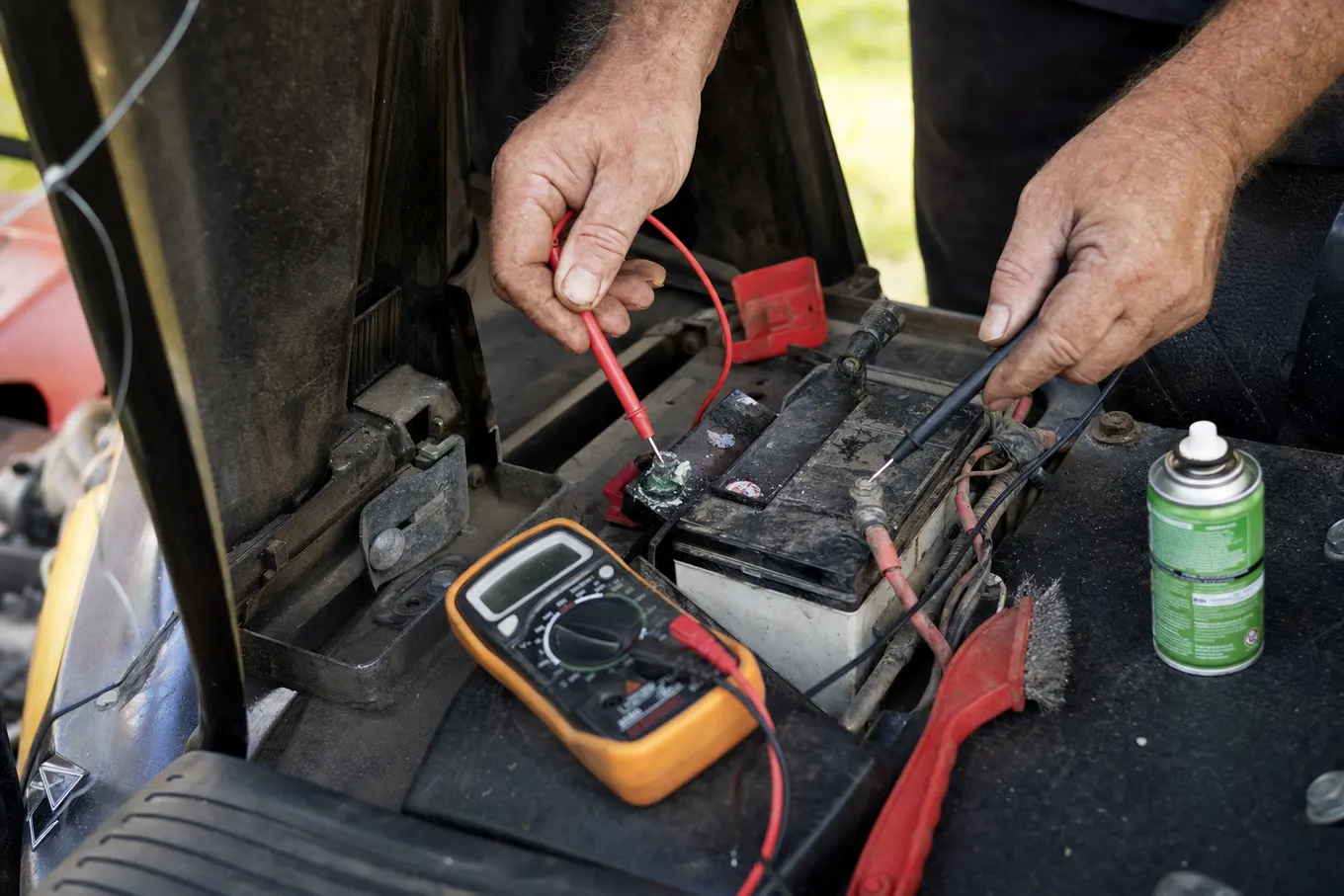
Riding mower won't crank, won't charge, or keeps killing batteries? Joe's Small Engine Repair in Port Charlotte tests the whole 12 volt chain, battery, cables, solenoid, starter, charging system and safety switches, and replaces only what actually failed. Straight answers, a quote you approve before the work, and pickup available if the mower cannot move under its own power. Call or text (941) 555-0123.
The 12 Volt System on a Riding Mower, Explained
Every lawn tractor and zero turn carries a miniature version of a car's electrical system. Seven pieces do all the work, and knowing what each one does makes every symptom on this page make sense.
The battery
A compact group U1 lead acid battery, rated in cold cranking amps. It has one violent job, shoving a couple hundred amps into the starter for a few seconds, then it rides along getting topped back up. Florida heat is its natural predator, and two to three summers of service is the honest local expectation.
Ignition switch and key circuit
The key switch is a traffic cop routing small currents: accessory, run, start. Its contacts wear, its terminals corrode behind the dash where nobody looks, and a failing one produces maddening sometimes-it-works behavior that gets blamed on everything else first.
The starter solenoid
A heavy duty relay, nothing more. Turning the key energizes a small coil that slams a copper bar across two big posts, connecting battery to starter. Thousands of starts pit and burn those contact faces until one day the solenoid clicks proudly and passes nothing.
The starter motor
A compact electric motor that throws a small gear into the engine's flywheel teeth and spins the whole works to life. It dies slowly: brushes wear thin, bushings dry out and drag, and the little bendix gear can hang up and grind instead of engaging.
The charging system
A stator, a ring of copper coils parked under the flywheel, makes alternating current as magnets sweep past. The regulator rectifier converts that to direct current at the mid 13 to mid 14 volt range and feeds the battery while you mow. No belt, no pulley, and most owners never know it exists until it quits.
The safety interlock circuit
Seat switch, brake switch, PTO switch and on many machines a reverse interlock, all wired in a chain of permissions. Break one link, through corrosion, a worn plunger or a bounced connector, and the mower refuses to crank or dies mid-mow with no other warning.
Harness, connectors and grounds
The wiring that ties it together, and in coastal Charlotte County, the part that ages fastest. Current has to return through ground straps and frame bolts, and one crusty ground can imitate a dead battery, a bad starter and a failed switch all at once.
Here is the encouraging part: nothing in that list is exotic, and nearly all of it is testable with instruments in minutes on our bench. Electrical work has a reputation for mystery it does not deserve.
Riding Mower Electrical Problems and What They Point To
Electrical faults are chatty. The exact sound, or silence, when you turn the key narrows the suspect list before a tool comes out. Find your mower's behavior below.
| What the mower does | Where we look first |
|---|---|
| Turn the key: total silence, not even a click | Battery state of charge, main fuse, ignition switch, brake and seat interlocks, ground strap |
| One loud clunk, then nothing | Burned solenoid contacts, seized starter, starved main cable, battery with volts but no amps |
| Rapid machine-gun clicking | Battery too weak to hold the solenoid closed, green terminal crust adding resistance |
| Cranks slower every week, finally quits | Aging battery, dragging starter bushings, undersized or corroding cables |
| Cranks strong, never fires | Not a 12 volt problem: fuel or ignition, covered in our no-start diagnostics |
| Dies when you engage the blades | PTO switch, clutch coil pulling voltage down, seat switch, weak charging output |
| Dies over bumps or when you shift your weight | Seat switch plunger, loose connector under the seat pan, chafed harness |
| Needs a jump every time it sits a week | Parasitic drain, sulfated battery, charging system not replacing what starting used |
| Battery smells like rotten eggs or bulges | Overcharging from a failed regulator, cooked cells, stop and disconnect it |
| Blows the main fuse repeatedly | Harness chafed through to the frame, pinched wire under the dash, shorted clutch coil |
| Headlights bright but no crank | Lights need a trickle, cranking needs a flood: voltage drop testing finds the choke point |
| Gauges flicker and engine stumbles on rough ground | Loose ground, corroded bulkhead connector, broken wire strand making and breaking |
If yours cranks strong and healthy but never fires, the 12 volt side has done its job and the problem lives in fuel or ignition. That path is covered in depth on our mower won't start page.
Why Southwest Florida Eats Mower Electrical Systems
The same climate that grows grass twelve months a year wages a quiet, constant war on copper, lead and rubber insulation. Five local forces explain most of the electrical work on our bench.
Heat: the reason Florida batteries retire in two or three summers
A lead acid battery is a slow chemical reaction in a box, and heat is the accelerator pedal on every chemical reaction inside it. The industry's own engineering guidance says useful life roughly halves for sustained operation around 15 degrees above the 77 degree baseline. Now consider where a mower battery lives: bolted beside a hot engine, under a steel hood, in a garage that holds 90 plus degrees from May through October. It is running the aging process at double speed or worse for half the year.
Heat pulls water out of the electrolyte and corrodes the internal grids that carry current, so capacity quietly shrinks month after month. The cruel joke is that hot weather makes starting easier, so the decline stays invisible until the first cool December morning asks the battery for everything it has and it comes up short. That is why our counter sees a battery rush every winter.
What actually helps: park the mower out of the sun, keep a float maintainer on it between mows, and have the battery load tested once a year instead of trusting the voltage number on a multimeter. Voltage says maybe. A load test says yes or no.
Salt air: green crust on grounds and connectors near the water
Within a few miles of Charlotte Harbor, Lemon Bay or the Gulf, airborne salt settles on every machine that works outdoors. Salt plus humidity turns copper into flaky green corrosion, and that corrosion does something sneaky: it creeps up under the insulation where you cannot see it, turning a fat copper cable into a thin corroded thread wearing a healthy looking jacket.
Corrosion is resistance, and resistance strangles current exactly when demand is highest. A starter that needs 200 amps through a compromised cable gets 80 and produces a slow sad crank, or one click and silence. The most common victim of all is the ground path: the braided strap or black cable bolted from battery to frame, and from frame to engine block. Those bolts live in the splash zone of wet clippings and rust happily. Half the machines towed in from Englewood and Boca Grande as electrical mysteries turn out to be one corroded ground connection wearing a green fur coat.
The fix is not glamorous: disassemble, brighten the metal, reassemble with dielectric grease, and protect it. The improvement, on the other hand, can feel like a new machine.
Humidity and the wet season: water finds the connectors
From June through September this county gets an afternoon rinse most days, and a mower parked outside or under a leaky shed roof gets soaked and steamed on repeat. Multi-pin connectors hold a drop of water like a cupped hand. The water wicks along the strands inside the insulation, and every wet-dry cycle deposits another layer of oxide on the contact faces.
The result is the classic Florida intermittent: a mower that starts fine in the dry afternoon but sulks on a dewy morning, or gauges that flicker in humid weather and behave in October. Moisture faults mock the parts-swap approach because every individual part tests fine once it is dry on a counter.
On machines we service, weather-exposed connectors get opened, dried, treated with dielectric grease and reseated. It is ten minutes of unglamorous work that prevents a repeat visit, which is the whole point of doing a job right.
Vibration and sandy turf: connections that shake themselves loose
Bahia lawns on sugar sand turn washboard-rough by midsummer, and a mower crossing them is a paint shaker with a seat. Every hour of that vibration works on the electrical system: battery hold-downs loosen and let the battery dance, terminal bolts back off a quarter turn, crimp joints fatigue, and wire bundles saw gently against frame edges and the steering shaft until insulation wears through.
A chafed wire touching the frame is a short circuit, and it announces itself by blowing the main fuse over and over, or by killing the engine only when the front wheels drop into a rut. These are the faults that make owners want to push the mower into the canal. They are also completely findable: we know the factory rub points on the common brands, and a harness section can be repaired properly with sealed splices rather than a wad of electrical tape.
If your machine stumbles on rough ground but purrs on the driveway, tell us exactly that when you call. That one sentence cuts the diagnostic time in half.
The snowbird flat line: what six parked months do to a battery
A parked lead acid battery drains itself a little every day, and Florida heat speeds that self-discharge along with everything else. Add the tiny constant draw many machines carry for an hour meter, and a mower parked in April is stone dead by July. Dead is not the worst part. A battery held below full charge grows hard lead sulfate crystals across its plates, and past a point, no charger can dissolve them. The battery comes back reading eleven-something volts, takes a charge overnight, and dies again by the weekend.
Seasonal residents from Warm Mineral Springs to Punta Gorda hit this every fall, back to back with the stale fuel problem. The prevention costs almost nothing: a float maintainer plugged in near the parking spot, or simply pulling the negative cable and topping the battery up once mid-season if someone checks the house. Our maintenance service handles pre-departure prep for exactly this reason.
If it is already too late, we load test before we sell you anything. Some batteries survive a summer of neglect. The test knows.
Fire ants, rodents and other locals with a taste for wiring
Ask anyone who works on outdoor equipment in Florida about fire ants and watch their face. Fire ants pack themselves into electrical housings, switch bodies, solenoid covers and connector shells, and their bodies bridge contacts while their chewing wrecks insulation. A mower parked over a sandy ant mound for a few weeks can develop symptoms that look exactly like a failed switch, because functionally, it now is one.
Rats and mice do their damage in storage season. A quiet shed, a warm engine shroud, and a harness jacket that is apparently delicious is the full recipe. We have opened blower housings and found nests, seed stashes and wiring stripped to bare copper. The repair is a careful harness inspection end to end, proper splices with sealed connectors, and loom where the factory should have put it in the first place.
If your mower sat for months and now does something electrically strange, say so up front. Sat-all-summer machines get a different first look than ran-yesterday machines, and it saves you money when we start in the right place.
Pressure washers: the well-meaning electrical killer
We admire a clean mower. We also fix a steady stream of machines that ran perfectly until the Saturday they got detailed. A pressure washer drives water past connector seals, into switch bodies and up under the dash in ways rain never manages, and the electrical complaints start a day or a week later once corrosion gets organized. The ignition switch and the PTO switch, both recessed into the dash where water pools, are the usual casualties.
Wash the machine, absolutely, a deck free of clipping cake lasts years longer. Just keep the high pressure wand pointed at the deck and frame, use low pressure or a damp rag around the dash, battery and connectors, and let the mower run a few minutes afterward to dry itself with its own heat. If the symptoms already started, the honest fix is opening and drying every affected connection, not waiting to see which one fails first.
Testing in Order Beats the Parts Cannon
The internet's favorite repair strategy is the parts cannon: buy a battery, then a solenoid, then a starter, and hope one of them was the problem. Sometimes the third part wins. The mower still cost three parts and three weekends, and when the real fault was a ground strap, the cannon misses entirely. Our bench runs the opposite way: measure, prove, then replace once.
- Load test the battery before believing anything else. A battery can read 12.6 volts and still collapse the moment the starter asks for real current. Every no-crank diagnosis starts by proving the power source, because a weak battery makes every other component test like a liar.
- Voltage drop the cables and grounds under cranking load. Looking at a cable tells you nothing about what is happening inside the crimp. Measuring the voltage lost across each connection while the starter pulls current finds the choke point in minutes, including the corroded frame grounds that fool everyone.
- Walk the key switch and interlock chain. Power in, power out, in the correct key positions, then each safety switch in sequence. This is where jumper-wire logic isolates exactly which permission in the chain is refusing, instead of condemning the starter for a seat switch's crime.
- Test the solenoid as a component. Does the trigger terminal see voltage when the key hits start? Does the coil click? And the question most people never ask: do the big posts actually conduct when it clicks? A solenoid can pass two of those three tests and still be the failure.
- Bench the starter last, with a current draw test. Once supply, switching and solenoid are proven, the starter gets tested directly. Amp draw tells the story: dragging bushings pull huge current and crank slow, worn brushes pull almost nothing and just spin weakly or not at all.
- Verify the charging system at running RPM. Battery voltage at full throttle should sit comfortably in the high 13s to mid 14s. If the engine is running off the battery instead of the stator, the new battery we just installed is already dying, so this check is not optional, it is the exit exam.
- Fix the proven fault, then re-run the chain. The repair is not done when the part is in. It is done when the whole circuit passes the same tests that caught the failure, key-off draw included.
This is why an electrical job here tends to be one visit instead of a summer-long subscription. You are paying for a verified answer, and the difference shows up in what you do not spend afterward.
Safety Switch Circuits: Seat, Brake, PTO and Reverse
Modern riders will not crank, or will not stay running, unless a chain of small switches all agree that conditions are safe. It is a genuinely good system that prevents genuinely gruesome accidents, and it is also the source of some of the strangest symptoms a mower can produce. Corrosion does not care that a switch was a safety feature.
The seat switch: the one that fails the most
Under the seat pan sits a plunger or membrane switch that closes when weight lands on it. Leave the seat with blades engaged and it kills the engine, which is exactly the design intent. The failure mode is Florida-classic: sun-baked seat foam compresses and stops pressing the plunger firmly, the exposed spade connector under the seat corrodes in the rain, or the wire gets pinched in the seat hinge.
The signature symptom is an engine that dies when you bounce through a dip, shift your weight to look behind you, or lean off the edge of the seat. Riders with this fault often get driven gingerly for a whole season, owner hovering perfectly centered like they are carrying soup. It is a quick diagnosis and an inexpensive fix, and mowing stops feeling like a balance exam.
The PTO switch: the yellow knob with a hard job
The blade engagement switch carries more current than any other switch on the dash because many machines route the electric clutch's draw straight through it. Heavy current plus years of cycles burns its internal contacts, and dirt or moisture finishes the job. Failures show up two ways: pull the knob and nothing happens, or the engine dies instantly at engagement because the switch also participates in the interlock logic.
Before condemning the switch, we test what it feeds. A dragging clutch or a slipping deck belt can masquerade as a switch problem, and the mechanical side of blade engagement lives on our belt and deck repair page. Correct diagnosis here regularly saves owners from buying a clutch they did not need, which is a much bigger ticket than the switch.
Brake, clutch and neutral switches: the no-crank gatekeepers
The machine wants the brake down, or the transmission in neutral, before it will allow a crank. The switches that verify this live down low near pedals and linkages, in the direct blast path of wet clippings, sand and everything a pressure washer throws. They corrode, their mounting brackets bend, and their adjustment drifts so the pedal no longer quite reaches the plunger.
The tell is a mower that cranks only if you stand on the brake pedal like you are stopping a train, or one that cranks some days and not others with no pattern you can name. The pattern exists, it is just mechanical: a sixteenth of an inch of linkage wear deciding whether a plunger gets pressed. Adjustment or replacement is straightforward once the guilty switch is identified with a meter instead of a guess.
Reverse interlocks: why blades stop when you back up
Most modern lawn tractors kill the blades, or the whole engine, when you shift to reverse with the PTO engaged, unless you press an override button first. Owners who bought their machine used and never got the manual frequently bring this in as a defect. Sometimes it is working exactly as designed and the visit becomes a two minute tutorial, no charge for the humility.
When the reverse system genuinely faults, the usual culprits are the little key-position sensor or the override module's connector, and the symptom expands: blades dropping out in forward gears too, or a crank that only works in one shifter position. It diagnoses cleanly with the wiring diagram and a test light, which beats the forum advice of unplugging things at random until the behavior changes.
Zero turns: same chain, more links
A zero turn runs the identical safety philosophy with extra participants. Each steering lever carries its own neutral switch, so the machine demands both levers swung out before it will crank, and pulls the plug if a lever comes inboard without a driver in the seat. Add a parking brake switch on many models and you have five or six permissions standing between the key and the starter. That is five or six small switches living in a vibration-rich, grass-packed environment, which is why a no-crank zero turn is a safety circuit problem more often than it is anything else. Owners get told their starter died. A test light usually has a cheaper opinion.
Commercial machines from the crews mowing Rotonda West and Deep Creek deed-restricted lawns rack up hours fast, and their interlocks wear on a schedule closer to months than years. We treat those switches as inspection items, not just failure items, because for a crew, the mower quitting mid-route costs more than the switch ever will.
One thing we will not do is bypass an interlock and hand the mower back. A jumper wire where a seat switch belongs turns a spinning blade into a machine with no conscience, and machines outlive their current owners: they get sold, loaned to neighbors and inherited by teenagers. The honest repair costs about the same as the shortcut and nobody's grandkid pays for it later. If a safety circuit is the fault, we fix the circuit.
Lawn Mower Starter Replacement, Done in the Right Order
How a starter actually dies
A mower starter is a small permanent magnet motor with one party trick: it flings a little gear, the bendix, up into the flywheel's ring gear and spins the engine through its compression strokes. Its wear items are humble. Carbon brushes shorten with every start until they barely touch the commutator. Bushings that center the spinning armature dry out and let it drag. The bendix gets gummy with dust and grass fines until it engages late, throwing that horrible metal-on-metal zing, or does not engage at all and the motor just whirs uselessly.
Each failure has a sound, and the sounds are diagnostic gold. Slow labored cranking that worsens as the engine warms points at drag. A whir with no crank points at the bendix. Silence with a healthy solenoid click points at brushes or a dead spot on the armature. Tell us what you hear over the phone and we are halfway to a diagnosis before the mower arrives.
The solenoid, demystified
People talk about mower solenoid replacement like it is engine surgery. It is a relay in a metal jacket, usually bolted within a foot of the battery, and it exists so the ignition key only ever handles a trickle of current while the solenoid's big copper contacts handle the flood. Those contacts arc a tiny bit with every single start. Add ten years of starts and the contact faces look like the surface of the moon, and resistance goes up until the starter is being fed through a keyhole.
Because solenoids are cheap and famous, they absorb a lot of wrongful convictions. The genuinely failed ones we replace, and the innocent ones we leave alone and go find the ground strap or cable end that was actually starving the circuit. That discipline is what keeps your bill honest.
Do not forget the key switch itself
Between battery and solenoid sits the ignition switch, and it earns a mention because it fails in disguise. Inside are small contacts that wear with every key cycle, and behind the dash its terminal cluster collects the humidity the dash was supposed to keep out. A worn switch produces symptoms owners swear are haunted: crank that only works if you hold the key just so, accessories that die while the engine keeps running, or a start position that works cold and not hot. Testing it is simple, power in against power out at each key position, and replacing it is inexpensive. It is on the checklist precisely because everyone else skips it.
Replacement done properly is a system job
When a starter or solenoid does get replaced here, the swap comes with the supporting work that makes the new part live a full life: mounting surfaces cleaned bright because many solenoids ground through their base, cable ends cut back to clean copper or replaced when corrosion has crept up the strands, hardware torqued, contacts dressed with dielectric grease, and the flywheel ring gear inspected for chewed teeth so the new starter is not grinding against old damage. Then the whole crank circuit gets measured again under load, because the standard is not that the part is new. The standard is that the numbers are right.
Choosing and Living With a Lawn Mower Battery in Florida
A battery is the one electrical part almost every rider owner will buy more than once, so it deserves more than a grab-whatever-fits trip to the store. A few minutes of knowledge here pays off every summer.
Buying the right battery, not just a battery
Nearly all lawn tractors and zero turns use the compact group U1 case, but inside that one label hides real variety. Cold cranking amps is the number that matters: a big twin cylinder engine asks for meaningfully more cranking muscle than a single, and an undersized battery works itself to death trying. Post orientation matters just as much, because U1L and U1R put the positive terminal on opposite corners, and the wrong one leaves cables stretched across the top of the battery where they can rub and short. And check the date code on the sticker before it goes in your cart. A battery that spent a year cooking on a warehouse shelf in Florida has already spent a chunk of its life doing nothing for you.
There is also a construction choice. The traditional flooded battery is the budget option and works fine with care. Sealed AGM batteries cost more up front but shrug off vibration, resist heat better, cannot spill acid on your deck, and generally buy an extra season or two in our climate. On machines that mow rough Bahia lots or live near the salt, we think the AGM math usually wins. Either way, we install what fits your machine and your budget, and the old core goes to the battery recycler instead of the landfill.
Installation details that quietly decide lifespan
A surprising share of young dead batteries were killed by their installation. A loose hold-down lets the battery bounce, and internal plates do not enjoy percussion. Terminals snugged finger-tight instead of wrench-tight build heat and resistance at every start. Cables routed against sheet metal edges saw through their insulation one vibration at a time. When a battery goes in at our bench, the tray gets cleaned of the acid grit that eats metal, the hold-down comes back snug, both cable ends get inspected to their far ends, and the terminals get coated so the green crust has nothing to grab. Five extra minutes, seasons of difference.
The maintainer habit: the cheapest electrical repair there is
A float maintainer is a small smart charger that holds a battery at full charge without overcooking it, and it is the single best gadget a Florida mower owner can own. Note the word float. An old-fashioned trickle charger left connected for weeks can overcharge and dry a battery out, which is trading one death for another. A proper maintainer plugged in between mows keeps sulfation from ever starting, doubles down during the wet season when mowing gaps stretch, and makes the October wake-up a non-event for seasonal residents. If you buy one thing after reading this page, buy that.
Charging Systems and Electric PTO Clutches
The stator and regulator: the charging system nobody can see
Mowers do not have a belt-driven alternator like a car. The charging hardware hides under the flywheel: a stationary ring of copper windings called a stator, swept by magnets cast into the spinning flywheel above it. That sweep induces alternating current, and a small finned box, the regulator rectifier, converts it to direct current and holds it at a level the battery can drink, roughly the high 13s to mid 14s at mowing throttle.
Stators rarely wear out mechanically because nothing touches them, but their wire leads cook, their connectors melt when resistance builds, and debris packed under the flywheel overheats the windings. Regulators die from heat and from rusty mounting bolts that break their ground path. The symptom pattern for any charging failure is the same: batteries that mysteriously keep dying, a mower that starts fine after the charger but not after an hour of mowing, or headlights that dim at idle and never brighten.
How we test charging, and why it is part of every battery job
The test is quick and decisive: battery voltage at idle, battery voltage at full throttle, AC output from the stator, DC output from the regulator. Fifteen minutes settles whether the charging system is feeding the battery or freeloading off it. We run this check any time a battery is replaced for dying young, because bolting a fresh battery onto a broken charging system just schedules the same failure for a few weeks out. Undercharging starves a battery to death slowly. Overcharging boils it. Both endings are preventable with one measurement.
Electric PTO clutches: where 12 volts meets the blades
On most modern riders and every zero turn, pulling the PTO knob energizes an electromagnetic clutch on the engine's lower shaft, which clamps a set of plates together and drives the deck belt. That clutch is an electrical component living a mechanical life, and it fails from both directions. Electrically, its coil can open or short, its connector corrodes, and, the underrated one, low system voltage makes it clamp weakly, slip, overheat and destroy itself. A tired battery or weak charging system can kill a perfectly good clutch as collateral damage.
Mechanically, the clutch carries its own bearing, which can howl exactly like a deck spindle and send owners chasing the wrong noise. Some clutches have an adjustable air gap that drifts over time; many are sealed and non-adjustable. Our job is sorting which side of the clutch's double life failed, coil or hardware, because the answers cost very different money. The belt-and-pulley half of that story continues on the belt, spindle and deck page.
The Ground Path: Where Half the "Dead" Mowers Are Hiding
Electricity only works in loops. Every amp that leaves the battery's positive post has to find its way back to the negative post, and on a mower, that return trip runs through the least glamorous hardware on the machine: a black cable, a braided strap, and a couple of bolts threaded into the frame.
Trace it once and the mystery evaporates. The negative cable runs from the battery to a bolt on the frame. The frame itself becomes a giant conductor. Somewhere near the engine, a strap or cable carries the path from frame into the engine block, because the starter grounds through the metal it is bolted to. Now count the opportunities for failure: two or three bolted joints, each one only as good as the metal-to-metal contact underneath it. Paint blocks current. Rust blocks current. The powder-coated frame of a newer mower is basically wearing an insulating jacket, which is why the factory grinds a bare spot under each ground bolt, and why that bare spot rusting over years later takes the whole machine down.
This is the fault that fools smart people, because everything up top looks perfect. The battery is new, the terminals shine, the solenoid clicks, and the mower is still dead or cranking like it is exhausted. Owners describe wiggling the key, tapping the starter, or leaning on the fender and having it suddenly crank, which is exactly how a marginal connection behaves. Our voltage drop test settles it without any guessing: put the meter across each joint while the starter pulls current, and the bad joint announces itself with a number. Think of it like water pressure through a kinked hose. The kink is invisible from outside. The pressure loss is not.
Harness repairs that survive a Florida summer
When wiring itself is the casualty, how it gets repaired decides whether you see the problem again. Twisted wires under a wrap of hardware store tape are a December repair that becomes a June breakdown, because our humidity crawls into the splice and corrodes the joint while the adhesive melts. Repairs at our bench use the boring correct method: proper connectors crimped to bare bright copper, sealed with adhesive-lined heat shrink, protected inside loom, and secured so the repaired section cannot resume sawing against whatever frame edge wounded it in the first place. Then the circuit gets loaded and measured, not just visually admired. Wiring work is one of those places where the difference between fixed and fixed-for-now is invisible on the invoice and enormous in August.
Battery Powered Mowers: What We Fix, and What We Will Say Out Loud
EGO, Ryobi, Greenworks and Kobalt machines are common on newer streets from Babcock Ranch to North Port, and their electrical architecture is a different animal: high voltage lithium packs, sealed motor controllers, brushless motors. Here is the honest split. The parts of these mowers that live in our world, blades, decks, wheels, drive hardware, handle switches, charging contacts and connections, we service gladly, and details live on the push mower repair page.
The packs and control boards themselves are built as sealed modules on purpose, and the realistic remedy for a failed one is a manufacturer replacement part, sometimes under the generous warranties these brands carry. We would rather tell you that in one phone call than charge you bench time to rediscover it. If your battery mower will not run, describe the lights and beeps it gives you when you call (941) 555-0123, and we will point you at the cheapest correct path, even on the days that path does not run through our shop.
What You Can Safely Check Yourself, and Where to Stop
We are not the shop that pretends every problem needs a professional. A handful of checks are safe for any owner, cost nothing, and sometimes end the story right there in your garage. A different handful look easy on video and end with a trip to urgent care or a melted harness. Knowing which is which is worth a scroll.
Fair game for any owner
- Look at the battery terminals. White or green fuzz, a clamp that rotates by hand, or acid crust on the tray are all findings worth acting on. Cleaning terminals with the cables off is a safe, satisfying Saturday job.
- Find and check the main fuse. Usually an inline blade fuse near the battery or solenoid. If it is blown, replace it once with the same rating. If the new one blows too, stop, that is a short circuit telling you it needs a professional hunt.
- Charge the battery overnight with a real charger. A full charge before any conclusion keeps you from replacing parts to fix a low battery. If it will not hold that charge through a week of sitting, the battery has voted.
- Peek at the seat switch connector. Tip the seat forward and make sure the plug under it is seated and its wires intact. Wandering dogs and pressure washers unplug more of these than anyone would guess.
- Record the symptom on your phone. Thirty seconds of video with sound, the click, the slow crank, the flickering dash, is diagnostic treasure. Send it with your quote request and we start smarter.
Where the DIY should stop
Shorting across the solenoid posts with a screwdriver is the internet's favorite trick, and we wish it would retire. It bypasses every safety interlock on a machine that may be in gear with blades engaged, and the arc it draws can spit molten metal at your hand or ignite battery gases sitting an inch away. Probing into a harness with a pick, wiring around a safety switch, and diagnosing by unplugging modules at random all belong in the same bucket: cheap right up until they are very expensive. When the easy checks above have not solved it, the next honest step is a meter in trained hands, and that step costs less than the parts-cannon alternative anyway.
The five minute Florida prevention routine
Electrical failures are the most preventable failures on the whole machine. Glance at the terminals monthly. Keep a float maintainer on the battery between mows. Rinse and towel the machine after cutting near the water, since salt washes off a lot easier than it sands off. Before any long absence, plug in the maintainer or pull the negative cable. And once a year, let a load test and a charging check catch the slow declines before they become roadside theater. If the electrical side checks out and the mower still runs badly, the problem has moved to fuel or mechanicals, and our general repair page maps that territory.
What Electrical Repair Costs, and What Moves the Number
Electrical jobs span a wide range for one honest reason: a battery swap and an intermittent harness hunt are different animals wearing the same symptom. Rather than invent numbers, here is what actually drives the quote. Which component failed, since a solenoid, a starter and a stator sit at very different price points. Whether corrosion brought friends, because one green cable end usually has siblings worth fixing in the same visit. Battery quality tier, where the cheapest battery on the shelf is usually the most expensive one per summer of service. And diagnostic time, which is where methodical testing earns its keep by finding intermittents in hours instead of billing you for a mystery tour.
Every job works the same way regardless of size: we test, we call you with what failed and the exact price to fix it, and the wrench stays on the peg until you say go. Compared against replacing a rider or zero turn, nearly every repair on this page is a small fraction of the machine's value, and we will tell you plainly on the rare day it is not. A pre-season electrical check also folds neatly into a full tune up if you want the whole machine gone through at once.
A word on parts, since electrical components span a wild quality range online. A bargain starter or regulator with no brand and no support can cost you the same job twice, once for the part and once for its funeral. We fit parts we are willing to stand behind, tell you when an OEM component is genuinely worth the difference and when the aftermarket equivalent is the smart buy, and back the work either way. Cheap is a price. Inexpensive is a value. They are not the same purchase.
Electrical Repair Across Charlotte County and Beyond
Salt-side towns send us corrosion, inland towns send us heat-killed batteries, and we sort all of it from one Port Charlotte bench. A mower that will not crank cannot exactly drive here, so pickup and delivery does the driving for it. Full coverage map on the service area page.
Mower Battery, Starter and Wiring FAQs
How long does a riding mower battery last in Florida?
Two summers is typical here, three if the mower lives in shade and gets ridden regularly. Battery makers publish the math on this: plate corrosion inside a lead acid battery speeds up dramatically for every few degrees above 77, and a Port Charlotte garage spends half the year well above that. A battery maintainer during idle stretches is the single cheapest way to stretch that lifespan, and a quick load test each spring tells you the truth before the battery strands you in June grass.
Why does my mower click once but not start?
That single hard clunk is the solenoid slamming shut, which proves the small trigger circuit works. What it does not prove is that current made it through to the starter. Three usual reasons: the solenoid contacts are burned and pass nothing, the battery has enough juice to click a relay but not to spin a motor, or a corroded cable is choking the amps somewhere between the posts. We measure at each point and replace the piece that actually failed.
What does a lawn mower starter replacement involve?
The starter itself is a bolt-on motor, usually two fasteners and one cable, so the labor is not the hard part. The hard part is being sure the starter is the problem, because a weak battery or a bad ground mimics a dead starter perfectly. We prove the supply side first, check the flywheel ring gear teeth the starter engages, then install and test. Bring us a mower with a genuinely failed starter and it is often a same-visit fix when the part is on hand.
Can I put a car battery in my riding mower?
It will not fit the tray, and it is more battery than the job needs. Nearly every lawn tractor and zero turn takes a compact group U1 battery, and the meaningful spec is cold cranking amps plus which side the positive post sits on, since U1L and U1R are mirror images. Buy the wrong orientation and the cables will not reach without stretching them across the battery, which is its own future short circuit.
Why does my mower battery go dead if I skip a couple weeks of mowing?
Three things gang up on it. Lead acid batteries self-discharge on their own and do it faster in heat. Small parasitic draws from an hour meter or a stuck relay nibble at the charge around the clock. And ten minute mow sessions never fully replace what starting took out. A battery that sits below full charge starts growing hard sulfate crystals on its plates, and every week in that state costs capacity it will not get back. A cheap float maintainer breaks the whole cycle.
Is it safe to jump start a riding mower from my car?
Yes, with two rules. The mower and the car are both 12 volt systems, so the connection itself is fine, but leave the car engine off so its charging system cannot shove extra voltage at the mower. And get the polarity right the first time, because reversed jumper cables can take out the regulator and any electronics in one flash. Also worth saying: a mower that needs a jump every weekend does not need better cables, it needs a diagnosis.
My mower shuts off when I get off the seat. Is that a defect?
If the blades were engaged, that is the seat switch doing exactly what it was built to do, and we would not change a thing. The defect version of this is different: the engine dying while you are still planted in the seat, usually when you bounce over a rut. That points to a worn seat switch plunger or a loose connector under the seat pan opening the circuit for a split second, and it is one of the most common electrical repairs we do.
Can you find electrical problems that only happen once in a while?
Intermittents are the chess matches of this trade and yes, we hunt them. The method is patience plus a meter: wiggle testing the harness while watching voltage, checking the known chafe points where wires rub the frame or steering shaft, heat cycling parts that only fail warm, and voltage drop testing connections that look fine but are not. We will be straight with you that this takes bench time, and you get a quote on the hunt before it starts.
Why do my blades quit spinning once the mower warms up?
Heat changes the electrical picture. An electric PTO clutch coil gains resistance as it warms, so a clutch that barely had enough voltage cold drops out entirely hot. A charging system that is undercharging lets system voltage sag the longer you mow, with the same result. Or the problem is not electrical at all, just a glazed belt slipping once it is hot. We test the clutch, the charging output and the belt so you replace one part, not three.
How fast can a bad solenoid be replaced?
Once testing proves the solenoid is the failure, swapping one is quick work: it is a small relay bolted near the battery with a handful of connections. The part is one of the least expensive on the whole machine, which is exactly why the parts-cannon crowd loves guessing at it. We test first, because a mower that still will not crank after a new solenoid means the money went to the wrong part. Call and we will tell you honestly what turnaround looks like today.
What is the right way to clean battery terminals?
Cables off, negative first. Scrub the posts and clamp interiors with a wire brush and a baking soda paste to kill the acid crust, rinse, dry completely, reconnect positive first, then coat with dielectric grease or terminal protectant. The step everybody skips is following each cable to its other end, because the ground bolted to the frame corrodes just as happily as the post you can see, and it causes identical symptoms.
Why did my voltage regulator fail?
Heat is the usual killer, which is why regulators are finned and bolted to metal that is supposed to carry heat away. A mount rusted loose ruins that heat path and the ground connection at the same time, and the regulator cooks. A worn out battery makes it worse by demanding maximum charge all the time. The tell is usually a battery that boils dry or a brand new battery that dies within weeks, and we confirm it by measuring what the charging circuit is actually delivering.
Do push mowers have electrical problems too?
Fewer, but real ones. A pull-start walk behind has a magneto ignition and a kill wire, and a chafed kill wire grounding against the handle will shut an engine down mid-stripe. Electric start push mowers add a small battery and starter with all the same corrosion issues as their bigger cousins, just in miniature. If your walk behind cranks or pulls over fine but will not fire, start with our no-start diagnostics rather than the electrical side.
Does salt air matter if my mower is stored in the garage?
It helps a lot, but it is not immunity. The mower spends its working hours outside in coastal air, cutting damp salt-kissed grass that sticks to every surface, and it carries that film back into the garage where humidity keeps the chemistry going. Waterfront machines from Englewood, Placida and Boca Grande show green connector corrosion years ahead of inland ones regardless of storage. A freshwater rinse of the machine after coastal mowing, followed by a real dry-off, slows the clock considerably.
Different question? The main FAQ page covers the rest of the shop, and (941) 555-0123 covers everything else.
Stop Buying Parts. Start With an Answer.
Describe what happens when you turn the key, and we will tell you what we would test first and what it will take to know for sure. If the mower cannot come to us, we come to it.
- Every electrical fault proven before parts go on
- Firm quote in your hands before repairs begin
- Talk to the shop directly: (941) 555-0123