
Lawn Mower Blade Sharpening in Port Charlotte, FL
The blade is the only part of the mower your lawn ever actually meets. We grind it at the factory angle, balance it so it spins true, and torque it back to spec, because the difference between cutting grass and beating it shows up in your yard within a day.
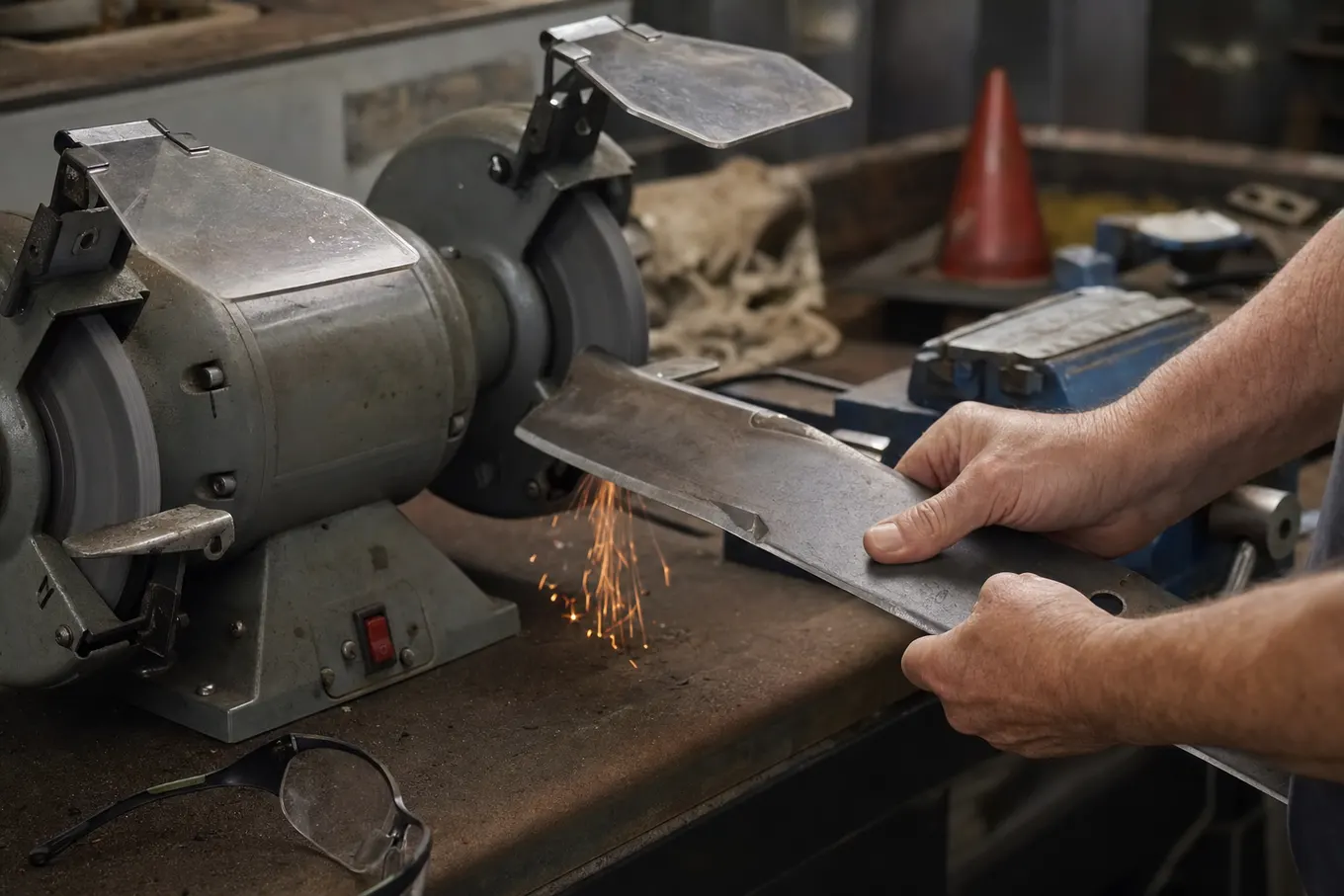
Searching for lawn mower blade sharpening near me? Our Port Charlotte shop sharpens and balances blades for every kind of mower: push, self propelled, riding, zero turn, gas or battery. Drop off loose blades for the quickest turnaround, often same day, or bring the whole machine and we will remove, service, reinstall and torque everything properly. Bent, cracked or worn out blades get replaced with the right style for your lawn. Call or text (941) 555-0123 before you head over.
Why Sharp Blades Matter More Than Anything Else You Do to Your Lawn
Picture the difference between slicing a tomato with a chef’s knife and pressing one apart with a spoon. Both get you two pieces. Only one of them leaves the tomato in good shape. Grass experiences mowing the same way. A rotary blade does not saw through grass, it strikes it at somewhere near two hundred miles an hour at the tip, and at that speed a keen edge shears the leaf cleanly in a single impact. A rounded edge arrives at the same speed but cannot shear, so it snaps the leaf, chews it, and leaves behind a frayed stump of torn fibers on every single plant it touches.
Now multiply that frayed stump by the number of grass plants in a yard, which runs into the millions, and you have the real cost of a dull blade. Each torn tip is an open wound. The plant loses water through it far faster than through a clean cut, which matters enormously in a place where summer afternoons actively try to dehydrate everything green. The shredded tissue then dies back, whitens, and browns, producing the signature look of a dull-cut lawn: healthy green for a day, then a spreading tan cast across the whole yard, as if the lawn caught a mild sunburn. People fertilize it, water it harder, and blame the heat, when the actual culprit is hanging under the deck.
The wounds do more than discolor. Ragged cuts are doorways, and Southwest Florida’s humid air keeps the doorways busy. The fungal diseases that plague St. Augustine lawns here, gray leaf spot flaring through the rainy months, large patch working the cooler ones, all establish more easily in torn tissue than in cleanly sheared leaves. Turf people have preached this for generations, and the mechanism is simple: a clean cut seals in hours, while a chewed one stays open, moist and inviting for days. Sharpening your blade is cheaper than a single round of fungicide, and unlike the fungicide, it also makes the yard look better on the way past.
There is a fuel and machine cost hiding in there too. Tearing fibers demands more force than shearing them, so a dull blade loads the engine harder in the same grass, burns more gas per pass, and drags cut quality down right as it drives wear up. You can hear the difference on thick summer St. Augustine: a mower with a fresh edge breezes through where a dull one groans and threatens to stall. A season of that strain lands on belts, bearings and the engine’s temper. Our maintenance page covers the machine care around it, but the blade is where cutting effort begins, and a sharp one is the single cheapest performance upgrade a mower can receive.
One more point that surprises people: mowing height and blade condition gang up on each other. St. Augustine wants to be mowed tall, and a lawn cut low with a dull blade takes a double stress hit, wounded tips and an exposed root zone at the same time, right in the season when stress invites weeds and disease to the open ground. A sharp blade will not fix a scalping habit, but a dull one guarantees that every other lawn care dollar works uphill.
Sharpness even changes how much you can safely mow at once. The one-third rule, never removing more than a third of the leaf in a single pass, assumes the grass gets a clean cut it can recover from quickly. Tear that same third off with a rounded edge and the recovery takes longer, the water demand spikes higher, and under the limited irrigation days most of our communities live with, the lawn has to heal on a ration. Sharp steel is how a yard gets through a Florida summer spending its water on growth instead of on triage.
Why Florida Sand Dulls Mower Blades on Fast Forward
Blade steel does not really lose its edge to grass. Grass is soft. What kills edges is everything traveling with the grass, and around here that means quartz sand, one of the harder common minerals on earth and conveniently also the substance our entire region is built on. Every rotation, the blade’s edge slaps through a thin fog of suspended grit kicked up by its own airflow. The effect is precise and unkind: a mower blade in this county spends its working life being sanded by the very ground it cuts over, edge-first, at full speed.
The rate of that erosion depends on how much sand actually reaches the blade, which is mostly a question of turf density. A thick irrigated St. Augustine carpet in a neighborhood like Rotonda West holds its sand down under a dense canopy, so blades there dull at a merely accelerated pace. A thin Bahia lot on unwatered ground, the standard out toward the big parcels, exposes bare sand between every clump, and blades there can go from crisp to useless in a handful of mows. Dry season makes everything worse, because there is no soil moisture gluing the fines down, and you can watch the dust plume follow the mower like evidence.
Sand does something else that northern sharpening advice never mentions: it does not stop at the edge. The same grit stream scours the underside of the blade’s lift wings, the upturned sails at each end that generate the deck’s airflow, and slowly grinds them thin from below. A blade can arrive at our bench with a serviceable edge and sails eroded to foil, and that blade is done, no matter how sharp we could make it, because a thinned sail is the part that lets go at speed. This is the number one reason blades in Southwest Florida get replaced rather than endlessly resharpened, and it is the first thing we inspect before a grinder ever touches your steel.
The practical upshot is a sharpening rhythm that would sound paranoid up north. Where a northern lawn might get by on one spring sharpening, lawns here run their blades two to four times as many hours a year through far more abrasive material. Waiting for the blade to look dull does not work either, because the erosion is gradual and the eye adjusts along with it. The lawn itself is the better instrument: the day the cut tips start fraying is the day the edge is gone, and the sections below cover exactly how often that tends to happen for each of our local grasses.
The coastal pockets add their own ingredients to the grinder. Lots on the barrier islands and around the passes, Boca Grande, Placida, the Manasota Key side of Englewood, carry crushed shell mixed through the sand, harder on edges still and prone to leaving the tiny half-moon dings that a plain sand lot never inflicts. And in the areas still working through hurricane recovery, most visibly out on Pine Island, the ground keeps surrendering screws, glass and construction debris seasons after the storm, which is less a dulling problem than a strike problem. Blades from those zip codes come to us with biographies, and they are why we inspect before we ever grind.
One measuring habit simplifies all of this: count mows, not weeks. A tally mark on the garage wall or a note on your phone after each cut turns blade wear from a mystery into arithmetic. Every yard has its own number, but each yard’s number is remarkably stable season to season, because the sand exposure and turf density that set the wear rate do not change much. Once you learn that your particular lawn burns through an edge in, say, a dozen cuts, the schedule writes itself, and you will never again stand in the garage in July trying to remember whether the blades were done in February or last fall.
Nine Ways a Dull Blade Announces Itself
Nobody needs to crawl under a deck to diagnose a tired edge. The lawn and the machine file their reports every mow, and once you know the signs, they are impossible to unsee.
- Frayed tips at eye level. Pinch a few blades of grass the day after mowing. Cleanly angled ends mean sharp steel. Ends that look chewed, split into strings, or already whitening mean the edge quit some mows ago.
- The two-day tan. A lawn that mows green and turns dusty brown across its whole surface within forty eight hours is showing you a million dead tip wounds at once. Water will not fix it. Grinding will.
- Survivor strips and stragglers. Single tall blades standing in the mowed path, or thin mohawk lines between passes, mean grass is bending under the edge and springing back up instead of being cut.
- Seed stalks that fold instead of fall. On Bahia especially: if the wiry stalks lay over as the deck passes and stand back up behind it, the edge has rounded past the point of gripping fibrous stems.
- Ropey discharge. A sharp blade throws confetti. A dull one throws wads and ropes, because torn grass exits in strips and mats instead of clean fragments, and clumping follows even in dry grass.
- The engine changes key. Same lawn, same height, but the motor digs in and drops pitch through ordinary patches. Tearing costs power, and you are hearing the bill being paid in real time.
- Vibration that grew gradually. Edges rarely wear evenly, and uneven wear is imbalance in slow motion. A buzz in the handles or seat that was not there in spring is often the blade, not the machine.
- Light glinting off the edge. Look along the cutting edge in sunlight. A sharp edge is a line too thin to reflect. A rounded one shows up as a bright silver ribbon, visible from a respectful distance.
- More passes for the same result. When you start double-cutting areas that used to take one pass, the blade is making you the compensation system. Your time is the most expensive part it consumes.
Two or more of these together is a verdict, not a suspicion. And because every one of them creeps in gradually, the honest move is to act on the first clear sign rather than waiting for the full collection, which is roughly the difference between a quick sharpening and a summer of secondhand lawn stress.
Sharpening, Balancing and Torque: What Doing It Right Involves
A blade service sounds like one job. It is actually five small ones, and skipping any of them undoes the rest. Here is each step as it happens on our bench, including the physics that make the boring parts matter.
Grinding the edge: factory angle, cool steel, real metal behind it
Every blade was designed around an edge angle, most in the neighborhood of thirty degrees, and holding that angle is the whole craft. Grind too steep and the edge is durable but blunt. Grind too shallow and it is briefly wicked sharp, then gone, because there is no steel supporting it against the sand. We grind to the factory geometry, follow the original bevel line, and take the minimum material needed to raise a clean edge along the full cutting length.
Heat is the quiet enemy at this step. Lean a blade hard into a fast wheel and the edge turns straw colored, then blue, and blued steel has lost its hardness where it matters most. A cooked edge feels sharp on day one and folds by the weekend. Controlled passes, light pressure and patience keep the temper intact, then a deburring pass removes the wire edge the grinder leaves behind, because that fragile burr otherwise becomes the first thing the lawn tears off.
Sharpen or replace: the four retirement tests
Before sharpening anything we run four checks. First, the sail test: inspect the underside of the lift wings for the sand erosion described above, because thinned sails end a blade regardless of edge condition. Second, cracks: anywhere, but especially radiating from the center hole or any bolt slot, and a crack of any size is an automatic retirement. Third, straightness: laid against a flat reference, any bend or twist means replacement, never straightening. Fourth, remaining metal: an edge that has been ground back until the bevel is eating into the thick body of the blade has no more sharpenings in it.
Pass all four, and sharpening is the right money. Fail any one, and a new blade is not an upsell, it is the only responsible answer for a part that spins inches from feet and flings whatever it breaks. We will show you what we found either way, and worn out blades make oddly satisfying garage wall trophies if you want yours back.
Balancing: the physics your spindle bearings live and die by
Sharpening removes metal, and it never removes exactly the same amount from both ends. The leftover difference seems laughable, a few grams, until the blade spins. Rotational force scales with the square of speed, so a small mass imbalance out at the blade tip becomes a genuinely large force at operating RPM, on the order of dozens of pounds, yanking the spindle sideways and reversing direction thousands of times a minute. The machine reports it as vibration. The bearings experience it as a hammer that never rests.
That is why blade balancing gets its own step and its own tool. Each sharpened blade sits on a balancer, and the heavy side gives itself away by dropping. We take a touch more metal off the heavy end, recheck, and repeat until the blade sits level. It adds minutes to the job and years to spindles, deck welds and the numb-hands experience of pushing a vibrating walk behind. Any shop that skips this step is selling half the service, and your spindles will eventually bill you the difference.
Torque: the spec nobody looks up and everybody should
The blade bolt is the one fastener on the mower holding a spinning piece of steel between you and physics, and it has an exact tightness written for it. Most walk behind blades spec somewhere in the 35 to 55 foot pound range, riders and zero turns frequently more, and the number exists for reasons in both directions. Too loose, and the blade can shift on impact, slip its timing on machines where that matters, or gradually work the bolt out. Too tight, and the bolt stretches, the mounting hardware crushes, and on many walk behinds you defeat the friction washers designed to let the blade slip on a hard strike and spare the crankshaft.
We look the spec up for your machine and set it with a torque wrench, not an impact gun and a feeling. It takes an extra minute. The alternative, a blade bolt at some unknown tightness on a part spinning at cutting speed, is nobody’s idea of a savings.
Multi blade decks: matched sets or matched problems
Riding mowers and zero turns spin two or three blades whose cutting arcs overlap by design. Service them unevenly, one sharpened, one worn short, one heavier than its neighbors, and the deck becomes a committee that cannot agree. Uneven blade lengths leave stepped ridges between passes. Mismatched sharpness leaves alternating clean and chewed stripes. A single unbalanced blade in the set shakes the whole deck while the other two mind their manners, and diagnosing which one is misbehaving costs more than servicing all three would have.
So multi blade decks get treated as sets on our bench: all blades off, all inspected against the same retirement tests, all sharpened to the same geometry, all balanced, all torqued to the same spec. If one blade needs replacement and its siblings do not, we will say so honestly, with the note that a new blade running alongside heavily worn ones can still cut unevenly because their lift characteristics no longer match.
After a strike: what gets checked beyond the blade
Sprinkler heads, landscape stones, stump edges and the toys the yard swallowed: every lawn eventually feeds its mower something hard. The blade takes the visible damage, but the impact travels. On riders, it shocks the spindle shaft and bearings, and a subtly bent spindle will vibrate forever after while everyone blames the new blade. On walk behinds, the blade adapter and the crankshaft itself absorb the hit, and the small shear key that protects ignition timing can partially give way, leaving an engine that starts hard or kicks back, a story our no start page knows well.
So a post-strike visit here is never just a grind. We check blade, adapter, spindle or crank runout, and the mounting hardware, then put it back together to spec. It is the difference between actually fixing a strike and merely repainting over it, and it is why the vibration question is the first thing we ask when a blade comes in with a fresh gouge.
Where the vibration goes: a tour up the driveline
Follow an unbalanced blade’s shaking upward and you meet everything it taxes. First stop, the spindle bearings, which absorb the sideways yank directly and respond by wearing their races oval. Next, the spindle housing bolts and the deck shell around them, where the oscillation works fasteners loose and, over seasons, opens hairline cracks at the welds. The deck belt picks up the wobble as flutter, wearing its edges against the pulley flanges. On a walk behind the path is even shorter and less forgiving: the blade bolts straight to the engine’s crankshaft, so every hour of unbalanced running is delivered directly to the crank’s bearings and seals with nothing in between.
And at the end of the line stands the operator, whose hands and spine rate the ride. The machine ages faster at every stop along that path, all for want of a two minute balance check. This is why we treat balancing as half of the service instead of a premium add-on, and why a search for blade balancing near me deserves a shop that owns a balancer and puts every single blade on it.
The Anatomy of a Mower Blade, and Where Each Part Fails
A mower blade looks like the simplest part on the machine, one piece of stamped steel, no moving parts. Look closer and it is four components sharing one silhouette, each with its own job and its own way of dying. The cutting edge occupies only the outer few inches of each end, which surprises people who assume the whole leading side does the work. It does not need to: the tip travels fastest, the tip meets the grass first, and the tip is where sharpening effort belongs. It is also why edge wear concentrates out there and why a blade can look fine along most of its length while being completely finished where it matters.
Behind the edge sits the bevel, the angled grind that forms it. The bevel is the blade’s geometry memory: every sharpening either preserves that angle or corrupts it a little, and a blade that has been freehand-ground for years often carries a wavy, multi-angle bevel that no longer supports a real edge. At the trailing side of each end rises the sail, the upturned wing that turns the blade into a fan, creating the suction that stands grass up and the airflow that moves clippings out. Sails fail by erosion here, sanded thin from underneath, and a thinned sail is structural failure waiting for permission.
The center section carries the mounting: a round hole, a star pattern, or a keyed shape depending on brand, clamped between washers and adapter at a specified torque. Cracks love this neighborhood because every shock the blade absorbs concentrates at the mounting, which is why our inspection lingers there. And running through it all is the blade’s body steel, chosen soft enough to bend rather than shatter on a hard strike. That is a deliberate safety decision by the people who made it: a bent blade is a ruined part, but a shattered one is shrapnel. It is also the engineering reason bent blades must never be straightened and returned to service. The bend consumed the toughness that was protecting you.
Blade length belongs in the anatomy lesson too, because it is a spec, not a suggestion. Deck housings and blade tip speeds are engineered together, and industry standards cap how fast a blade tip may travel. Fit a longer blade than the deck was designed for and the tip overspeeds and can meet the housing; fit a shorter one and the cut develops permanent uncut rings. Always replace like-for-like on length and mounting pattern, and when in doubt, bring the old blade and the model number and let us do the matching. Two blades that look identical at the counter can be half an inch and one mounting star apart, and the deck knows the difference even when the eye does not.
Mulching, High Lift, Low Lift and Gator Blades: What Belongs on a Florida Deck
Blades are not interchangeable philosophies. The bends and teeth stamped into each style change how air and clippings move under the deck, and the right choice depends on your grass, your soil and your season.
Standard and medium lift: the honest default
The blade most machines ship with, a straight cutting edge and a moderate upturned sail, is a compromise in the best sense. It generates enough airflow to stand the grass up and discharge clippings cleanly without demanding much engine power or vacuuming the ground beneath it. For a typical irrigated lawn mowed on schedule and side discharged, it remains the right answer, and no upgrade is being missed. Keep it sharp, keep it balanced, and the standard blade will outperform any specialty blade that is neither.
High lift: maximum airflow, maximum sand intake
High lift blades carry taller sails that pull a stronger column of air through the deck, which is exactly what bagging setups and heavy discharge conditions want. The catch, in this county, is that the airflow does not know the difference between grass and ground. Over our loose, dry soils a high lift blade becomes a sand pump, hoisting grit into its own path, accelerating edge wear, sandblasting the underside of the deck, and packing the bag with dust along with the clippings. On dense turf they earn their keep for baggers. On thin or sandy lawns they mostly harvest the one crop we never run short of.
Low lift: the sleeper pick for sand country
Low lift blades run shallow sails and gentler suction, and they were designed for precisely the conditions much of our service area offers: sandy, dusty ground with grass that does not need a hurricane under the deck to stand up. Less airflow means less sand lifted into the cutting path, which means edges that last noticeably longer and decks that erode slower. The tradeoff is reduced discharge power in thick, wet growth, where a low lift blade can leave clumps a stronger sail would have thrown clear. For Bahia lots and any yard where the mower trails a dust cloud, low lift is the quiet recommendation most owners have never heard.
Mulching blades: nutrient recycling with a wet season asterisk
Mulching blades curve through more than one cutting plane and keep clippings circulating under the deck, chopping them fine enough to drop into the canopy and decompose, which returns a meaningful share of the lawn’s nitrogen needs right back to the soil. In our dry season they are excellent: modest clipping volume, fine cut, tidy finish, free fertilizer. In the roaring growth of July they meet more grass than any deck can re-cut, and the result is clumping, bogging and a smeared finish that helps nobody. Plenty of local owners run mulching steel from fall through spring and swap to discharge blades for the wet months, a two blade wardrobe that costs little and suits the climate perfectly.
Gator style blades: the debris eaters
Gator pattern blades add angled teeth along the sail that redirect airborne material back into the edge for repeat processing. They were born for mulching leaves, which makes them a favorite on the oak-canopied lots of Punta Gorda and the older harbor neighborhoods, and their aggressive recutting also handles the wiry summer seed stalks that Bahia raises faster than anyone can mow them. They give up a little pure discharge performance to the true high lift, and their toothed profile takes a few extra minutes on the grinder, but for yards that grow debris as reliably as grass, they are the practical pick. Whichever style suits your yard, we will sharpen it to its own factory geometry, because a gator ground like a standard blade becomes neither.
A note on switching styles: it is completely routine, with two rules. Match the replacement to your deck’s specified length and mounting pattern exactly, because style is negotiable and fitment is not. And treat the swap as a small service in itself: clean hardware, correct washer stack, torque set properly, and a minute of running the deck before it meets grass to confirm everything spins true. Keep the retired set instead of tossing it. Sharpened and hung on a nail, it becomes the second set the section below makes the case for.
Sharpening Schedules for St. Augustine and Bahia Lawns
St. Augustine, the default turf of the irrigated neighborhoods, is a broad-leafed, soft-tissued grass that displays blade problems like a billboard. Its wide leaves make every ragged cut visible, and because the lawn is watered and fed, it grows fast enough to need cutting year round, which piles hours onto the edge quickly. The grass itself is gentle on steel. The schedule is what wears the blade: an irrigated St. Augustine lawn in growth season needs mowing weekly, and the edge quietly accumulates a season’s work in a couple of months. Figure on a fresh edge several times a year, weighted toward the wet season when both growth and disease pressure peak and a clean cut buys the most protection.
Cut height is part of the blade story on St. Augustine too. This grass holds its health at the tall end of the mowing range, and tall mowing means the blade meets leaf tissue high above the soil, away from the sand. Owners who creep their decks lower chasing a golf course look push the blade down into the grit zone, dull it faster, stress the grass harder and open the canopy to weeds, a four way loss for one aesthetic that St. Augustine was never going to deliver anyway. Keep it tall, keep the edge fresh, and this grass rewards both.
Bahia plays by opposite rules. It thrives unirrigated on the sandy, open lots where St. Augustine would surrender, which means the turf is thinner, the bare ground is closer, and the blade works in a grittier environment every single pass. Then summer arrives and Bahia commits its signature offense: tall, wiry seed stalks that shoot up within days of mowing, tough enough to bend under a mediocre edge rather than cut. Every Bahia owner knows the sight of a just-mowed lawn already waving new stalks, and a dull blade turns that weekly annoyance into a field of fold-over stems that pop back up behind the mower.
Bahia blades therefore live the hardest life in local turf care: more sand per hour, more fibrous material per cut, and often bigger acreage per mow. They need attention on the shortest cycle of any lawn we service, and they are the strongest local case for the gator style blades described above, whose recutting teeth handle seed stalks better than straight steel. For acreage machines out toward Arcadia and the rural east county, pairing blade service with each oil interval is the rhythm that keeps both the engine and the cut honest, and our tune up service bundles exactly that.
The newer builds add two more grasses to the local mix worth a mention. Zoysia, increasingly popular in upscale developments for its dense, fine carpet, is deceptively demanding on steel: all that density means far more leaf blades sheared per pass, and a dull edge turns its famous velvet finish into fuzz faster than on any other turf here. Bermuda, showing up on sports style lawns and some reclaimed pasture, is wiry, fast growing and mowed short, which keeps the blade low, busy and close to the sand all at once. Both reward the same policy as their neighbors, just enforced more strictly: edges checked by the lawn’s appearance, not the calendar.
To make the schedules concrete, here is how a blade year tends to play out on two real local archetypes. The irrigated St. Augustine quarter acre in a neighborhood like Deep Creek: a fresh edge in February with the spring service, a touch-up around June as the wet season opens, a third pass in August or September when growth and fungus pressure peak, and an inspection in the fall to decide whether the set winters as-is or goes out sharp. The unirrigated Bahia acre in North Port Estates: everything above, compressed. The edge that opened the wet season is often gone by late July between the sand exposure and the seed stalks, so a mid-summer sharpening is not a luxury, it is the difference between mowing and flattening.
Neither archetype maps perfectly onto any single yard, and that is the point: the schedule belongs to the lawn, not to a calendar printed somewhere it never sands. Bring us one season of your mowing story, what you cut, how often, what the ground looks like between the grass, and we will hand back a blade plan you can run on autopilot.
Run Two Blade Sets and Never Mow Dull Again
Lawn crews figured this out decades ago and homeowners almost never copy it: own two sets of blades. One set works on the mower while the other hangs on the garage wall, freshly sharpened and balanced, waiting. When the working set shows its first symptoms, the swap takes fifteen minutes with a socket and a torque wrench, the lawn never sees a dull mow, and the tired set rides along to the shop whenever life next passes our way. No downtime, no mowing on a dead edge for three weeks because the calendar got busy, no wet season gamble.
The economics are friendlier than they sound. The second set costs the same as the first, once, and after that you are simply alternating wear you would have paid for anyway. Sharpening on a relaxed schedule also lets the work be done right instead of rushed, and it spreads the blade budget invisibly across the year. A strip of masking tape on each set with the date it went on turns the whole system into a self-keeping logbook. For the multi acre machines out in the east county, some owners run three sets in rotation through the wet season and simply drop the spent ones with us on a monthly rhythm. Their lawns are the ones you slow down to look at.
Battery mower owners, this strategy is quietly made for you, with a bonus the gas crowd never sees. An electric deck pays for dullness in runtime: torn grass draws more current, and more current drains the pack faster, so a dull blade literally shrinks how much lawn one charge finishes. Keeping a fresh set in rotation is the cheapest range extender an EGO, Ryobi or Greenworks machine can get, and since those blades come off with a simple bolt like any other, the two-set habit works identically. Sharp steel does not care what spins it.
How Blade Service Works at Our Shop
Blade work is the least complicated thing we sell, and the process is built to keep it that way: minimal waiting, no mystery steps, and nothing done to your equipment without your yes.
- Call or text first. Tell us whether you are bringing loose blades or the whole mower, and the machine’s brand and model if it is coming along. Loose blades with a heads-up are usually a same day service.
- Drop off, or send the mower with us. The shop takes walk-in drop offs, and pickup and delivery covers riders and zero turns that have no trailer waiting on them.
- Inspection before grinding. Every blade goes through the retirement tests: sails, cracks, straightness, remaining steel. You hear about a failed test before any work, with a straight price for the replacement path.
- Grind, deburr, balance. Factory angle, cool passes, burr removed, then the balancer until the blade sits dead level. Multi blade decks get serviced as matched sets.
- Reinstall and torque. Blades go back on the correct way up, on clean hardware, torqued to your model’s spec with a torque wrench. If we spot spindle play or adapter damage during reinstall, you get told, not billed.
- Back to the lawn. Pick up your blades or your machine, and watch the next mow prove the point. The color of the lawn two days later is the receipt.
Sharpening Your Own Blades: An Honest Assessment
Plenty of capable people sharpen their own blades, and if that is you, no sales pitch here, just the three mistakes that undo most driveway jobs. The first is angle drift: freehand grinding tends to steepen or flatten the bevel a little more each session until the blade cuts like a butter paddle, and without the original geometry as a guide, sharp-feeling and sharp-working drift apart. The second is heat: an angle grinder held a beat too long blues the edge, and that softened steel will not hold up to sandy grass no matter how fine the finish looks. The third, and by far the most common, is skipping balance entirely, which converts a free sharpening into a slow spindle replacement plan. A basic balancer costs less than lunch, and if you take one thing from this page, take that.
On tools, a quick honest ranking. A flat file is slow and humble and nearly impossible to ruin a blade with, which makes it the best choice for occasional touch-ups. A bench grinder is fast and consistent in practiced hands and a temper-cooker in impatient ones. The drill-mounted sharpening stones sold in blister packs split the difference poorly, following whatever angle the blade already has, including the wrong one, and polishing it wronger. And an angle grinder freehand is how most of the wavy, blued, lopsided blades on our wall of shame got that way. Whatever the tool, count your strokes or passes and repeat the same number on the other end, which is the poor man’s first step toward the balance the real fix still requires.
The safety notes are not negotiable, whoever does the work. The spark plug wire comes off before hands go anywhere near the blade, because a rotated blade can fire a mower engine and has, into exactly the kind of moment you would expect. Gloves on for handling, because even a dull blade is sharp enough for skin. Blades that are bent stay bent and get replaced, never hammered flat, and any crack, anywhere, retires the blade on the spot. Steel leaving a deck at cutting speed is the single most serious failure a mower can produce, and every rule above exists because somewhere, sometime, it did.
Where the shop earns its place is everything wrapped around the grind: the judgment calls on sail erosion and remaining life, the balance verification, the torque spec looked up and actually set, the spindle and adapter checks while everything is apart, and replacement blades matched to your machine and lawn on the spot. If your Saturday is worth more than a wrestling match under a mower deck, drop the blades or the machine with us and spend it elsewhere. Either way, the lawn only cares about the result: a true edge, spinning in balance, torqued to spec.
Blade Sharpening Cost: The Factors, Straight Up
Blade service is one of the least expensive line items in mower care, and the price moves with a short list of honest variables. Loose blades cost less than blades we remove and reinstall, because the labor difference is real. Blade count matters: a single walk behind blade, a two blade rider and a three blade zero turn are three different jobs. Condition adds the rest: a toothed gator profile takes longer on the grinder than a straight edge, rust-welded bolts take shop time to free without damage, and a blade that fails inspection converts the ticket from sharpening to replacement, always with your say-so first.
Whatever the configuration, you get the number before we start, which is how every job at this shop works. And measure the cost against what rides on it: the sharpening is a fraction of one lawn treatment, a small fraction of a spindle repair, and a rounding error against resodding fungus-killed turf. Cheap insurance is an overused phrase, so call it this instead: the best value-per-dollar service a Florida lawn ever buys. Add it to a seasonal tune up and the trip pays for itself twice.
What no price list captures is everything that rides along free: the inspection that catches a cracked blade before it flies, the spindle play noticed during reinstall, the heads-up that your belt is a season from retirement, the right-blade-for-your-lawn conversation at the counter. A grinding wheel is a commodity. Judgment about what is spinning under the machine your family walks behind is not, and that is the actual product here.
Blade Programs for Lawn Crews and Heavy Cutters
A residential blade sees a lawn a week. A crew blade sees twenty a day, most of them on schedules that do not care what the sand did to yesterday’s edge, and commercial operators around here know that cut quality is the product their customers actually judge. For that workload, per-blade sharpening at retail cadence stops making sense, and a standing arrangement starts to.
So we run it as a rotation: bring your spare sets on a rhythm that matches your route load, weekly or biweekly through the wet season for most operations, and swap sharpened-and-balanced sets for spent ones in a single stop. Blades get inspected against the retirement tests every cycle, so a cracked or sail-worn blade never sneaks back onto a machine that mows next to somebody’s pool cage, and replacement steel gets quoted the moment a set ages out. Zero turn fleets, walk behind crews and the solo operator with two machines and a dream all fit the same system. If your season lives on zero turns, the same visit can flag deck and drive issues before they cost a route day. Call (941) 555-0123 and tell us your machine count and your weekly acreage, and we will shape the rotation around it.
Blade Service From the Barrier Islands to the Back Country
Sandy coastal lots dull blades fastest, so it is no accident where our blade work comes from. Every community below has its own local page, and the service area overview maps the full radius.
One edge, one lawn, one long mowing season
In January, a mower blade can look almost too clean for Florida work. The cutting edge has a clear bevel. The corners still have their shape. The sail at the back of the blade is ready to pull air through the deck instead of just stirring clippings around. On a Port Charlotte lawn, that fresh edge starts its year cutting cooler season growth, patchy Bahia, St. Augustine runners that never fully quit, and the odd winter weed that seems personally offended by being mowed. The blade is sharp enough to slice, but not razor sharp. It has a working edge, the kind that cuts grass cleanly without folding over the first time it finds grit.
February and March are the polite months. The lawn may not be exploding yet, but the blade is already keeping score. Every pass across a sandy yard takes a little shine off the bevel. A mower that sat while a snowbird was gone may start the season with stale fuel problems, but the blade has its own quiet problem: the edge is doing more work than it looks like. It trims around irrigation heads, driveway edges, patio pavers, fire ant mounds, and dry spots where soil sits high. Nothing dramatic happens. That is how most mower blade wear starts. No bang, no smoke, just a clean edge getting rounded a few thousand cuts at a time.
Then the spring flush arrives and the blade goes from part-time worker to full-time employee with no lunch break. Warm nights wake the grass up. Rain gives it a push. Suddenly the mower is not just clipping tips, it is moving a thick mat of growth through the deck. A sharp blade cuts each stem once and throws it away cleanly. A tired blade hits the grass, bends it, tears it, and makes the engine work harder to finish the same row. You can hear the difference when the deck stays loaded with wet clippings. The blade is no longer just a piece of steel. It is the first part in a chain that affects cut quality, engine load, deck airflow, and how often you have to make a second pass.
Somewhere along the way, there is usually a sprinkler-head kiss. It might be a quick tick near a corner head that sat a little too proud. It might be a solid clack from a buried root, a paver edge, or a chunk of shell hiding in the grass. The mower keeps running, so the moment gets shrugged off. But the blade remembers. One small nick can leave a tooth in the cutting edge. One harder hit can twist a corner or bend the blade enough that it starts cutting one side lower than the other. That is the point where sharpening is not the whole story. The blade needs real impact damage checks, because grinding a bent or cracked blade into a prettier shape does not make it safe or true.
By May and June, sugar sand has taken over the plot. Sand does not care how new the edge was in January. It acts like a slow file every time the blade sweeps through low grass, bare spots, and sandy runners. The front edge rounds off first. The tips wear faster because they travel the widest circle and see the highest blade speed. The sail can get thin, especially on blades that have lived under a deck packed with old clippings and damp grit. Near the coast, salt air adds its own little insult, rusting the surfaces that stay wet after a morning mow. None of this looks like a breakdown. It looks like a blade that has been doing honest work.
July is when the blade gets bullied. The wet season loads the deck with heavy grass, and the mower has to lift, cut, and discharge material that is wetter than it should be. If the blade is still in decent shape, the lawn looks clean after one pass. If the edge is rounded, the deck starts leaving stringers, stragglers, and little rows of mashed grass that stand back up after you put the mower away. The engine may sound like it is fighting the lawn, but often the blade is the weak link. A dull blade asks the whole mower to compensate for poor cutting. That is not a fair deal for the spindle, belt, bearings, or your patience.
August is usually the month when the lawn tells on the blade. You finish mowing, step back, and the yard does not look freshly cut. It looks scuffed. The tips have a pale, shredded look instead of a clean green top. A day or two later, those torn tips dry brown, and the whole lawn can look thirsty even when the irrigation is doing its job. People sometimes chase that with more water or fertilizer, but the problem may be spinning under the deck. A blade that tears through August growth is leaving thousands of tiny wounds. Grass can recover from mowing. It has a harder time recovering from being chewed every week.
That is the choice a blade gives you every season. Sharpen it at the right time and the mower feels lighter, the lawn looks cleaner, and the deck does the work it was designed to do. Ignore it and the same blade will keep spinning for months, but it will mow ragged. It will beat up the grass, load the engine, and hide small damage until it becomes obvious. A good blade sharpening service is not about making steel shiny. It is about catching the blade while there is still enough good metal left to restore the edge, balance it, and send it back into the season ready for Port Charlotte's sand, heat, rain, and stubborn grass.
Professional sharpening is more than touching steel to a grinder
A driveway angle grinder can make a blade feel sharp in one spot and wrong everywhere else. The problem is that mower blades do not work like pocket knives. They spin fast, carry lift, and bolt to a spindle that does not forgive guesswork for very long. A professional sharpen is a short job, but it is not a careless one. The blade comes off, gets cleaned enough to read the metal, and gets checked before anyone decides that grinding is the right answer.
Inspect for cracks, bends, and sail wear. We look at the cutting edge, the bolt hole, the tips, and the sail before sharpening starts. Cracks near the center hole or along the lift wing are not cosmetic. A blade with a bent tip can cut unevenly even if the bevel looks fresh. A worn sail can stop moving air through the deck the way it should, which hurts lift and discharge. This step is where a blade either earns another round of service or gets pulled from the rotation.
Restore the angle without cooking the temper. The edge needs the right working bevel, not a thin razor lip that folds over in one sandy mow. We remove only the metal needed to get past nicks and rounding. Heat matters. If the edge turns blue from too much grinding pressure, the steel has been overheated and softened. That kind of sharpness is a short trick. It may look nice on the bench, then disappear as soon as the blade meets dry Bahia and sand.
Balance the blade after metal comes off. A few grams do not sound like much when the blade is sitting in your hand. At blade speed, that imbalance becomes vibration, and vibration travels into the spindle, bearings, deck shell, belt, and engine mounting points. Mower blade balancing is not decoration. It is how you keep one sharpened side from becoming heavier than the other. If a mower buzzes through the handle or shakes the seat after a sharpen, the edge may be sharp, but the job is not finished.
Look under the deck while the blade is off. Blade removal gives us a clear look at the underside of the mower, and that is useful. Packed clippings can block discharge. A rubbed belt path, cracked pulley, loose spindle, or damaged deck baffle can make a good blade cut badly. If the problem is really airflow or deck drive trouble, sharpening alone will not fix it. That is why blade work often overlaps with belt and deck repair checks when the symptoms point past the cutting edge.
Reinstall with the right torque and washer orientation. The sharpest blade in town is still a problem if it is mounted wrong. Some blades have a clear top and bottom. Some washers are cupped or keyed. The bolt needs to be clean enough to seat correctly and tight enough to hold under load without being abused. Wrong orientation can wreck cut quality. Loose hardware can wallow the blade hole or damage the spindle. Overdoing it with an impact wrench can create its own trouble.
When we say a blade is done, we do not ask you to take it on faith. Bent blades, cracked blades, badly worn sails, and blades with the ends ground away are not good candidates for another sharpening. We show you what failed and why it matters. Sometimes the honest answer is a sharpen and balance. Sometimes it is replacement. The goal is the same either way: a mower that cuts cleanly without shaking itself apart or beating up the lawn.
Blade Sharpening and Balancing FAQs
Can I bring in just the blades instead of the whole mower?
Absolutely, and it is the fastest way to do this. Pull the blades, drop them at the counter, and loose blades usually turn around same day when you call ahead. Snap a photo of how they were mounted before removal, because a blade installed upside down cuts almost nothing and beats the grass instead. If wrenching under the deck is not your thing, bring the whole machine and we will handle both ends of the job.
How can I tell my blades are dull without crawling under the mower?
Ask the lawn instead. Grab a handful of grass tips a day or two after mowing and look closely: clean angled cuts mean the edge is working, while shredded, stringy ends that have gone white or tan mean the blade is tearing. Other tells are stragglers standing up in the mowed path, clippings coming out ropey instead of confetti, and a machine that suddenly sounds like it is working harder in the same grass.
How many times can one blade be sharpened before replacement?
It depends less on a count and more on how much steel each sharpening removes and how much sand has eroded the rest of the blade. A blade cutting clean turf might take many touch-ups over several seasons. A blade living on exposed sand loses metal every mow all on its own. The retirement tests are physical: a lift wing worn thin, an edge ground back into the thick of the blade, any crack, or any bend.
Do brand new blades need sharpening before use?
No. Factory edges ship at the correct angle and, just as important, factory blades ship in balance. Sharpening a new blade only removes life from it. What a new blade does need is a correctly torqued bolt at installation and a quick recheck after its first hour of work, since fresh hardware can seat and relax slightly. After that, treat it like any other blade and let the lawn tell you when it is time.
What does blade balancing actually do, and can I skip it?
Sharpening removes steel, and if more comes off one end than the other, the blade spins lopsided. At cutting speed that tiny difference becomes a strong oscillating force that hammers the spindle bearings, works fasteners loose and buzzes through the whole machine. Balancing simply confirms both halves weigh the same and corrects them until they do. Skipping it turns every mowing hour into a bearing endurance test, which is why we will not.
I hit a sprinkler head. Do I just need a sharpening?
Maybe, but the sharpening is the least of it. A hard strike can bend the blade, crack it near the center, bend the spindle on a rider, or shear the small key that protects the crankshaft on a walk behind. If the machine vibrates at all after a strike, stop mowing immediately. Bring it in and we will check the blade, the spindle or crank, and the mounting hardware in one pass. Strikes are cheap or expensive depending entirely on what keeps running afterward.
Are mulching blades a good idea for St. Augustine lawns?
In the dry season, yes: the clippings are small, they disappear into the canopy, and the lawn gets its nutrients back. In the thick of the summer wet season, mulching blades meet more grass than they can re-cut, and the result is clumping and a bogging engine. Many owners here run mulching blades from roughly November through May and switch to a discharge setup for the heavy months. We will set you up either way.
What is a gator blade and would it help my yard?
A gator style blade is a high lift blade with angled teeth on the sail that push clippings back into the cutting path for another pass. They shine on yards with debris the standard blade struggles with: oak leaves in the old neighborhoods, pine straw, and the wiry seed stalks Bahia throws up all summer. They are a popular fit around here for exactly those reasons, and we sharpen them at their factory geometry just like any other blade.
Why does my lawn look brown a couple of days after I mow?
Because every grass tip was torn instead of cut, and torn tissue dies back. Each ragged end dries out, turns pale, then tan, and multiplied across a whole yard it reads as a brown haze that appears a day or two after mowing. The lawn is not sick. It is wounded. A sharp edge produces clean cuts that seal quickly and keep their color, which is why sharpening is a lawn health service more than a mower service.
How sharp should a mower blade actually be?
Sharp like a butter knife, not like a razor. A rotary blade cuts with speed plus a clean edge, and an over-thinned razor edge rolls, chips and vanishes within minutes of meeting sandy grass. The goal is a crisp, correctly angled edge with enough metal behind it to survive. That is also why hand-testing a blade edge with your thumb tells you very little, apart from eventually costing you a thumb.
Can a bent blade be straightened and reused?
No, and this one is a hard no rather than a shop preference. Bending steel back weakens it at the bend, and a cracked blade letting go at full speed sends a chunk of metal off at highway-and-then-some velocity with only a thin steel shell containing it. Bent blades get replaced, every time, no exceptions. The good news is that replacement blades for common machines are inexpensive and usually easy to get.
Do you sell replacement blades if mine are past saving?
We can supply and fit new blades for most common brands and deck sizes, and we will match the style to your lawn while we are at it: standard, mulching, high lift, low lift or gator pattern. Bring the model number off the deck or the old blade itself and matching is quick. If something oddball has to be ordered, we will tell you the realistic timeline before you commit.
Do dull blades really cost me anything besides looks?
They cost you in three currencies. Fuel, because tearing grass takes measurably more power than slicing it and the engine drinks accordingly. Wear, because a laboring engine and a vibrating deck age every bearing and belt faster. And lawn health, because a yard full of open wounds loses more water in our heat and invites the fungus problems that thrive in our humidity. The sharpening pays for itself before it ever gets to pretty.
How often should blades be sharpened on a typical lawn here?
Think in mows, not months. On clean, dense turf an edge is usually ready for attention somewhere between fifteen and twenty five cuts. On thin turf over our sand, halve that. For most year-round lawns in this area it works out to a fresh edge several times a year, and the easiest rhythm is pairing one sharpening with each seasonal service and adding one mid wet season, when the grass is growing hardest and the cut quality matters most.
Can I sharpen lawn mower blades without removing them?
You can touch up an edge while the blade is still on the mower, but it is a compromise. You cannot inspect the full blade, balance it properly, or see the center hole and lift sail well. For a real sharpening, the blade should come off. That also lets the deck underside get checked while access is easy.
How sharp should a mower blade actually be?
A mower blade should be butter-knife sharp, not razor sharp. It needs a clean working edge that cuts grass instead of smashing it, but a shaving edge is too thin for sand, roots, and normal yard debris. If the edge feels clean and consistent without a fragile wire lip, it is usually in the right neighborhood.
Do new mower blades need balancing?
Yes, it is worth checking. New blades are usually close, but close is not the same as balanced on your mower. Manufacturing tolerance, paint thickness, and handling can leave one side heavier. A quick balance check before installation can prevent vibration complaints that get blamed on the engine, spindle, or deck.
Why does my mower blade keep coming loose?
Start with the mounting stack. The blade may be upside down, the washer may be flipped, the bolt may be dirty or stretched, or the blade hole may already be damaged from running loose. Impact with roots or sprinkler heads can also shock the hardware. Do not keep tightening it blindly. Find the reason it is losing clamping force.
For everything beyond blades, the full FAQ page digs deeper, or skip straight to a human at (941) 555-0123.
Drop Off Dull Steel, Pick Up a Better Lawn
Loose blades or the whole machine, one visit puts a true, balanced, properly torqued edge back under your deck. Tell us what you have and we will tell you when it can be ready.
- Loose blades often sharpened same day
- Balanced and torqued to spec, every time
- Replacement blades matched to your lawn
- Fastest answer: (941) 555-0123