Small Engine Repair in Port Charlotte, FL
Plenty of shops will work on anything with a spark plug. We went the other way: the engines that power lawn mowers, and nothing else. Briggs & Stratton, Kohler, Kawasaki and Honda, diagnosed with instruments, repaired with the right parts, and judged with honest math when repair stops making sense.
Looking for small engine repair near Port Charlotte? Joe's Small Engine Repair specializes in one kind of small engine: the ones on lawn mowers. Compression and leak down testing, valve adjustments, carburetion, ignition, rebuilds and full repowers on Briggs & Stratton, Kohler, Kawasaki and Honda power, with a firm quote in your hands before work begins. Call or text (941) 555-0123 and tell us what the engine is doing.
Small Engine Repair With the Lane Deliberately Narrowed
The phrase small engine repair covers a sprawling territory: mowers, edgers, tillers, chainsaws, string trimmers, pressure washers, generators, go karts, pumps and half the machines in any Florida garage. Most shops that hang the sign take all of it, because turning away work feels unnatural. We turned most of it away anyway, and the reason is simple: a mechanic who sees forty different machine types a month is adequate at forty things. A mechanic who sees mower engines all day gets genuinely good at one thing, and good is what you are actually shopping for.
Here is what the narrow lane buys you in practice. Parts, first: our shelves carry the service parts that mower engines eat, the plugs, filters, gaskets, needles, belts and cables for the common Briggs, Kohler, Kawasaki and Honda configurations, so routine repairs do not stall waiting on a delivery truck. Pattern recognition, second: whatever your engine is doing, the odds are excellent that another engine did the identical thing on this bench recently, which collapses diagnostic time and, with it, your bill. Tooling, third: the gauges, testers, flywheel pullers and specialty bits for mower engines are all here and worn from use, not ordered as needed. And judgment, last and most valuable: knowing which failures are common, which are rare and which repairs are worth the money on which machines takes a volume of repetition that generalists never accumulate on any single engine family.
It is worth spelling out what lives outside the lane, because the reasons differ. Handheld equipment, the trimmers, blowers and chainsaws, is mostly a two stroke world with its own failure modes, its own tooling and an economics problem: many handhelds cost so little new that honest labor on them regularly fails the is it worth it test, and a shop set up for them in volume handles that math better than we could. Generators deserve specialists for a different reason: when a generator matters, it really matters, and you want someone who lives in transfer switches and voltage regulation, not someone moonlighting from mower decks. Golf carts, marine engines, dirt bikes: each is its own trade. Respecting that is not modesty, it is the same principle that makes us good at mowers.
The trade is straightforward and we honor it in both directions. Bring us a generator or a chainsaw and we will politely point you elsewhere, because you deserve a specialist in those too. Bring us anything that cuts grass, from a decades old push mower to a commercial zero turn, and you are handing it to people who chose this exact work on purpose. More about how the shop came to be run this way lives on the about page, and the full service catalog is under services.
If you are comparing shops right now, take this shopping list with you whoever you choose: ask what the shop actually specializes in, and listen for a straight answer instead of everything. Ask whether you approve a firm price before work begins, and walk away from vagueness. Ask how the shop handles machines that are not worth fixing, because the answer tells you whose side the diagnosis is on. Small engine mechanic covers a wide range of operations, from someone's carport to dealer service departments, and the questions above sort them faster than any ad. We win on those questions often enough that we are happy to hand them out.
One more clarification worth making: this page covers the engine itself. The machine wrapped around it, decks, drives, belts, electrics and blades, is the rest of the site, starting at lawn mower repair. The line between engine problem and mower problem is blurry from the owner's seat, and you never need to figure out which side yours falls on before calling. Describing the symptom is enough. Sorting it is the job.
The Engine Families on Florida Mowers, and Their Personalities
Engines have personalities the way dog breeds do: shared traits, known quirks, predictable ways of aging. After enough teardowns you stop seeing brands and start seeing patterns. Here is the field guide to what is probably bolted to your mower, and what it will most likely want from a shop someday.
First, a distinction that saves confusion at the counter: the name on your mower's deck is almost never the name on its engine. Craftsman, Toro, Cub Cadet, Husqvarna and John Deere build or brand mowers, then buy engines from the companies below. Nobody walks in knowing this and everybody benefits from it, because parts, specifications and known issues all follow the engine maker, not the mower badge. When you call about an engine problem, the sticker on the engine shroud matters more than the logo on the hood, and finding it takes ten seconds once you know to look.
Briggs & Stratton: the engine most of Florida mows with
Odds are your mower has a Briggs on it, because for generations most mowers have. The singles on push and self propelled machines run from the old L head workhorses through the modern overhead valve designs, including the recent series marketed around never needing oil changes. About that claim: adding oil is not the same as renewing oil, and in our heat we change it anyway and recommend you let us. The company knows how to build a durable simple engine, and the parts support is the best in the business, with kits and components available for machines old enough to vote several times over.
Personality traits we plan around: valve lash on the overhead valve singles and twins drifts with wear, producing the classic hard cranking complaint that owners misread as a starter or battery problem. The twins that power lawn tractors work hard in our climate, and their head gaskets and breathers earn periodic attention. Auto choke systems on newer walk behind engines are convenient until the linkage or thermostat drifts, at which point cold manners deteriorate. None of these are scandals. They are known maintenance realities on an honest engine, and every one of them is routine work here.
Kohler: two distinct reputations wearing one badge
Kohler power on a mower means one of two rather different stories. The Courage and similar budget singles that came on price point lawn tractors are light duty engines that live decent lives under gentle use and show their limits under heavy Florida acreage duty. The Command and 7000 series twins are a different class entirely, built with commercial intentions and commonly seen still pulling strong on machines with serious hours. Knowing which Kohler you own is half of predicting its future, and the spec plate tells us instantly.
Service personality: many Kohler engines run hydraulic valve lifters, which means no periodic lash adjustment for you, but a heightened sensitivity to oil quality and level, since the lifters live on clean pressurized oil. A ticking Kohler is often reporting on its oil before it is reporting on its parts. Fuel shutoff solenoids and ignition modules are the electrical items we test most on these engines, and parts availability across the range remains strong. A well kept Command twin is one of the easiest engines on this bench to recommend investing in.
Kawasaki: the commercial standard, with fine print
Walk any commercial cutting crew's trailer in Charlotte County and you will mostly hear Kawasaki twins. The FR, FS and FX families earned the professional market honestly: strong castings, good cooling design, and longevity under exactly the kind of abuse lawn crews deliver. When a homeowner buys a zero turn with a Kawasaki on it, they are buying the grown up version of the machine, and the engine is a large part of why.
The fine print is that commercial grade does not mean maintenance free. These engines specify periodic valve lash checks that almost nobody performs, they insist on clean cooling fins the way all air cooled twins do, and they reward quality oil changed on schedule. One modern warning we pass along: counterfeit filters and service parts in famous brand boxes circulate online, and a fake filter can undo everything the engine was built to survive. Buy from reputable suppliers or let the shop source parts, because on an engine this good, cheap consumables are the only bargain that costs money.
Honda: precision that pays you back, and demands fresh fuel
Honda's GCV walk behind engines and GXV commercial versions are machined to tolerances the price does not fully explain, and the result is the easiest starting, quietest running mower engine most people ever own. The GCV design even runs an internal timing belt rather than gears, part of why it is so light and smooth. When owners tell us their Honda has started on the first pull for years, we believe them, because that is the normal report.
The personality trait to respect: precision hates contamination. The same fine tolerances that make these engines lovely make them quick to protest stale fuel and dirty air, and a neglected Honda loses its manners faster than a crude engine would, then recovers them completely with proper service. Parts support is excellent and the engines respond beautifully to care, which makes them among the most rewarding machines we see. If yours has gone from first pull to fifth pull, that is not age, that is a service request, and an affordable one.
Tecumseh and the old guard: keeping yesterday's engines mowing
Tecumseh engines powered enormous numbers of Craftsman, Toro and other machines for decades, and plenty still cut grass around here every week. The company stopped building small engines years ago, which changed the repair conversation: common service parts remain findable, specific internal components increasingly do not, and every year the hunt gets longer. We work on them gladly and honestly, which means telling you at the diagnosis stage whether the part your engine needs still exists at a sane price.
Our rule for old iron: the math gets stated plainly, then you decide, because the value of a machine you have owned thirty years is not entirely financial and we know it. Sometimes the right call is a repower with a modern engine on a frame built better than anything sold today. Sometimes it is one more careful repair. Sometimes it is a respectful retirement. All three are answers we give, depending on what the teardown shows.
Loncin and the new imports: the engines arriving on budget machines
Look closely at newer entry level mowers, including some wearing famous mower brand names, and you will find import engines, with Loncin the name we see most. The honest report from the bench: the castings and machining are generally decent, the designs borrow proven layouts, and the engines run fine. These are not the horror stories of early import decades. They are competent engines built to a price.
The weak point is the ecosystem. Parts distribution is younger and thinner than the networks Briggs and Kohler spent generations building, documentation can be sparse, and some components arrive only as larger assemblies rather than individual pieces. Practically, that means small repairs are easy, deep repairs sometimes hit supply walls, and the repair versus replace decision arrives earlier in the engine's life than it would for the legacy brands. We tell you where that line is for your specific engine before you commit a dollar.
The old two stroke Lawn-Boys: a soft spot with honest limits
Every so often a genuine two stroke Lawn-Boy putters into the lot, trailing its signature haze and a devoted owner, and we smile, because these were charismatic machines: light, torquey, and unmistakable in sound. They are lawn mowers, so they are in our lane, and the basics, fuel system service, ignition, blades, remain very fixable. The oil mixed into their gas even spares them some of the four stroke crankcase dramas on this page.
The honest limits: production ended long ago, deep parts are a collector's hunt, and modern E10 is even harder on their fuel systems than on everything else here. Owners running one today should be running ethanol free fuel mixed fresh with quality two stroke oil, no exceptions. Bring one in and you will get the same straight math as any engine, plus a little extra patience, because machines that make people this loyal have earned careful hands.
Compression, Leak Down and Valve Lash: Measuring What an Engine Has Left
Every four stroke engine on every mower does the same dance: pull in air and fuel, squeeze it, burn it, push out the exhaust. The squeeze is where the power lives, and the squeeze is what wears away. These three tests turn how is my engine doing from a feeling into a number, and the number is what honest repair decisions get built on.
The compression test is the entry exam. A gauge threads into the spark plug hole, the engine gets spun, and the needle reports how much pressure the cylinder builds. Strong pressure means rings, valves and head gasket are all doing their jobs. Weak pressure means the squeeze is leaking away somewhere, and the engine will start reluctantly, run soft and burn oil's worth of trouble down the road. There is a catch that trips up driveway testing, though: most mower engines carry an automatic compression release, a small mechanism that deliberately bleeds pressure at cranking speed so the starter or your arm can spin the engine. It makes healthy engines read artificially low on a simple gauge, and it has convinced more than a few owners their good engine was dying. We know what each engine family should read through its release, which is exactly the kind of specialist trivia the narrow lane exists for.
The leak down test is the follow up interrogation, and it is the better instrument in most mower cases. Instead of measuring what the engine can build, we park the piston at the top of its squeeze, feed the cylinder regulated compressed air, and measure what percentage escapes. Then comes the part that feels like a magic trick: listening for where the air goes. Escaping air rushing toward the carburetor names the intake valve. Air sighing out the muffler names the exhaust valve. Air burbling up through the oil fill names the rings and cylinder walls. In a few minutes, without splitting the engine open, we know not just how much wear exists but which repair would fix it, and those are wildly different invoices. A valve that needs seating is modest work. Rings and a worn bore are the beginning of the rebuild or replace conversation.
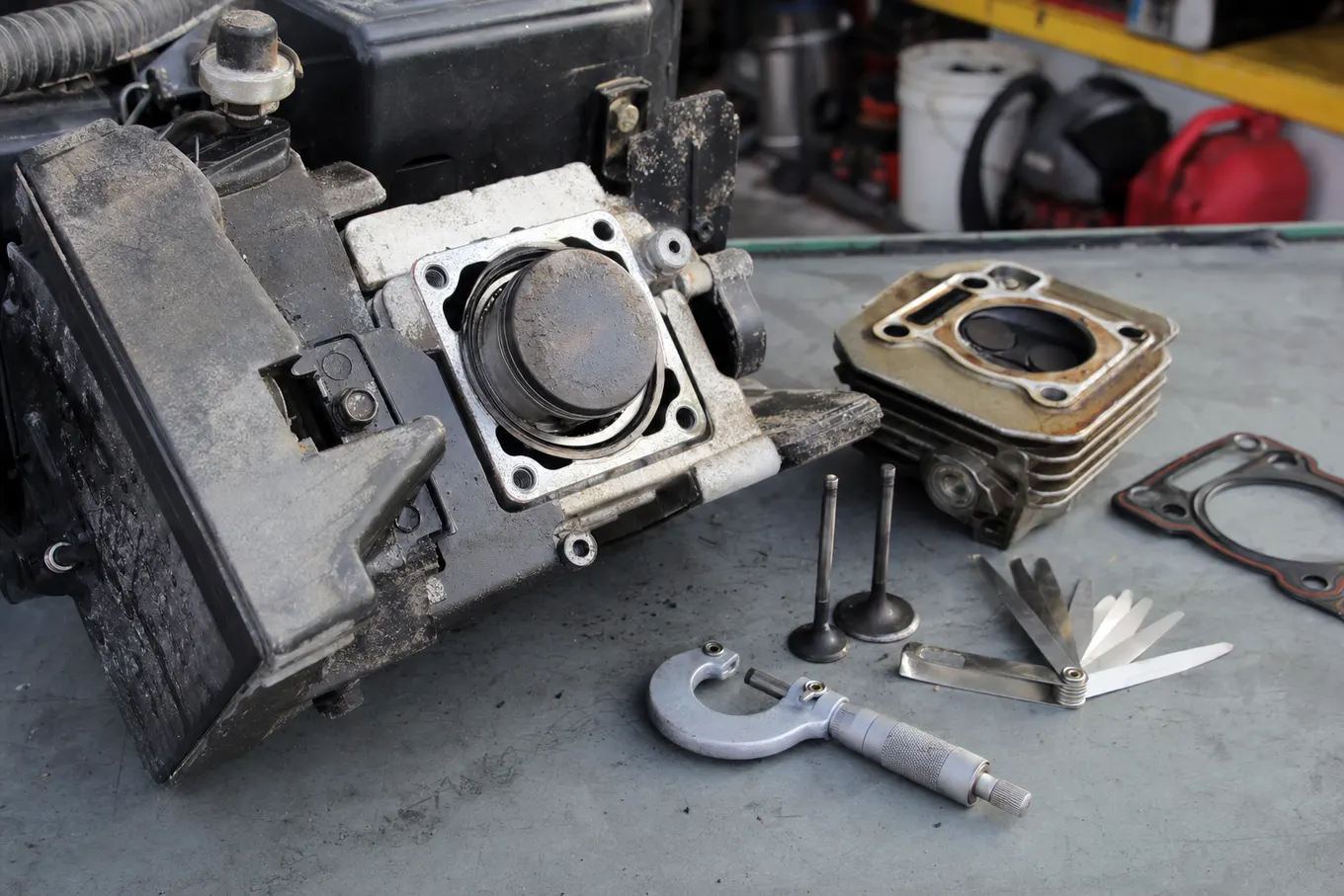
The valve adjustment is the maintenance item hiding behind half of these stories. Between the rocker arm and each valve stem lives a specified clearance, a few thousandths of an inch, set with feeler gauges and locked in place. Wear pulls that clearance out of spec over time. When it opens too wide, the automatic compression release stops doing its trick, and the engine that spun easily for years suddenly fights the starter, drags the battery down, or yanks the pull rope back. When it closes too tight, valves never quite seat, compression bleeds away, hot restarts get moody and exhaust valves risk burning. The adjustment itself is unglamorous: covers off, engine positioned precisely, gauges, patience. The effect is outsized, and on hard working twins we check it as part of any serious service, because it is the cheapest compression repair that exists.
How an engine evaluation actually runs
- History and numbers first. How the engine has been fed, how it failed, and the model identification off the shroud, because the spec sheet changes what healthy means before any tool comes out.
- Cold start observation. The first thirty seconds from stone cold are the most honest the engine will be all day: cranking effort, smoke color, how it settles to idle, what the exhaust says.
- Warm run and speed check. Governed rpm verified against spec with a tachometer, throttle response walked through its range, and any surge, miss or hunt provoked on purpose while instruments watch.
- Compression through informed eyes. The gauge reading interpreted with the compression release accounted for, against what this specific engine family should produce, not a generic number.
- Leak down with ears on. Percentage measured, escape path located, verdict separated into valve work, ring wear or healthy.
- Valve lash measured. Clearances checked against spec while the covers are off, because it is the cheapest fix in engine work and the most commonly guilty.
- The verdict, priced. What we found, what it costs to fix, what we would do if it were ours, and no work until you say go.
What do the results decide? Everything downstream. An engine that tests healthy justifies fixing whatever else ails the mower with full confidence, because the expensive heart is strong. An engine with a valve problem gets a modest repair and returns to strength. An engine leaking through its rings gets the honest conversation, with numbers, about rebuilding, repowering or retiring, covered in the section below. What never happens here is spending your money on a machine whose engine we have not proven, because bolting new parts around a dying engine is the most polite way a shop can waste your money.
The Engine Systems We Service, and How Each One Fails
Beyond the big three tests, engine work here covers every system between the gas cap and the muffler. A quick tour of each, what it does, and the way it typically dies in this climate, so the invoice never contains a mystery.
Magneto ignition: spark with no battery required
Mower engines make their own electricity for spark. Magnets cast into the spinning flywheel sweep past the ignition coil, inducing the high voltage pulse that fires the plug, no battery involved. It is why a push mower with no electrical system at all can sit for a decade and still spark, and it is a genuinely elegant piece of engineering hiding under every shroud.
The system has three failure points and we test all of them rather than guessing. Coils fail with age and heat, sometimes only when hot, which is a signature Florida complaint. The precise gap between coil and flywheel matters, and a coil installed carelessly after other work robs spark strength. And the flywheel key, the little peg that locks the flywheel's magnets in the correct position relative to the piston, can shear on blade impact, moving the spark to the wrong moment. Plug condition rounds out the picture, and reading a plug's face is a diagnostic skill all by itself, one your grandfather's mechanic had and we kept.
The governor: the engine's cruise control, and the myth that hurts it
Inside or beside the crankcase, every mower engine runs a governor, flyweights or an air vane that senses engine speed and works the throttle for you. Ask for full speed and the governor holds it, leaning into the throttle as thick grass loads the blade and easing off in the thin stuff. When it is set correctly you never think about it. When its linkage is bent, worn or reassembled wrong, you get idle chaos, refusal to reach cutting speed, or a frightening full throttle scream at startup, and the fix is proper setup, a procedure with exact steps per engine family.
Now the myth: the internet is full of videos about removing or defeating the governor for more power. On a mower engine this is how you convert a working machine into a grenade with a countdown you cannot hear. These engines are built, balanced and priced to live at their governed speed, and unrestrained revs stress the rotating parts past anything the designers allowed. The valves float, the rod stretches, and the ending is a hole in the block. We set governors to specification, we do not delete them, and we will talk you out of the video you watched with genuine affection.
The breather system: why an engine pushes oil where oil should not be
A running engine's crankcase is a violent place, with the piston pumping up and down above it, and a small breather system vents the pressure this creates, routing it back into the intake. When the breather clogs, or when worn rings pump extra combustion gas past the piston, crankcase pressure climbs and starts pushing oil out of every gasket and seal it can find, or up through the breather into the air filter, where owners discover it as a mysteriously oil soaked filter.
This is a favorite example of why symptoms need interpretation before parts. Oil in the filter box can be a cheap breather fix, a tipped mower's aftermath, an overfilled crankcase, or the first announcement of ring wear, and the leak down test sorts the innocent versions from the expensive one in minutes. Replacing gaskets around a pressurized crankcase treats the stain instead of the cause, so we chase the pressure first.
Seals, gaskets and the archaeology of an oil leak
Engines mark their territory in predictable spots: the sump gasket where the two case halves meet, the crankshaft seals top and bottom where spinning metal exits the case, the valve cover, and the oil drain and filter connections that get disturbed most often. Florida adds its accelerant, heat cycling that ages rubber and paper gaskets faster than mild climates would, and a deck environment full of abrasive dust that chews at the lower crank seal.
Finding the true source is the actual work, since oil travels with airflow and gravity before it drips, and the wet spot is rarely the leak. We clean, run and trace before quoting, because replacing the wrong seal fixes nothing at full price. Worth knowing: the lower crank seal on a walk behind lives just above the blade, so a leak there sometimes follows a blade strike that nudged the crank, and checking for that is part of the repair, not an upsell.
Starters, charging and the electrical border crossing
On riding mowers the engine hosts the starter motor, the flywheel alternator that recharges the battery, and the wiring that ties them to the machine. Failures here sit on the border between engine work and mower electrical work, and the diagnosis has to cross that border fluently: a slow crank can be a starter dying, a battery sagging, a corroded cable, or the valve lash problem from the section above masquerading as all three. We test in sequence rather than swapping parts in hope, and the full electrical side, batteries, solenoids, switches and wiring, has its own page under electrical repair.
Recoil starters and pull ropes: small parts, big mornings
The recoil starter is a spring, a pulley, a rope and a set of pawls that grab the flywheel when you pull, and it lives a hard life in sandy air. Ropes fray where they exit the housing, springs fatigue and lose their rewind, pawls wear until they slip, and one day the handle comes out limp or refuses to retract. All of it is repairable, and none of it is expensive relative to the frustration it causes.
The diagnostic distinction that matters: a recoil problem changes how the rope behaves, a hard pulling engine changes how the rope fights you. Limp, sticky or non retracting rope is the starter mechanism. A rope that pulls like the engine is angry points back to valve lash, deck drag or worse, covered elsewhere on this page. Owners often buy a recoil assembly for what turns out to be a lash problem, so we check which story your rope is telling before either repair.
Fuel and carburetion: the short version
No engine page in Southwest Florida escapes fuel, but this site gives the topic the full treatment it deserves elsewhere. The short version: ethanol gas aging in our humidity is the number one reason engines arrive here running badly or not at all, the carburetor is where the damage lands, and the cure ranges from cleaning to replacement depending on what the teardown shows. The complete story, from float bowls to ultrasonic tanks to the fuel habits that end the cycle, lives on the carburetor cleaning and repair page. From the engine's perspective the summary is simple: feed it fresh fuel and clean air, and most of this page's other sections stay theoretical.
How Southwest Florida Grinds Down Mower Engines
Engines age everywhere, but they age here in specific, recognizable ways. These are the four local wear patterns behind most of the tired engines we measure, and what interrupts each one.
Worth understanding before the list: these patterns compound each other rather than taking turns. Sand that thins the oil's film makes the heat problem worse. Heat that oxidizes the oil makes the sand more abrasive. Blocked cooling raises temperatures that accelerate every other failure on the page. An engine suffering two of these at once does not age twice as fast, it ages more like four times, which is why the worn out engines we measure are usually victims of a combination, and why fixing just one contributor buys less time than owners hope. The good news mirrors the bad: every habit below that interrupts one pattern takes pressure off the others too.
Sand in the airstream: the quiet cylinder lapping machine
Our soil is fine silica sand, and mowing lifts a cloud of it exactly where the engine breathes. The air filter is the only defense, and the defense fails two ways: filters loaded past capacity start passing fines, and cheap or badly seated filters leak around their edges from day one. Sand that gets through does not pass politely. It embeds in the cylinder wall and lands in the oil, where it works like the grinding compound machinists use on purpose, rounding ring edges and opening clearances a little with every hour.
The teardown tell is unmistakable: dust trails inside the intake tract and a glazed, worn bore years ahead of schedule. The prevention is almost embarrassingly cheap: quality filters that fit properly, checked monthly in season, replaced generously, and never, ever running the engine with the filter off, not even for a minute of testing. An engine that dusted is an engine shopping for its replacement, so this is one place where a few dollars of paper genuinely protects hundreds of dollars of iron.
Cooked by clippings: air cooled engines losing their air
Mower engines have no radiator. The fins cast into the cylinder and head are the radiator, and a flywheel fan blows air across them through the shrouds. Now consider what our grass does: St. Augustine cut in the wet season is heavy, damp confetti, and it plasters itself over fins and packs the shroud passages like insulation. The engine keeps running, just hotter, and heat is the master accelerator of everything bad: oil breaking down, varnish forming, tolerances shifting, gaskets hardening, hot start gremlins arriving.
The fix is unglamorous and effective: shrouds off, fins actually cleaned, not just the visible screen, at least yearly for machines that work our full season. It is part of a proper tune up here precisely because so many engines come in wearing a grass sweater nobody has removed in years. If your engine has grown hot tempered late in the mowing season, this is the first suspect, and the cheapest one on the list.
Oil on a twelve month clock: the interval everyone miscounts
Oil intervals are written in hours, and Florida mowers accumulate hours at roughly double the pace of the northern lawns the manuals imagine, because our grass never stops growing. The owner changing oil every spring is doing the right ritual at half the right frequency, and running small air cooled engines hot on old thin oil is how bearings and bores age in fast forward. Cheap singles raise the stakes further: many carry no low oil protection at all, so running a quart low is not a warning light, it is a seizure. The habit that saves engines here is boring: check the level every few mows, change by hours or twice a season, whichever arrives first. Our maintenance service is built around that Florida arithmetic.
Fuel where it does not belong: dilution and the milky dipstick
Two contamination patterns show up on dipsticks here. The first is gasoline in the oil, usually delivered overnight by a carburetor float valve that stopped sealing, covered in detail on the carburetor page. Oil that smells like fuel or sits above the full mark has stopped being a lubricant, and the engine should not run another minute on it. The second is moisture: oil gone pale or milky under the cap on machines that only ever run for short stints. Engines need to reach full temperature long enough to boil off the water their own combustion and our humid air put into the crankcase, and five minute mows never get there. Both patterns are cheap to catch with a ten second dipstick habit and expensive to ignore, which makes the dipstick the highest paid inspector on your property.
Storm water: what flooding does to an engine, hour by hour
When storm surge or standing water reaches engine height, the damage is not the water alone, it is the clock that starts when the water recedes. Water pulled into the cylinder sits against bare machined steel, and rust begins blooming on the bore and valve seats within days. Water in the crankcase separates against parts engineered to live in oil. The single most important thing an owner controls is the urge to try it: cranking a flooded engine can bend internals against incompressible water and turn a recoverable engine into scrap.
Brought in promptly, the drill is methodical: plugs out, all fluids drained, fuel system emptied, cylinder flushed and oiled, electrics dried and tested, then careful assessment before the first supervised start. Plenty of flooded engines in this county have come back to work after Ian and the storms before it. The ones that did not usually lost their chance in the first week, to rust or to a hopeful crank. If your machine went under, call before you touch the key.
Vibration: the wear multiplier nobody budgets for
The engine's crankshaft points straight down into the blade, which means blade condition is crankshaft news. Our lawns are full of surprises, sprinkler heads, oak roots surfacing through sand, storm debris, and every strike either bends the blade or knocks it out of balance. An unbalanced blade turns thousands of times a minute into a hammer drill aimed at the crank bearings, the flywheel nut, the mounting bolts and every welded seam nearby. The mower gets buzzy, the owner gets used to it, and the engine spends months absorbing punishment that a sharpening bench would have ended in a day.
The engine protection habit, then, is a blade habit: sharpened and balanced regularly, inspected after any strike you can hear, details on the blade sharpening page. If your machine buzzes your hands or rattles its deck hardware loose, do not file it under personality. Vibration is a symptom with causes and consequences, and quieting it is cheaper than the bearing work it eventually purchases.
Engine Swap, Rebuild or New Mower: Running the Math Honestly
Sooner or later every engine conversation arrives at the fork: put money into this engine, put a different engine on this machine, or put this machine out to pasture. There is no universal answer, but there is a universal method, and it starts by valuing the mower around the engine.
Question one: what is the chassis worth? Not sentimentally, structurally. A commercial zero turn frame with healthy hydros, a fabricated deck and quality spindles is a machine worth thousands of dollars of remaining life, and hanging a fresh engine on it is often brilliant economics. A big box lawn tractor with a stamped deck going thin and bushings gone sloppy is a machine whose engine may simply have outlived its body. The chassis test decides how much engine investment the machine can justify, and we make that assessment with you honestly, including deck rust, drive condition and what deck and spindle work the machine would need alongside the engine.
Question two: which repair tier does the engine need? Some engine problems are small even when they feel fatal: valve work, gaskets, seals, a carburetor, an ignition module. Those get fixed and nobody talks about replacement. The fork arrives with bottom end wear: rings, bore, crank, rod. A true rebuild means teardown, measurement, machine work where needed and precision assembly, and its labor cost is real, which is why it earns its keep mostly on expensive commercial twins. For many singles, a short block, the factory assembled bottom half that reuses your external parts, splits the difference nicely. And sometimes a complete new engine, matched for shaft size, rotation, mounting and power takeoff, costs close enough to internal surgery that it wins outright. We price the tiers against each other, not in isolation.
Question three: what future are you buying? A repower on a good frame typically buys years of service for a fraction of a comparable new machine, and on commercial gear the case is stronger still. But if the honest projection is one limping season before the transmission or deck presents its own bill, we will say so, because a repair that only relocates the disappointment is not a repair worth selling. Used engines deserve a sentence here too: we treat them with suspicion on principle, and never install one without compression and leak down proof, because inheriting a stranger's worn engine is not a savings, it is a deposit on a second repair.
A note on what a repower involves, because the labor is where estimates surprise people. A replacement engine has to match your machine in shaft diameter and length, crankshaft orientation, mounting bolt pattern and power takeoff, and then everything that connected to the old engine has to connect to the new one: throttle and choke controls with different geometries, exhaust that may not line up, charging and safety wiring with different plugs, belts that need exact pulley heights. Matching and adapting is normal work for a shop that repowers mowers regularly, and a minefield for a first timer with a shopping cart. When we quote a repower, the number includes the fitting, the wiring, the test running and the tuning, so the mower leaves finished rather than almost.
One scenario deserves its own mention: the mower whose maker vanished. Brands and importers come and go, and owners of orphaned machines assume the whole mower died with the company. Usually not so. The engine on most of these machines is a standard Briggs, Kohler or import unit with normal parts support, and engines mount to decks in standardized ways, which means an orphaned mower with a good frame is often a perfect repower candidate. The badge is dead. The machine frequently is not, and ten minutes of measuring tells us which.
Buying used? Borrow our checklist
The same tests that judge your engine judge a stranger's. If you are shopping a used mower, insist on a stone cold start and watch how it wakes: long cranking or instant smoke are both stories. Check the oil before starting, low, black, gritty or gas smelling oil tells you how the machine was loved. Blue smoke that persists past warmup means oil is getting burned somewhere it should not be. Listen at idle for knocks and ticks, and treat any hour meter with polite skepticism, since meters fail and batteries get disconnected. None of this requires tools, all of it filters out the worst candidates, and for a machine that costs real money, a pre purchase once over on our bench turns maybe into measured. We would rather check an engine before you buy it than diagnose it after.
However the math lands, the process is the same: findings in plain language, options priced side by side, our recommendation stated once and not repeated as pressure, and the decision entirely yours. People sometimes expect a sales pitch at this stage. What they get is arithmetic, because the repeat customers and referrals that keep this shop busy come from the times the arithmetic said do not spend, and we said it out loud.
An Engine Never Fails Alone
Engines and the mowers around them trade damage in both directions, which is why engine work here always comes with eyes on the neighbors. A bent or unbalanced blade hammers vibration into the crankshaft and its bearings every second it spins, so a blade sharpening and balancing habit is quietly an engine protection habit. A dragging deck or seized spindle loads the engine like a hill that never ends. A weak charging system starves the battery and cooks starting components, territory covered under electrical repair. And the engine returns the favors: a hard vibrating engine loosens the machine around it, and an overheating one bakes belts and wiring nearby.
Practically, this means two things. When your engine is on this bench, the blades, deck, belts and charging system get looked at before reassembly, because sending a fresh engine back into a hostile machine is bad medicine. And when the engine is healthy, keeping it that way is mostly a mower care rhythm, the seasonal maintenance that keeps air clean, oil fresh, fins clear and loads sane. Engines here rarely die of one big thing. They die of five small things nobody was watching, and watching them is a service we literally sell.
If you want all of that in a single appointment, the yearly full tune up is the engine's physical exam: oil, plug, filters, blade service and a set of experienced eyes over everything this page described, timed for before the growing season gets serious. Most of the engines we condemn each year would have been cheap saves twelve months earlier, and that single sentence is the best argument for maintenance anyone has ever made.
Engine Work for the Whole 30 Mile Circle
From the shop in Port Charlotte we handle mower engines for four counties' worth of lawns, from Cape Coral's do it yourself canal lots to Arcadia's ranch acreage, with pickup and delivery doing the hauling when the machine cannot come to us. Engine work travels well: the diagnosis happens on our bench either way, and a dead engine does not care what it rides here on. Town details and drive times live on each page below, and the complete list is on the service area page.
What your mower engine is doing while you hear it run
A mower engine looks simple from the outside because most of the busy parts are hidden behind sheet metal, a plastic cover, and a little dirt. Inside, it is a timing machine. Air has to enter at the right moment. Fuel has to mix cleanly. Spark has to happen when the piston is in the right place. Oil has to reach the moving parts. Cooling air has to move across the fins instead of bouncing off a wad of packed clippings. Good lawn mower engine repair starts by knowing which part of that chain stopped doing its job. That is also why a focused small engine mechanic listens to the symptom before grabbing parts. A mower that surges, a mower that kicks the rope back, and a mower that starts cold but refuses hot are telling three different stories.
The helpful way to think about it is this: a mower engine does not need perfection, but it needs balance. A slightly dirty air filter might still mow a small dry yard. Add old E10 fuel, a blade that is dull from sugar sand, a deck packed underneath, and ninety-degree air, and that same engine now has to work harder while breathing worse and cooling poorly. Owners often see the final symptom, not the pileup. The engine did not suddenly become mysterious. It ran out of margin. That is why small clues matter. A change in rope feel, a new hot restart problem, a puff from the breather, or a surge that gets worse under load can point to the system that is losing the fight.
How a four-stroke mower engine actually makes power
A four-stroke engine repeats the same little story thousands of times while you mow. On the intake stroke, the piston drops and the intake valve opens so the cylinder can pull in air and fuel. On compression, both valves close and the piston squeezes that mixture into a tight space. On power, the spark plug lights it and the burning mixture shoves the piston down. On exhaust, the exhaust valve opens and the piston pushes the used gases out. If one chapter is missing, the engine may still tease you. A carburetor bowl can hold enough fuel for a few seconds. A weak spark can fire in open air but quit under compression. A leaking valve can make the starter spin easily but never build a proper squeeze. That is why we do not treat every no-start mower like a dirty carburetor. If the basics are not lined up, our lawn mower wont-start diagnostics start with fuel, spark, compression, and timing before the parts guessing begins.
The governor is the most misunderstood part on the machine
The governor is not a speed booster. It is the part that keeps the engine from running away from itself when the load changes. When thick grass pulls the blade down, the governor opens the throttle so the engine can recover. When the blade spins free again, it closes the throttle before the engine overspeeds. On many push mowers, that control happens through an air vane or a small internal governor system tied to the throttle plate. On riders and zero turns, the setup can be a little more involved, but the job is the same. The symptom owners recognize is hunting: the engine goes up and down, up and down, like someone is tapping the throttle. Sometimes the governor is only reacting to a lean carburetor, a vacuum leak, old fuel, or a sticky linkage. Bending springs or cranking on screws can turn a repairable surge into an overspeed problem. The governor protects the blade, the crankshaft, and the person standing behind the handles. It deserves more respect than it gets.
Valves, lash, and hard hot-starts in Florida heat
Valves are the engine doors. The intake valve lets the fresh mixture in. The exhaust valve lets the burned gases leave. Valve lash is the tiny clearance that lets those doors close completely as the engine expands with heat. Too much clearance can make the engine noisy and lazy. Too little can hold a valve open just enough to bleed compression away. Florida makes marginal valve settings show up faster because the engine is already working in hot air, often after mowing wet, heavy grass. A common complaint is simple: it starts fine cold, cuts half the yard, then will not restart until it cools. On some overhead valve engines, lash also affects the compression release, the little feature that makes the starter's job easier. If the release cannot do its trick, the rope can feel brutal or the starter can stall against compression. Adjusting valves is not glamorous work, but it can separate a worn-out engine from one that only needs its breathing set back where the manufacturer intended.
The flywheel key is a small part with a serious job
The flywheel key is a soft metal alignment key between the flywheel and the crankshaft. Its job is to keep ignition timing in the right place, but it also acts like a sacrifice part when the blade hits something solid. A mower blade has momentum. So does the flywheel. If the blade stops suddenly on a root, stump, paver edge, or sprinkler head, the key can shear instead of forcing all that shock straight through the crank and flywheel. When it shears, the engine may still have spark, fuel, and compression, yet the spark happens at the wrong time. Owners usually notice a rope that jerks back, loud popping, a mower that almost starts but will not settle, or a machine that changed behavior right after an impact. The part is simple. The diagnosis matters. If a mower was running well before a blade strike and now acts possessed, timing needs to be checked before anyone starts blaming the carburetor, coil, or fuel cap.
Splash lubrication, pressure systems, and why oil level is everything
Many smaller mower engines do not have an automotive-style oil pump pushing oil through drilled passages. They use splash lubrication, where a dipper or slinger flings oil around the crankcase so the rod, crank, cam, and cylinder get a film of oil. Some larger riding mower and zero-turn engines use pressure lubrication with a pump and filter, but even those systems cannot save an engine that is run low, overfilled, or tilted the wrong way for too long. Oil level matters because splash systems need the moving parts to reach the oil, not skim above it. Overfilled oil can foam, smoke, and get pulled into the intake. Low oil can make a rod knock start quietly, then get expensive fast. The habit that saves engines is boring: check the level on flat ground, use the right oil, and change it before it turns into thin black soup. Our lawn mower maintenance work treats oil as a wear part, not a decoration on the dipstick.
Air-cooling is not optional in Port Charlotte weather
Most mower engines are air-cooled, which means the engine depends on a flywheel fan, cooling fins, and shrouds to move air where heat is being made. Those plastic and metal covers are not there just to make the engine look finished. They direct airflow across the cylinder and head. If the fins are packed with dry grass, sand, seed heads, or oily dust, the engine can run hot even with the oil full. If a shroud is left off after a repair, the fan may move air, but not through the places that need it. Florida does not give engines much mercy. Hot afternoons, thick St. Augustine, wet-season growth, and slow mowing around tight yards can all keep the load high. The symptom can be power fading after twenty minutes, oil that smells cooked, a hot restart problem, or repeated head gasket trouble on engines already running lean. A clean cooling path is not cosmetic. It is part of the engine's survival system.
What we usually find after a mower engine dies
Dead engines do not all die the same way. Some fail from age and hours. Some are killed by one bad afternoon. Some are technically repairable but make no sense once the crank, rod, cylinder, valves, and labor are added up. The honest part of small engine repair near me is not pretending every mower deserves an engine rebuild. Teardown tells the truth. Metal color, oil smell, cylinder marks, filter dirt, valve faces, piston top, and crank play all leave clues. A good inspection also separates the final failure from the habit that caused it. That matters because the next mower can live longer if the owner knows what actually happened.
We also pay attention to the mower around the engine. A solid engine on a rotted deck is one kind of decision. A failed engine on a clean rider with a good deck, good tires, and a serviceable transmission is another. The engine autopsy is not just about finding the broken part. It is about judging whether the rest of the machine deserves that repair. That is where a plain explanation beats a dramatic one. A scored crank, dirt-polished cylinder, bent rod, or cooked head gasket does not need sales theater. It needs context: what failed, what probably started it, what the realistic paths are, and which habits would have changed the outcome.
The oil-starved engine
An oil-starved engine usually leaves evidence before it locks up. The oil may be low, burnt, metallic, or missing from places where it should have left a film. On teardown, the rod journal can be scored, the bearing surface can look smeared, and the rod may show heat discoloration. Before the final stop, owners sometimes hear a light knock that gets sharper under load. Then the engine loses power, gets louder, and may seize or throw the rod. Repair depends on how far the damage traveled. A lightly worn top end is one thing. A damaged crank and rod in a common mower engine often turns into a replacement conversation. The prevention habit is simple and not exciting: check oil before mowing, check it again after a hard or tilted job, and do not assume the low-oil sensor will rescue the engine every time. Sensors are helpful. Dipsticks still matter.
The dusted engine
A dusted engine is one that breathed dirt instead of filtered air. In Charlotte County, sugar sand is hard on blades, bearings, belts, and air filters. If the filter is missing, installed wrong, soaked with oil, torn, or bypassed by a warped cover, fine grit can go straight through the intake. Inside the engine, that grit acts like lapping compound. We may see a polished or glazed cylinder, worn rings, low compression, oil consumption, and dirt tracks inside the intake throat. The mower may still run, but it smokes, lacks power, fouls plugs, and needs more choke than it should. Repair is realistic only if the cylinder, piston, and ring wear are still within reason. Many dusted engines are tired all the way through. The habit that prevents it is changing or cleaning the filter properly, not knocking it out against a trailer rail and calling it good. A filter that cannot seal is worse than an ugly filter that still fits tight.
The hydrolocked engine
Hydrolock means liquid got into the cylinder above the piston. Air compresses. Liquid does not, at least not in a way a mower connecting rod appreciates. The liquid might be fuel from a carburetor needle that leaked while the mower sat, or water from washing, flooding, or storage in the wrong spot. The warning sign is an engine that will not turn normally, a starter that clunks, or a rope that stops hard. Do not keep cranking through it. That can bend a rod, damage the starter, or fill the crankcase with fuel. On teardown, we look for a bent rod, washed cylinder walls, fuel-thinned oil, rust marks, and signs of where the liquid entered. If the rod is straight and the engine was stopped quickly, repair can be as practical as clearing the cylinder, changing contaminated oil, and fixing the cause. If fuel caused it, lawn mower carburetor repair is part of the engine repair, not a separate nuisance.
The overheated engine
Overheated engines often look cooked before they look broken. Paint can discolor near the head, oil can smell burnt, plastic near the shroud can warp, and the head gasket may show a dark track where combustion escaped. Inside, we may find carbon from a lean-running carburetor, scuffed piston skirts, tight valve clearances, and oil that has lost its ability to protect under load. The cause can be blocked cooling fins, missing shrouds, wrong oil, low oil, a lean fuel mixture, or mowing too slowly through heavy growth with the deck packed. Repair is realistic if the engine still has good compression, the gasket surfaces are sound, and the bottom end stayed lubricated. It is not realistic when heat has damaged the crank, rod, cylinder, and valve train together. The prevention habit is a seasonal inspection before summer growth gets ridiculous. A proper lawn mower tune-up should look at cooling airflow, oil condition, carburetor behavior, and the warning signs that heat has been winning.
We tell owners the truth about dead engines because miracle rebuilds are not a service. Sometimes a mower needs a repair. Sometimes it needs an engine. Sometimes the machine is not worth feeding another major part. The useful answer is the one that explains what failed, what caused it, whether the rest of the mower is healthy enough to justify the work, and how to avoid repeating the same failure on the next engine.
Small Engine Repair FAQs
Do you repair pressure washers, generators or chainsaws?
No, and that is a choice we made on purpose rather than a gap we hide. This bench works on the engines that power lawn mowers: walk behinds, riders, tractors and zero turns. Saying no to everything else keeps our parts stock deep, our pattern recognition sharp and our turnaround honest for mower owners. For handhelds, generators and pumps, a general small engine shop will serve you better, and we will say so cheerfully.
Which small engine brands do you work on?
The families that actually live under mower hoods: Briggs & Stratton singles and twins, Kohler, Kawasaki, Honda GCV and GXV, the older Tecumseh units still soldiering on, and the newer import engines like Loncin appearing on budget machines. Those names cover nearly every gas mower sold in Southwest Florida going back decades, which is the point of specializing.
What is a valve adjustment and why would my mower engine need one?
Overhead valve engines need a precise sliver of clearance between the rocker arm and the valve stem, and that clearance drifts as seats wear. Too wide and the compression release stops helping the starter, so cranking turns slow and stubborn. Too tight and valves hang open, bleeding compression and risking burnt valves. It is a routine, inexpensive service with outsized effects, and it is skipped by almost everyone until the symptoms arrive.
What does low compression actually mean?
The piston is supposed to squeeze the air and fuel into a tight package before the spark lights it. When rings, valves or a head gasket stop sealing, part of the squeeze escapes, taking power and startability with it. A gauge tells us how much is missing. A leak down test tells us where it goes, and that difference decides whether you are buying a small valve job or having a bigger conversation.
Is it worth putting a new engine on an old mower?
When the machine around the engine deserves it, absolutely. A repower is smart money on a commercial grade zero turn, a solid walk behind with a good deck, or a lawn tractor with a healthy frame and transmission. It is poor money on a rusted big box mower whose engine simply outlived the cheapest parts around it. We put real numbers on both roads and let you compare them side by side.
What is the difference between rebuilding and replacing an engine?
A rebuild opens your engine and renews the wear parts: rings, gaskets, seals, sometimes valves or an oversize piston. Replacement swaps in a whole new engine, or a short block, which is the factory fresh bottom half wearing your original carburetor, coil and shrouds. Rebuilds tend to earn their keep on expensive commercial twins. On small singles, a complete new engine often costs surprisingly close to deep internal work, and we show you that comparison before anything is decided.
Why did my mower suddenly get hard to pull start?
The everyday answer is valve clearance drifting wide enough that the compression release no longer cracks a valve during cranking, leaving your arm to fight the engine at full strength. Other candidates: grass packed under the deck dragging the blade, too much oil in the crankcase, or the early stage of a mechanical bind. Wide valve lash is the common one, and it is a bench adjustment, not a new engine.
My twin cylinder engine uses oil but never leaks a drop. Where does it go?
Out the exhaust, quietly. Worn rings or valve guides let oil into the combustion chamber where it burns with the fuel, often too gradually to make visible smoke. Air cooled twins working Florida summer loads develop this pattern honestly with age. A leak down test separates rings from guides and tells us how urgent the situation is, which beats guessing by a wide margin.
How many hours should a lawn mower engine last?
Longer than the cheapest ones get, and less than the marketing implies, is the honest frame. Residential singles are built to a lighter standard than commercial twins, but maintenance moves lifespan more than any badge does: the same engine can be worn out shockingly early on neglected oil or still strong far past expectations on clean oil and clean air. Instead of quoting mythology, we measure yours with a gauge and tell you what its hours actually did to it.
Can you identify my engine from a photo?
Usually. Text a picture of the whole engine plus the identification numbers: Briggs stamps model, type and code into the shroud area or nearby metal, Kohler and Kawasaki hang spec and serial plates or stickers on the housing, and Honda casts its designation into the case. Those numbers make parts research exact instead of approximate, which shortens every repair that follows.
What kills small engines fastest in Southwest Florida?
Dirty air and hot running, with neglected oil driving the getaway car. Our fine sugar sand slips past cheap or badly seated air filters and laps the cylinder walls like grinding paste. Grass clippings mat over the cooling fins until the engine bakes under load. Stack a year round cutting season on top, with oil changes that come by calendar instead of by hours, and you have the biography of most worn engines on this bench.
Why does my engine still surge after the carburetor was cleaned?
Because surging is a lean condition, and the carburetor is only one place lean comes from. Air sneaking in behind the carb through a hardened intake gasket or cracked manifold leans the mixture exactly like a dirty jet does, and no amount of carb cleaning fixes an air leak. Governor linkage set wrong after service does it too. We pressure and spray test for leaks and verify governor setup, which is how a stubborn surge finally dies.
My engine has started knocking. Can I finish the season on it?
Please do not try. A new metallic knock is clearance announcing itself where clearance should not exist: a rod bearing, a wrist pin, a flywheel coming loose. Caught immediately, some of these are genuinely repairable for reasonable money. Mowed on for another month, the usual finale is a connecting rod exiting through the side of the block, and no shop anywhere can un-throw a rod. Park it and call.
Is an old flathead engine still worth fixing?
Often, yes. The old L head Briggs and Tecumseh engines are simple, torquey and famously tolerant, and parts for the common models remain available. If the block and crank are healthy, a fuel system service, valve lapping and fresh gaskets can buy years of Saturdays. When a flathead needs deep internal work, the math usually points to repowering or retiring the machine, and we will lay out both paths without sentiment doing the pricing.
How many hours does a mower engine last?
There is no honest single number because engine life depends on oil care, air filtration, cooling, storage, mowing load, and whether the mower gets run low or dirty. A homeowner mower that gets clean oil, a sealed air filter, fresh fuel, and cooling fins kept clear can last a long time. A neglected engine in sand, heat, and wet-season grass can wear out much sooner.
Can you rebuild a Briggs and Stratton engine or just replace it?
Yes, some Briggs and Stratton engines can be rebuilt, but replacement sometimes makes more sense. We look at compression, crankshaft condition, cylinder wear, parts availability, the mower's overall condition, and what failed in the first place. If the engine only needs valves, seals, a gasket, or carburetor work, repair may be practical. If the crank and bore are damaged, replacement often becomes the cleaner answer.
Why does my mower engine knock?
A knock usually means something has too much clearance or is being hit harder than it should be. Low oil, worn rod bearings, a loose blade, carbon buildup, bad timing after a blade strike, or an engine running under heavy load can all sound ugly. The key detail is when it knocks: at startup, under load, after warming up, or right after hitting something.
What does a blown head gasket look like on a mower?
On many mower engines, a blown head gasket shows up as hard starting, low power, puffing from the breather, oil smoke, oil leaks near the head, or a dark burned track between the cylinder and pushrod area. Some engines still run, just badly. A compression or leak-down check helps confirm it before parts come off.
Is synthetic oil worth it in a lawn mower?
Synthetic oil can be worth using if it matches the engine maker's recommended viscosity and service rating. It handles heat well and can stay stable under hard summer mowing. It is not magic, though. The wrong oil, dirty oil, or oil left in too long can still hurt the engine. Correct level and regular changes matter more than the label.
General repair questions have their own home on the FAQ page. For a question about your specific engine, the fastest route is (941) 555-0123.
Let's Find Out What Your Engine Has Left
Describe the symptom, the smoke, the noise or the number of pulls it takes, and include the engine's numbers if you can find them. You will get an honest read, a firm quote, and a recommendation we would give our own machine.
- Compression and leak down testing with real answers
- Rebuild, repower and replace math priced side by side
- Talk to a human: (941) 555-0123