Lawn Mower Repair in Port Charlotte, FL
Whatever your mower is doing or refusing to do, this is the shop that figures it out and fixes it. Honest diagnosis, a real price you approve first, and work done by someone who repairs lawn mowers all day, every day, and nothing else.
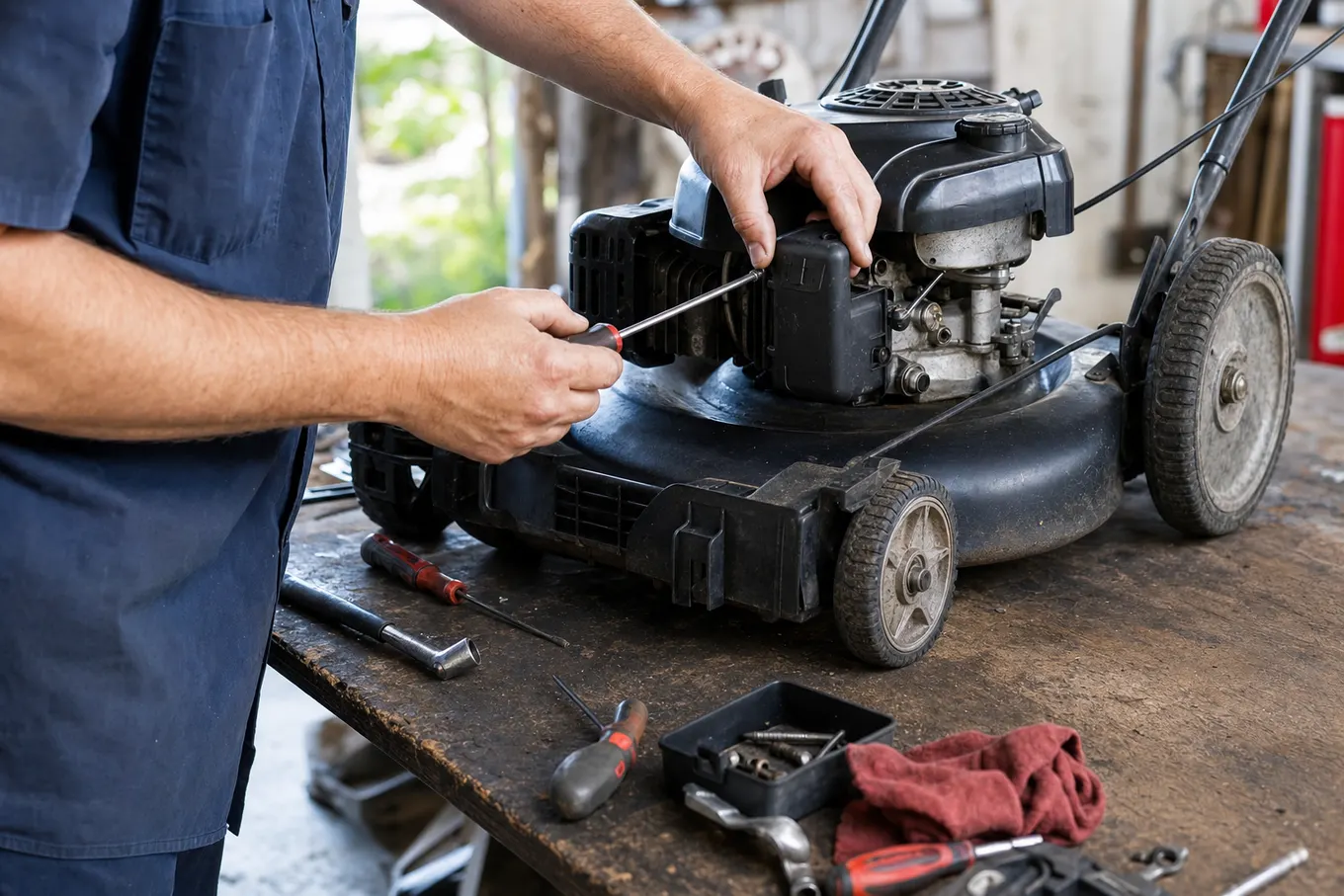
Need lawn mower repair in Port Charlotte? Joe’s Small Engine Repair fixes push mowers, self propelled mowers, riding mowers, lawn tractors and zero turns from one local shop at 4502 Meager Cir. You get a diagnosis, a firm quote before any work begins, and fast turnaround, with pickup and delivery available across the 30 miles around Port Charlotte. Call or text (941) 555-0123.
Every Kind of Mower That Cuts a Florida Lawn
Lawn mower is a big category and we cover all of it. If it has a blade and it is supposed to cut grass, it belongs on our bench.
Push and self propelled mowers
The 21 inch workhorses from Toro, Craftsman, Honda and everyone else. Hard starts, drive problems, cables, wheels, blades and the engines themselves.
DetailsRiding mowers and lawn tractors
Deck problems, drive and transmission issues, electrical gremlins, steering slop and engine work on every major riding brand.
DetailsZero turn mowers
Residential and commercial zero turns: hydro drives, spindles, clutches, seats and switches, and the big twin cylinder engines.
DetailsBattery and electric mowers
EGO, Ryobi, Greenworks and friends. Blades, decks, drives and honest guidance on packs and electronics.
DetailsThe engines underneath
Briggs & Stratton, Kohler, Kawasaki and Honda small engines: compression, valves, carburetion, ignition and rebuild-or-replace calls.
DetailsMowers that cannot get here
Dead riding mower and no trailer? Pickup and delivery runs across our whole service area. We come get it.
DetailsWhat Your Mower Is Telling You
Mowers fail in patterns. Find what yours is doing and you will see the usual suspects we check first, plus the deep guide for that exact problem.
| Symptom | Usual causes we find | Deep guide |
|---|---|---|
| Cranks but will not start | Old fuel, gummed carburetor, fouled plug, bad coil | Won’t start guide |
| Starts, then dies in seconds | Clogged carb jets, blocked fuel cap vent, dirty filter | Carburetor service |
| Runs rough, surges, hunts | Carburetor, stale gas, air leak, governor out of adjustment | Carburetor service |
| No crank, no click | Dead battery, corroded terminals, safety switch, solenoid | Electrical repair |
| Clicks but will not turn over | Weak battery, bad solenoid, failing starter motor | Electrical repair |
| Cuts uneven, scalps, misses strips | Dull or bent blades, deck out of level, bad spindle | Blade sharpening |
| Screeching or grinding under deck | Spindle bearings, belt riding wrong, debris jam | Belt and deck repair |
| Blades will not engage | PTO clutch, belt, switch or cable, weak battery on electric clutch | Belt and deck repair |
| Mower will not move forward | Drive belt, transmission, wheel hardware, hydro fluid | Riding mower repair |
| Smoking from the engine | Oil overfill, tipped mower, rings or head gasket | Small engine repair |
| Battery dies every few weeks | Charging system, parasitic drain, cooked battery | Electrical repair |
| Leaking gas or oil | Carb float stuck, primer line, seals, loose drain | General repair |
Why Lawn Mowers Fail Faster in Southwest Florida
Repairing mowers in Port Charlotte is different work than repairing them in Ohio. Our machines run nearly twelve months a year in heat, humidity, sand and salt. Understanding what that does to a mower is most of diagnosing one.
Ethanol fuel: the number one mower killer in Charlotte County
Nearly every gas station around here pumps E10, gasoline with ten percent ethanol. Ethanol pulls moisture straight out of our famously humid air. Give it a few weeks in a vented mower tank and the fuel begins to separate, the water settles, and the mixture turns into varnish inside the carburetor’s tiny passages. The mower that ran perfectly in May will crank and crank in August and never fire.
It is such a reliable failure that fuel is the first system we check on almost every no start that comes through the door. The fix ranges from fresh fuel and a bowl clean to a full ultrasonic carburetor cleaning or replacement, and we will show you exactly what came out of yours. The prevention is cheap: stabilizer in every can, or ethanol free fuel if you store the mower more than a month.
Sugar sand: what our soil does to blades, bearings and filters
Southwest Florida lawns grow out of fine sugar sand, and every pass of the mower throws a little of it into the air. That sand is an abrasive. It rounds off blade edges in a fraction of the time sod farms up north would expect, it works its way into spindle bearings and wheel bushings, and it loads air filters until the engine is breathing through a pillow.
This is why blade sharpening is a two or three times a year job here, not an annual one, and why we always check filters and spindles even when you came in for something else. Sand damage is quiet and cumulative, and catching it early is dramatically cheaper.
Salt air: the slow corrosion tax within a few miles of the water
From Charlotte Harbor to Manasota Key, salt rides the breeze. It settles on steel decks, wicks into cable sheaths, and creeps into electrical connectors. The result shows up as rust blisters on decks, throttle and drive cables that bind, and the crusty green corrosion on battery terminals and ground straps that causes half the electrical no starts we see.
If you live near the water, a rinse and dry after mowing and a yearly protective going over make a visible difference in how long the machine lasts. When corrosion has already done its work, we repair what is repairable and tell you honestly when a deck is past saving.
Heat and the twelve month season: wear on a Florida schedule
A mower in New England might run 25 hours a year. Yours can easily run double or triple that, and it does its hardest work in 95 degree August air that makes engines run hot and batteries age fast. Belts glaze and stretch under wet season grass loads. Cooling fins pack with clippings and choke airflow. Oil breaks down quicker in sustained heat.
The practical answer is a Florida service rhythm: oil more often than the manual’s northern assumptions, belts and cooling checked yearly, and a battery expectation of two to three summers, not five. Our maintenance service is built exactly around that rhythm.
Snowbird storage: what six idle months does to a mower
Half of our neighbors head north between April and November, and their mowers sit. Gas sours, batteries drain flat and sulfate, and by the time the mower is needed again it will not start and will not hold a charge. Every fall we wake up a wave of these machines.
If that is you, two choices work: have us prep the mower before you leave, stabilized or drained fuel, fresh oil, battery plan, clean dry deck, or just bring it to us when you return and we will bring it back to life. The prep is cheaper. Either way, do not keep cranking a soured machine, that only washes cylinders and fouls plugs.
The Order of Operations on Our Bench
Guessing is expensive. A small engine needs three things to run, fuel, spark and compression, and a mower needs a working chassis around that engine. We test in a fixed order so the real fault gets found instead of the loudest symptom.
- Listen to the story. What it did last, what you tried, how it was stored. Half of diagnosis is in the story, which is why we actually ask.
- Check the safety circuit first on no starts. Seat switches, blade switches, brake switches. Florida corrosion loves these, and a two dollar connector should never be misdiagnosed as a dead starter.
- Prove or rule out fuel. Fuel condition, delivery, and the carburetor. Given our ethanol reality, this catches the majority of running problems right here.
- Test spark properly. Plug condition and gap, then coil output at the right point, not just "it sparked once against the block".
- Measure compression when the first two check out. This tells us the honest truth about the engine’s internals, and it is where the repair or replace conversation gets real data.
- Then the chassis. Deck, spindles, belts, drive, wheels, cables and electrical, because a strong engine on a broken chassis still cuts a bad lawn.
You get the findings in plain language, a firm price, and the decision stays yours. That is the entire philosophy of the shop in one sentence.
Repair or Replace? How We Actually Advise It
A new self propelled mower worth owning runs several hundred dollars, and a decent riding mower or zero turn runs several thousand. Most repairs cost a small fraction of that, which is why repair usually wins. But not always, and a shop you can trust should be willing to say so. Here is the framework we use when you ask us straight:
- Engine health decides it. Good compression and a straight crankshaft mean the heart is strong, and everything around it is economically fixable.
- Deck rust is the other deal breaker. Surface rust is cosmetic. Rot holes and flexing steel on a walk behind usually end the conversation, though riding mower decks can sometimes be replaced sensibly.
- Quality tier matters. A ten year old commercial grade machine is often worth more repair money than a three year old big box special. We will tell you which one you own.
- Add up the season, not the moment. A repair that gets you three more Florida seasons beats a payment on a new machine that will face the same sand and salt.
When the math says replace, we say replace, and you leave with advice on what to buy for our conditions instead of a repair bill you should not have paid. People remember that, and it is why their next mower comes to us too.
What a Port Charlotte lawn mower mechanic knows by brand
A good lawn mower mechanic does not treat every mower like the same green or red box with a blade under it. The engine may come from one company, the deck shell from another, the drive system from a shared supplier, and the badge on the hood from a brand with its own quirks. That is why brand knowledge matters in real lawn mower repair. You are not just asking whether the mower starts. You are asking whether this particular machine is built in a way that rewards repair, hides its weak points, or turns one simple problem into half a day of disassembly.
Port Charlotte gives those machines a hard life. Yards are sandy, grass grows heavy after rain, storage can mean months of sitting, and many owners have a mix of older riders, newer box-store tractors, push mowers, and zero turns. When someone searches for lawn mower repair near me, they usually do not need a lecture on brand loyalty. They need someone who can look at the actual mower in the driveway and tell the difference between a sensible fix and a machine that is asking for more patience than it deserves.
We are an independent mower repair Port Charlotte shop. That means we are not trying to sell you a new unit from one brand line. We are looking at what is in front of us: parts access, engine condition, deck condition, drive condition, age, and how the mower fits the work you ask it to do. The badge helps guide the inspection, but the machine earns its own answer.
John Deere 100 and S100 series lawn tractor repair: what should be checked first?
John Deere 100 and S100 series lawn tractors are common around Charlotte County because they are comfortable enough for larger yards and familiar enough that owners know what they have. The good side is parts support. Blades, belts, filters, pulleys, deck pieces, spindles, and common engine service parts are usually not a treasure hunt. A mechanic also knows the tiers matter. A homeowner 100 series machine is not the same animal as a heavier garden tractor, so the right repair question is not whether green paint is good. It is whether this tractor has been asked to do work beyond its frame, transaxle, deck, and cooling capacity. On these units we watch deck spindle noise, belt routing wear, tired idlers, parking brake and pedal linkage feel, steering slop, and hydrostatic drive weakness after years of hot mowing. The engines underneath may be very serviceable, which is why checking the engine underneath can change the whole decision. Older John Deere lawn tractors can be worth repairing when the frame is solid, the deck is not rotted thin, and the transmission still pulls well under load. If the hood is cracked but the machine cuts cleanly, that is cosmetic. If the hydro gets weak after ten minutes and the deck sounds like a coffee can full of bolts, the conversation gets more serious.
Toro and Lawn-Boy mower repair: what happens with Personal Pace drives and Recycler decks?
Toro and Lawn-Boy walk-behind mowers have a loyal following for a reason. The Recycler deck design can mulch nicely when the blade is sharp, the underside is clean, and the engine is holding speed. Personal Pace drive systems are also pleasant when everything is adjusted correctly, because the mower matches your walking speed instead of dragging you around the yard like you owe it money. The weak points are usually not mysterious. Drive cables stretch, rear wheels wear their gear teeth, belts glaze, transmission parts get packed with debris, and mulch decks lose performance when damp clippings build a felt pad under the shell. A shop should check whether the drive complaint is really a drive failure, a cable adjustment, a wheel gear issue, or an engine power problem showing up as poor self propel. Parts availability is generally good on widely sold Toro family mowers, though very old Lawn-Boy two-cycle machines and oddball variants can require a more careful value call. Older Toro mowers can absolutely be worth repairing if the deck is sound and the engine has compression. A rusted-through deck, wallowed wheel mounts, and a tired drive system all at once is different. That is where honest lawn mower service matters: a small drive cable is a fix, but a worn-out mower wearing three fixes in a trench coat is still worn out.
Craftsman and Murray era mower repair: how do MTD-built machines change the value call?
Craftsman and Murray names cover a long stretch of mower history, and the badge alone does not tell the whole story. Many later machines share MTD-built layouts with other store brands, which can be a good thing for common service parts. Belts, pulleys, blade adapters, cables, starters, solenoids, and deck hardware may cross over more easily than owners expect. The practical side is that some of these mowers were built to hit a price point, so a mechanic has to separate a decent basic machine from one that has been used up. On riders and tractors we watch deck hanger wear, thin brackets, steering sector play, belt guards bent into the belt path, and transaxles that were never meant for constant towing or rough ground. On push mowers we look closely at wheel adjusters, handle mounts, deck corrosion, and blade adapter damage after a hard strike. Older Craftsman machines can be great value repairs when the chassis is simple, parts are available, and the owner just needs reliable mowing instead of showroom pride. Murray era units can go either way. A clean older mower with a strong engine may be a keeper. A neglected rider with deck rust, bad tires, weak steering, and electrical hacks from three previous owners may be a polite no. The best answer comes from putting eyes and hands on it, not from treating every Craftsman or Murray as automatically good or bad.
Husqvarna, Poulan Pro, and AYP family repair: why do shared platforms matter?
Husqvarna, Poulan Pro, and the broader AYP family show why platform knowledge saves time. Different badges can share deck architecture, belt routing ideas, control layouts, and chassis parts. That helps with diagnosis because a mechanic may have seen the same failure under a different name last week. These machines often do well as practical homeowner riders when they are maintained and not treated like small farm tractors. Their weak points tend to show around deck systems, steering wear, safety switches, control cables, cracked plastic body pieces, and drive complaints that may be adjustment, belt, idler, or transmission related. We also pay attention to how the deck is hanging. A mower that leaves one low stripe may not need some grand engine theory. It may have worn deck links, bent hangers, mismatched blades, or a tire issue. Parts access is usually reasonable for common service items and many chassis parts, especially on mainstream AYP patterns. It gets harder on older trim parts, discontinued plastic pieces, and machines that have already been patched with whatever fit close enough. Older Husqvarna and Poulan Pro units can be worth repairing when they are mechanically straight and used for normal mowing. The warning sign is a stack of unrelated failures. If the engine, deck, steering, wiring, and drive all need attention, the badge family cannot rescue the math. Still, a clean shared-platform mower with a known parts path can be a smart repair.
Cub Cadet and Troy-Bilt repair: what should be checked on MTD premium lines?
Cub Cadet and Troy-Bilt sit in that space where many machines share MTD roots, but the owner experience can feel different depending on build level, deck style, and how the mower has been cared for. Cub Cadet riders and zero turns often have nicer controls, heavier-looking decks, and a more finished feel than the bare-bones store-brand units. Troy-Bilt machines tend to be straightforward and serviceable when kept in their lane. The known watch list includes deck spindle wear, belt covers that trap grass, idlers that seize, steering components that loosen, PTO engagement issues, battery and solenoid trouble, and hydro units that should be evaluated under load instead of only across a flat driveway. Hydrostatic drive complaints need patience. Sometimes the belt is slipping, the linkage is out of adjustment, the bypass rod is partly engaged, or the fan is missing and the unit has been cooking. Sometimes the hydro itself is tired. Parts availability is usually good for common MTD platform service parts, but trim, specific deck shells, and older hydro components can change the value. Older units are worth repairing when the engine is healthy, the deck shell still has metal where metal should be, and the transmission pulls confidently. They are less attractive when the mower has lived outside uncovered and every fastener has decided to become one with the frame.
Snapper and Ariens mower repair: are older rear-engine riders still worth saving?
Snapper and Ariens have built machines that make old-school mower people nod a little. Older Snapper rear-engine riders in particular can be simple, compact, and surprisingly durable when they have not been abused. Ariens equipment often has a reputation for sturdy build in certain lines, though the exact machine still matters. The good part of many older units is serviceability. You can see what is going on. Belts, pulleys, friction drive parts, steering pieces, cables, and engine service items can often be inspected without needing to remove half the mower and a panel that was clearly installed by someone with tiny hands. The weak points depend on age: worn friction discs, stretched chains where used, tired bearings, cracked tires, deck spindle wear, rust around deck mounting points, hard-starting engines, and controls that have gained a lot of personality over the years. Parts reality is mixed. Common service parts may still be easy, but specific old body panels, discontinued drive parts, and odd deck pieces can take digging. Older Snapper and Ariens machines can be worth repairing when the main structure is sound and the mower fills a real need, especially for a smaller yard where a compact rider is perfect. They are not always worth chasing if major obsolete parts are gone or if the machine has been modified past recognition. Nostalgia is nice. It does not cut grass by itself.
Commercial zero turn repair: what do Exmark, Scag, Gravely, Hustler, and Ferris machines need?
Commercial brands like Exmark, Scag, Gravely, Hustler, and Ferris are built for harder work than a typical homeowner rider, but that does not mean they are magic. They cut a lot of grass, carry more weight, run hotter, and punish weak maintenance habits faster. What they do well is productivity. Heavier decks, stronger frames, better controls, serviceable spindles, and more serious hydro systems can make sense for acreage or professional mowing. The mechanic's watch list is also more demanding. We check hydro performance on both sides, cooling fans, wheel motors, hydraulic leaks, deck spindle heat, belt alignment, clutch engagement, engine cooling fins, dirty air filters, blade balance, safety circuits, and cracks around high-stress mounts. Parts availability is often good for common commercial wear items, but some assemblies are expensive enough that quote-before-work matters a lot. Older commercial units can be worth repairing when they have been maintained and the hour load matches the condition. They can also be money pits when they came from a crew that ran them hard, skipped cleaning, and sold them right before the expensive work arrived. For owners comparing commercial zero turns with homeowner riders, the key is duty cycle. A pro machine can be a great tool, but only if the repair plan respects how much force, heat, and vibration it has already lived through. For broader riding brands and tractor repair, the same rule applies: condition beats reputation.
What really drives lawn mower repair cost before any work begins
The first money rule in our shop is simple: you approve the quote before the repair goes forward. That protects you from the worst version of lawn mower repair, where a mower disappears into a shop, comes back with a bill you did not expect, and everyone acts like the awkward part is your fault. It is not. A mower owner should know what is being fixed, why it matters, and whether the machine deserves the work.
Quoting first also changes how we diagnose. The goal is not to keep adding parts until the mower behaves. The goal is to find the cause, explain the repair path, and stop long enough for you to decide. That is especially important on older riders, inherited push mowers, commercial zero turns, and machines that have already been through a few backyard fixes. Sometimes the answer is a normal service. Sometimes the answer is a cheap correction. Sometimes the honest answer is that the mower is trying to spend your money in several directions at once.
That is why a good quote is not only a number. It is a short mechanical story. The mower does this because this part is worn, stuck, bent, dirty, corroded, loose, or out of adjustment. This is the work needed to correct it. This is what we can see now. This is what could still show up after the obvious failure is fixed. If you are looking for mower repair Port Charlotte service and you want plain answers, this is the part that matters most.
How much of a mower repair is parts, and how much is labor?
The balance changes from job to job. A blade cable on a walk-behind mower may be a modest part with enough labor to route and adjust it correctly. A spindle or clutch on a rider may be a more expensive part but a fairly direct repair if access is good. A carburetor cleaning can be mostly labor because the actual pieces are small, while a hydro drive problem can swing the other way if a major assembly is involved. Labor is not just wrench time after the cause is known. It includes getting the mower safely positioned, removing covers or decks, confirming the complaint, cleaning enough grime to see the parts, testing after the repair, and making sure the fix did not uncover a second failure. Parts quality also matters. The cheapest part that technically fits may not be the best part to put on a machine you rely on every week. The right quote should make the balance clear without burying you in shop language. You should know whether most of the cost is the component itself, the access time, the diagnosis, or the cleanup needed to make the repair hold.
Why does access change the cost between push mowers, riders, and zero turns?
Access is one of the least glamorous cost drivers, but it is real. A push mower can often be tipped, secured, inspected, and serviced with fewer layers in the way. A lawn tractor may need the deck dropped, belt guards removed, linkages disconnected, or body panels moved just to reach the failed part. A zero turn can be even tighter. Engines, pumps, filters, wiring, tanks, guards, and control linkages may be packed into a compact frame because the machine is designed to work, not to make a mechanic's afternoon breezy. Access affects electrical repairs too. A bad connection under a seat is different from an intermittent wire buried near a frame pivot where vibration has rubbed the insulation thin. This is why two repairs that sound similar can quote differently. Replace belt on a push mower and replace belt on a rider are not the same operation. Even the same brand can vary depending on deck size, engine placement, and prior repairs. A fair lawn mower service quote accounts for the time required to reach the problem, correct it without breaking surrounding parts, and reassemble the mower so it is safe to run.
Why do fuel system repairs vary so much from one mower to another?
Fuel problems can look the same from the driveway and be very different on the bench. One mower only needs fresh fuel, a drained bowl, and a cleared main jet because the varnish is light. Another needs the carburetor removed, opened, cleaned through the tiny passages, fitted with proper soft parts, and adjusted after reinstallation. A third has corrosion, a damaged float, a leaking needle, or plastic parts that are warped enough that replacement makes more sense than trying to save it. Tank condition matters too. If stale fuel has left debris in the tank or the fuel line is breaking down inside, cleaning only the carburetor is a short vacation from the same problem. We also consider the engine around the fuel system. If compression is low or the ignition is weak, a carburetor repair will not perform miracles. That is why a quote should separate a simple bowl clean, a real rebuild, and replacement. The owner hears mower will not start, but the mechanic has to decide whether fuel is missing, too much fuel is flooding the engine, air is restricted, spark is weak, or several small problems are taking turns pretending to be one big one.
Why can electrical diagnosis take time even when the part is small?
Electrical work is where tiny parts create large mysteries. A mower may click but not crank because of a weak battery, corroded cable, bad ground, failing solenoid, starter draw problem, brake switch, seat switch, PTO switch, key switch, fuse, or a wire that only opens when the frame flexes. Replacing the first shiny part in the chain is guessing. Diagnosis means testing voltage where it should be, checking load, following the safety circuit, and confirming whether the command is reaching the component. Intermittent problems take longer because the mower may behave perfectly while it is being watched. Of course it does. A lawn mower has a sense of theater. On riders and zero turns, electrical access can be awkward, and prior owner wiring repairs can add another layer. We see twisted wires, mismatched connectors, bypassed switches, and fuse holders that have spent too much time near heat and moisture. A good quote for electrical work should explain whether the time is going toward testing, repair, cleanup of old wiring damage, or replacement of a confirmed failed component. That is the difference between a lawn mower mechanic and a parts dartboard.
When is there a cheap fix a shop should just say out loud?
More often than people think. A mower that seems dead may have a safety lever cable out of adjustment, a disconnected spark plug boot, old fuel in the bowl, a clogged air filter, a battery terminal that is loose enough to arc, or a blade control that is not fully releasing the brake. A rider that will not move may have the hydro bypass rod engaged. A mower that cuts badly may have a blade installed wrong, mismatched tire pressure, or a deck packed so tight with grass that the blade is trying to mow inside a cave. A fair shop says so. The goal is not to make every visit sound dramatic. It is to solve the problem and keep trust intact for the day when the mower really does need deeper work. Cheap fixes still need to be verified, because the first visible issue is not always the only one. But if the repair is simple, you should hear that clearly. If prevention is the smarter path, a regular lawn mower tune-up is usually easier on a machine than waiting for failure season to pick your Saturday for you.
The repair-or-replace conversation is free because it has to be. We would rather tell you a mower is not worth a major repair before you approve work than collect money fixing the first failure and then point at the second one later. If you want us to look at your mower and explain the quote before work begins, get a lawn mower repair quote and tell us what the machine is doing.
What breaks on lawn mowers each season in Southwest Florida
Port Charlotte does not give lawn mowers a neat northern off-season. Grass can slow down, surge, dry out, get soaked, and start growing again while the mower is still wearing clippings from the last round. That year-round rhythm changes what breaks. A mower that behaved in February may be angry in April. A rider that cut fine in May may start eating belts in August. A battery that seemed acceptable before a snowbird trip may be flat when the garage door opens again.
Seasonal lawn mower repair is not fortune telling. It is pattern recognition. The same weather, storage habits, yard conditions, and mowing schedules create the same failure clusters every year. If you know what each part of the year does to the machine, you can catch problems earlier and plan lawn mower service before the whole neighborhood is trying to book the same week.
March through May spring mower rush: why do so many mowers suddenly need no-start repair?
Spring in Port Charlotte is when a lot of owners rediscover what the mower did all winter. The grass wakes up, the first serious cut is overdue, and engines that sat with old fuel are asked to run like nothing happened. Carburetors are the usual suspects because the float bowl can hold enough stale fuel to gum the jet, stick the float, or let the engine fire briefly and die. Batteries that survived light winter use may fail under real cranking demand. Blades also show up in rough shape because the first cuts reveal what sand, roots, sticks, and last year's neglect did to the edge. The smart owner does not keep cranking until the starter, battery, and patience all lose. If the mower smells flooded, only runs for a second, surges, or needs choke to stay alive, stop and get it checked before the problem expands. Spring is also a good time to look at belts, tire pressure, oil level, filters, and deck buildup because one hard first mow can expose every weak part at once. For the common spring complaint, our mower will not start repair page explains the no-start side in more detail.
June through September wet season grind: why do belts, decks, and engines suffer?
Wet season is where mowers earn their keep and sometimes complain about the job. Grass grows fast, clippings stay wet, and decks pack up underneath. A clogged deck makes the blade work harder, reduces airflow, leaves clumps, and can push the engine hotter because it is under heavier load. Belts also take a beating. Wet grass, pulley rust, misalignment, weak tension, and debris under belt guards can make a belt slip, glaze, jump, or shred. Storm debris adds another layer. A small branch hidden in thick grass can bend a blade, damage a spindle, knock a belt loose, or stress a crankshaft on a push mower. Overheating shows up when cooling fins are packed with dust and grass, air filters are dirty, or the engine is mowing heavy wet growth at too low a speed. A smart owner cuts more often during growth surges, avoids mowing soaked grass when possible, clears the deck after heavy cuts, and stops after a hard strike instead of continuing to see what happens. That little experiment can get expensive. If your mower keeps throwing belts or the deck sounds wrong, belt and deck repair is not a place to guess.
October and November snowbird turnover: what fails when mowers wake up or get handed off?
Fall around Port Charlotte brings a different kind of mower trouble. Some owners are returning to homes that sat for months. Others are leaving and want the mower ready for a neighbor, family member, tenant, or property helper. Machines get woken up, borrowed, moved, sold, or asked to run after sitting in a hot garage with fuel aging in the system. Batteries are common failures because heat and storage are a rough combination. Fuel problems show up too, especially when the mower was parked with untreated gas or a half-empty tank breathing humid air. Tires may be low, cables may feel stiff, and decks may carry dried clippings from the last rushed mow before travel. The smart move is a turnover check before the mower is needed. Start it, run it long enough to prove it restarts hot, make sure it drives and stops, confirm the blades engage, and look for leaks or mouse-chewed wiring before the job gets handed to someone else. If you are leaving town, do not park the mower dirty with questionable fuel and expect it to be cheerful months later. That is not storage. That is a slow prank on future you.
December through February winter service window: why is this the smart time for mower maintenance?
Winter is the closest thing Port Charlotte mowers get to breathing room. Grass may still need cutting, but the rush is usually lighter, which makes December through February a smart window for work that owners put off during the busy months. This is when blades can be sharpened, oil changed, filters replaced, cables adjusted, belts inspected, decks cleaned, batteries tested, tires checked, and small leaks addressed before they become spring surprises. Riders and zero turns also benefit from a slower look at spindle noise, pulley wear, steering play, brake function, safety switches, and charging output. The reason this season saves trouble is not that winter magically repairs anything. It gives you timing. You can fix the mower before the first heavy growth push, before every carburetor in town decides to clog at once, and before a small belt crack turns into a weekend stuck in tall grass. For owners who want the boring kind of reliable, the good kind, winter is the best time to schedule lawn mower maintenance. Boring mowers are underrated. They start, cut, and go back in the shed without becoming the main character of your day.
One Shop, Thirty Miles of Lawns
Mowers come to us from four counties. Every town below has its own page with local drive times, drop off details and the problems we see most from that area, or see the full service area.
Lawn Mower Repair FAQs
Do I need an appointment for lawn mower repair?
A quick call or text ahead of time helps us be ready for you, but we work with your schedule. Tell us the symptom before you come and diagnosis starts the moment the mower rolls off your tailgate.
Can you repair a mower that has been sitting for years?
Almost always. A mower that sat needs the fuel system cleaned out, fresh oil, a new plug and often a battery, and then it usually wakes right up. Long sitting is a curable condition. Rust through the deck or a seized engine is where we start talking honestly about whether it is worth it.
What information should I bring with my mower?
The brand and model number helps us order parts faster. The model sticker is usually on the deck, under the seat, or on the engine shroud. A photo of it on your phone is perfect. And tell us the story: what it did last, what you already tried, what it smelled or sounded like.
Do you buy or take old mowers?
Ask us. Depending on the machine we can sometimes take a dead mower off your hands for parts when you pick up your repaired one. It beats paying to dump it.
Can you fix a mower that got rained on or flooded?
Rain alone rarely kills a mower, but standing water does real damage: water in the fuel, the oil and the cylinder. Do not try to start it. Bring it in as soon as you can, because the sooner water comes out, the less corrosion sets in. After our summer storms this is a call we know well.
Do you sharpen blades while I wait?
Often yes, if you call ahead so we can time it. Blades off the mower are quick. Blades still on the mower take longer because doing it right means pulling, sharpening, balancing and torquing them back properly.
Will you tell me if my mower is not worth fixing?
Yes, plainly and before you spend money. Some shops see a dead mower as a blank check. We would rather tell you the truth and have you send your neighbors here than win one bad invoice.
Do you work on commercial mowers for lawn crews?
Yes. We know a crew mower down is money lost by the hour, so we prioritize getting you honest answers fast. Zero turns, walk behinds and trailers full of two stroke handhelds are a conversation, since our focus is mowers.
Can I get my mower picked up the same day I call?
Sometimes, depending on the route and the day. Pickup and delivery runs around Port Charlotte and the surrounding towns regularly. The earlier in the day you call, the better the odds.
What payment do you take?
Ask when you call and we will make it easy. The important part of the money conversation happens before the repair, not after: you approve the exact price first.
My mower is under warranty. Should I still come to you?
Factory warranty work has to go through an authorized dealer for that brand, and we will tell you so if that is your best move. Once a mower is out of warranty, an independent shop like ours typically fixes it faster and for less.
How do I know if my mower needs a repair or just a tune up?
If it runs but runs poorly, starts hard, surges or cuts badly, a tune up with a carburetor check catches most of it. If something broke, will not move, will not start at all, or makes a new bad noise, that is a repair. Describe it to us and we will point you to the cheaper correct answer.
What does it mean when my lawn mower blows white smoke?
White smoke often means oil is getting into the combustion chamber or burning off a hot surface. That can happen after the mower was tipped the wrong way, overfilled with oil, run on a steep angle, or hit hard enough to damage something. A brief puff after tipping may clear. Heavy smoke that continues, comes with low power, or follows an impact needs inspection before you keep mowing.
Why does my lawn mower only run with the choke on?
The engine is usually running lean, which means it is not getting enough fuel for the amount of air entering the engine. A partially clogged carburetor jet is the common cause, especially after stale gas sits in the bowl. It can also be an air leak, fuel restriction, dirty tank, or weak fuel flow. Running on choke is a clue, not a fix.
How long does lawn mower repair usually take in Port Charlotte?
Timing depends on the season, the repair, and whether parts are on hand. A simple service or common push mower repair can move faster than a rider that needs diagnosis, deck removal, or a special-order part. Spring and wet season are busier because more machines fail at once. The useful answer comes after inspection, when the shop knows what failed and what parts are needed.
What are the symptoms of a bent crankshaft on a push mower?
After a blade strike, watch for severe vibration, a wobbling blade, uneven cutting, a mower that feels rough immediately, or a blade bolt area that no longer runs true. Sometimes the blade is bent and the crankshaft is fine. Sometimes both are damaged. Do not keep running it to test your luck. A bent crank can be unsafe and can damage more parts.
Should I use an independent mower repair shop or a dealer service department?
A dealer can make sense for warranty work, brand-specific recalls, or proprietary parts tied to a newer machine. An independent shop makes sense when you want practical diagnosis across multiple brands, older mowers, mixed fleets, and repairs where the real question is value. The important part is not the sign on the building. It is whether the mechanic explains the failure clearly before work begins.
Do older mowers need ethanol treatment if they still run fine?
Yes, if the mower sits between uses or goes through storage periods. Ethanol fuel can absorb moisture and leave deposits as it ages, and older fuel systems are not improved by neglect. Treatment is not a cure for a dirty carburetor, but it helps reduce future trouble when paired with fresh fuel, regular running, and proper storage. Old mowers like simple habits.
More answers on the full FAQ page, or ask us directly at (941) 555-0123.
Tell Us What Your Mower Is Doing
Sixty seconds, straight to Joe’s phone. Describe the symptom, attach a photo if you have one, and we will come back with the honest next step.
- Quote approved by you before any work
- Pickup and delivery available
- Or just call: (941) 555-0123