
Lawn Mower Won't Start? Repair & Diagnosis in Port Charlotte, FL
A dead mower is not one problem. It is six different problems that share a symptom, and each one announces itself by sound. This page teaches you to hear the difference, hands you the checks that are safe to run in your own driveway, and tells you exactly when to stop and let the shop take over.
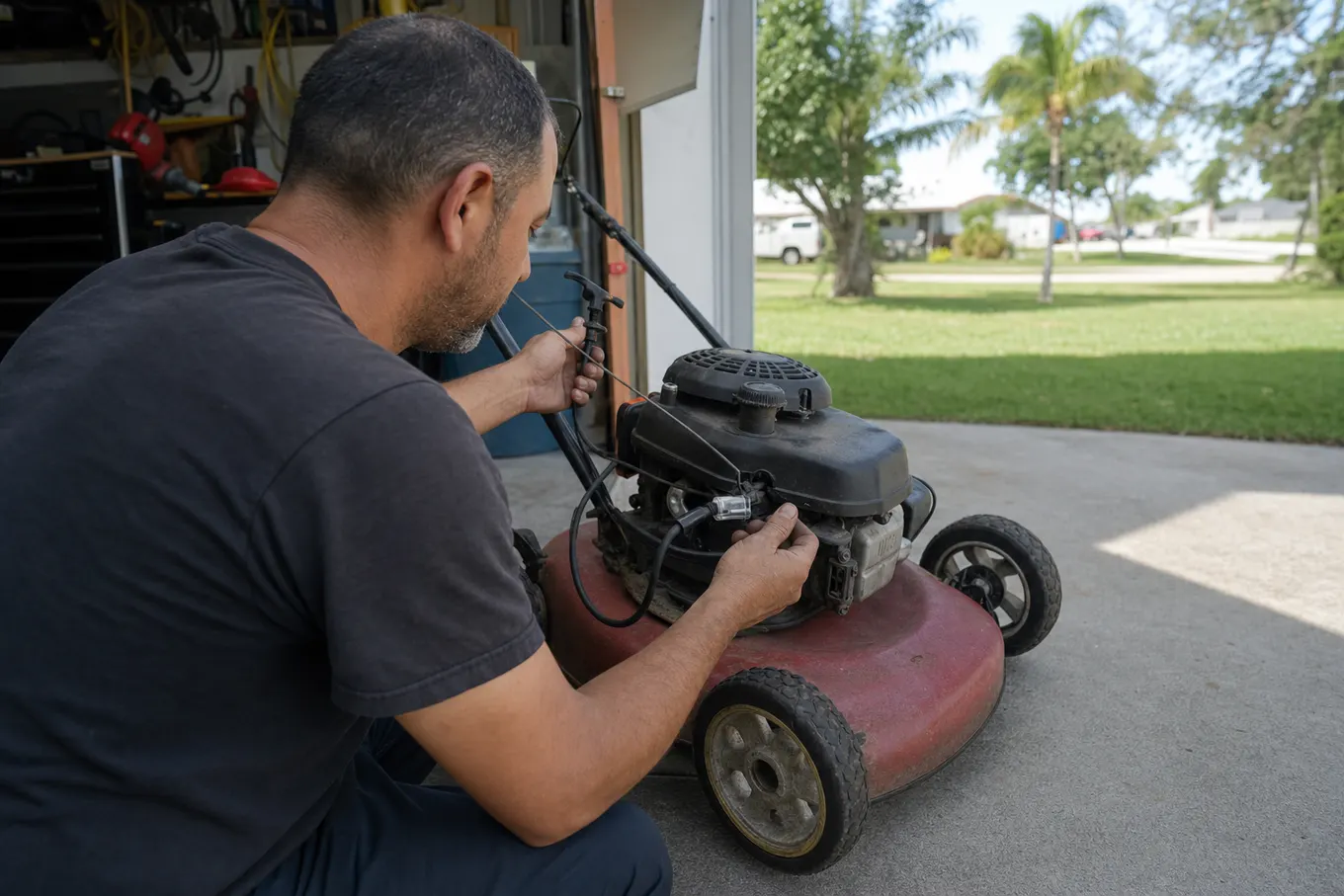
Lawn mower won't start? Joe's Small Engine Repair in Port Charlotte diagnoses every flavor of it: riding mowers that won't turn over, engines that crank but never fire, mowers that start then die, and machines that only fail when hot. We test in a fixed sequence, name the actual fault, and quote the fix before touching it. Dead machine and no trailer? Pickup runs across the whole area. Call or text (941) 555-0123.
Six Ways a Mower Refuses to Start, and What Each Sound Means
Before you open a single panel, answer one question: what happens in the first three seconds after you turn the key or pull the rope? That sound sorts your problem into one of six bins, and each bin has its own likely causes, its own safe driveway checks, and its own moment where continuing on your own starts costing money. Match your sound in the table, then open that section below. If your mower has performed more than one of these tricks lately, the history matters too: a machine that clicked last month and sits silent this month is narrating a battery or connection dying in stages, and telling us the sequence is as useful as telling us the symptom.
| What you get | Where it points | Section to open |
|---|---|---|
| Total silence when you turn the key or pull the bail | Power delivery or a safety interlock sitting open | Dead silence |
| One click, or machine gun clicking | Voltage starving the starter motor | Clicks only |
| Engine spins normally but never fires | Fuel, spark or compression missing | Cranks but will not fire |
| Fires right up, dies within seconds | Fuel delivery that cannot keep pace | Starts then dies |
| Starts cold, refuses to restart hot | A component failing only at temperature | Hot start trouble |
| Dies in thick grass, restarts after a rest | A marginal system exposed by load | Quits under load |
| Pull rope locked solid | Mechanical bind, packed deck or hydrolock | The do not do list, then call us |
Dead silence: the riding mower won't turn over, not even a click
What it usually is around here. Silence means the starter circuit never received the request. In Southwest Florida the list runs: a battery drained flat or aged out early by heat, terminals wearing that fuzzy green corrosion our salt air grows, a safety interlock switch sitting open, a blown main fuse, a failing ignition switch, or wiring chewed by the rodents that move into sheds after every storm season. Notice what is not high on the list: the starter motor itself. Total silence is almost always upstream of it.
Safe five minute checks in your driveway:
- Turn the key to the run position and look for signs of life: headlights, an hour meter, a fuel gauge. Dead everything points at the battery or its connections. Life plus silence points at the interlocks, fuse or switch.
- Sit squarely and fully on the seat, set the parking brake hard, confirm the blade engagement is fully off, and push the clutch or brake pedal to the floor. Then try again. Interlock geometry is fussier than people expect, and a shifted seat pan or a half set brake keeps the circuit open.
- Look at the battery terminals. Green or white fur, or a cable you can wiggle by hand, is a finding. Clean and snug beats corroded and loose every time.
- Find the inline fuse holder near the battery or under the dash and check whether the fuse is blown. Carry spares of the right rating, never a bigger one.
When to stop and bring it in. If the checks above change nothing, the fault sits in the interlock wiring, the ignition switch, the solenoid trigger circuit or the harness, and finding it means a meter, a wiring diagram and experience with where these machines corrode. Please do not arc across the solenoid with a screwdriver to force a crank. It works just often enough to be dangerous, it bypasses every safety in the machine, and it can weld contacts or start a mower that is in gear.
Shop note: a fuse that blows again after replacement is not a fuse problem, it is a short circuit announcing itself, and feeding it bigger fuses turns a wiring repair into a wiring fire. And if your mower lives in a shed, look for chewed insulation before anything else. Storm seasons push rats and mice indoors, mower harnesses are apparently delicious, and we rewire the evidence every year.
Clicks only: the solenoid answers but the engine never spins
What it usually is around here. A click means the request arrived and the solenoid closed, but the starter got too little current to turn the engine. One loud click per key turn usually means a big connection problem or a dying starter. Rapid chattering clicks mean the battery is so weak the solenoid cannot even hold itself closed. Florida context matters: heat is brutal on lead acid batteries, so they age out here faster than their labels suggest, and humid salt air corrodes the crimp inside a cable end where no one can see it. A cable can look perfect and conduct like a wet shoelace.
Safe five minute checks in your driveway:
- Put the battery on a proper charger overnight. A ten minute jump is not a test. If the battery will not hold a charge after a real charging cycle, you have your answer.
- Remove, clean and firmly reseat both battery terminals, then follow the negative cable to where it bolts to the frame or engine and clean that contact too. The ground side causes more click no starts than the positive side.
- With headlights on, turn the key. Lights that die completely during the click say big resistance or dead battery. Lights that barely dim while it clicks suggest the starter circuit beyond the solenoid.
- Smell for gas and check the oil level. An engine that is hydrolocked or full of fuel diluted oil can refuse to spin, and that is a tow to the shop, not a battery problem.
When to stop and bring it in. Fully charged battery, clean connections, still clicking: the remaining suspects are the solenoid, the starter, and voltage drop somewhere in the run, and separating them takes a meter under cranking load. Also stop if you have been cycling the key over and over. Repeated click attempts cook cables and solenoid contacts, and the damage spreads. Our electrical and starter service handles this exact chain every week.
Shop note: sustained heat shortens battery life well below whatever the label promised, so a battery that seems young by the calendar can still be done by Florida math. And a rider that needs a charger or a jump before every single mow is asking a second question: whether the engine's charging system is actually putting anything back while you cut. We test both sides, because replacing batteries into a dead charging circuit is a subscription, not a repair.
Cranks but won't start: strong spinning, zero firing
What it usually is around here. A cranking engine that never fires is missing one of the three ingredients of combustion: fuel arriving, spark at the right moment, or compression to squeeze the mix. In this county the rankings are lopsided. Stale E10 and a varnished carburetor take first place by a wide margin, with a fouled plug close behind. After that: a coil that quit, a flywheel key sheared by a blade strike you may not even remember, valve clearance drifted far enough to kill compression, or on riders, a kill circuit grounding the spark through a corroded interlock.
Safe five minute checks in your driveway:
- Answer the fuel age question honestly. If the gas is from last season, or you cannot remember, that is finding number one. Fresh fuel is the cheapest experiment in this hobby.
- Loosen the gas cap a turn and crank again. If it fires with the cap loose, the vent is plugged and you just solved it for pocket change.
- Pull the spark plug and look: wet means fuel is arriving and spark is suspect, bone dry means fuel is not arriving, black and crusty means it needed replacing anyway. Photograph it for us either way.
- Check the air filter. A filter soaked in oil from a tipped mower, or packed with debris, can block enough air to prevent starting.
When to stop and bring it in. Give it two or three honest cranking sessions and then stop. Endless cranking washes the oil off the cylinder, fouls the plug you just checked, drains the battery, and on riding mowers overheats a starter that was not built for marathons. If it pops or kicks back during cranking, stop immediately, because that is a timing or valve symptom and cranking into it risks damage. A no fire diagnosis at the bench is quick and definitive: spark tested under load, fuel delivery measured, compression read. Cranking in the driveway is none of those things. For the fuel side story, the carburetor page explains exactly what old gas does and how we reverse it.
Shop note: the first start after a long sit deserves extra patience even on a healthy machine, because the fuel that was waiting in the carburetor evaporated while it sat and the system has to refill before anything can fire. Several long, spaced pulls or key cycles with proper priming is normal. What is not normal is the mower that cranked happily last weekend and refuses this weekend with no sit in between. A sudden overnight no fire, especially right after mowing over something you heard, moves the sheared flywheel key way up the list.
Starts then dies: fires eagerly, quits within seconds or minutes
What it usually is around here. An engine that fires proves spark and compression exist, so this symptom is nearly always fuel arithmetic: the engine burns more than the system can deliver, runs through the small reserve waiting in the carburetor, and starves. The restriction hides in a varnished jet, a clogging filter, a collapsing line, a plugged tank vent, or on riders, an anti afterfire solenoid or tired fuel pump. A rarer cousin is ignition heat collapse, where a failing coil dies as it warms, but the rhythm differs: fuel starvation fades out gradually, coil failure cuts out like a switch.
Safe five minute checks in your driveway:
- Run it with the gas cap cracked loose. Longer run time with the cap loose convicts the vent, and a vented replacement cap ends the story.
- Try holding partial choke after it starts. If choke keeps it alive, the engine is telling you it is starving, and the carburetor circuits need professional cleaning, not another additive.
- If your fuel filter is clear plastic, look at it while cranking and running. No visible fuel movement, or a filter full of sediment, is a finding.
- Time the failure. Dies in ten seconds every time is bowl starvation. Dies at twenty minutes every time smells like heat or vent. Write the pattern down, it genuinely changes the diagnosis.
When to stop and bring it in. When the cap test and the choke test point at starvation, the fix lives inside the carburetor and fuel path, and opening those is shop work if you want it to stay fixed. The full anatomy of that repair, ultrasonic cleaning included, lives on our carburetor cleaning and repair page. If the choke test does nothing and the cutouts are sudden, mention that specifically when you call, because it points us at ignition instead and saves a step.
Shop note: the clock is a witness in this symptom. A mower that dies at nearly the same interval every time is describing something systematic, like a vent building vacuum or a bowl emptying at a fixed rate. A mower that dies at random intervals is describing something loose, like debris drifting on and off a jet or a connector making and breaking contact. Riders add two purely electrical impostors, a failing anti afterfire solenoid and a weak fuel pump, both of which imitate a dirty carburetor well enough to fool a parts counter. Timing notes from you shortcut all of it.
Starts hard when hot: fine every morning, dead every afternoon
What it usually is around here. Hot start failure is a heat soak problem, and Florida provides the heat for free. The classic culprits: an ignition coil whose internal connections open up as they expand, fuel percolating out of the carburetor bowl parked next to a baking engine block, valve clearances tightening as metal grows, or a cooling system so packed with clippings and sand that the whole engine runs far hotter than its design assumed. That last one matters doubly here, because our grass is wet, heavy and constant, and it plasters itself over cooling fins like papier mache.
Safe five minute checks in your driveway:
- With the engine cold and the plug wire off, look through the blower housing screen at the cooling fins. If you see a felt blanket of debris, you have found at least an accomplice.
- Check the oil level. Low oil runs hot, and hot is the whole disease here.
- For the hot restart itself: full throttle, no choke or primer, and give it a minute before trying. A percolation flooded engine wants air, not more fuel.
- Keep notes: how many minutes of mowing before it dies, how many minutes of rest before it restarts. Those two numbers are diagnostic gold.
When to stop and bring it in. When the pattern repeats despite a clean cooling intake and correct oil, the remaining suspects need bench instruments: a coil tested at temperature, valve lash measured, fuel delivery watched during a hot fail. This symptom embarrasses driveway mechanics because the mower always behaves after it cools, so bring us the failure notes and we will reproduce it here on purpose. Deliberately running a machine to failure is only a good idea when someone is standing there with instruments.
Shop note: you can also change the odds with scheduling. Mowing in the early morning instead of the mid afternoon keeps every component farther from its failure temperature, and parking a just worked engine in blazing sun invites the bowl to boil, so shade for the cool down helps more than it should. These are workarounds, not repairs, but they tell us something when they work: a machine that behaves at dawn and fails at three in the afternoon has drawn us a temperature graph of its own problem.
Runs then quits in tall grass: dies under load, restarts after a rest
What it usually is around here. Wet season St. Augustine and Bahia are heavy crops, and pushing a mower into them is a load test. Machines with a marginal system pass the driveway test and fail the yard test: a partly restricted fuel circuit that cannot feed full demand, a coil that dies only at load temperature, a deck packed so full of wet clippings the blades drag the engine down, or on riders, a seat interlock connector that disconnects for a millisecond every time the front wheel drops into a rut. That last one fools everyone, because the engine death is instant and total, then the mower starts right back up.
Safe five minute checks in your driveway:
- Sort the death. Fading, sputtering loss of power over a few seconds is fuel or heat. An instant cutoff like someone turned the key is electrical, usually an interlock.
- Note the terrain. Dies on the bumpy stretch or on slopes points at a switch or wiring bounce. Dies in the thickest grass regardless of bumps points at fuel volume or blade drag.
- With the key out and the plug wire pulled, scrape the deck underside. A packed deck is both a load problem and a cut quality problem, and clearing it is legitimate DIY.
- Check the air filter and the cooling intake screen. Load makes an air starved or overheating engine fail faster.
When to stop and bring it in. If a clean deck, fresh filter and calm terrain still produce cutouts, the remaining candidates want instruments: fuel flow measured against demand, ignition watched under load, interlock circuits wiggle tested with a meter. Belt and deck drag problems on riders have their own page at belt, spindle and deck repair. And if the mower quits in grass that is frankly taller than any mower should face, we will say that too, kindly.
Shop note: wet season technique protects marginal machines and healthy ones alike. Raise the deck a notch, slow the ground speed, overlap passes by half, and take the jungle in two cuts a few days apart rather than one heroic push. Bahia seed stalks in particular are wiry, fibrous things that wrap blades and pack decks, and a Saturday spent stalling through them costs more engine heat than two lighter passes ever would. The mower that dies in tall grass is often trying to survive a workload nobody would assign twice.
Safety Interlocks: The No Start Cause Nobody Suspects
A shocking share of mowers that will not start have nothing wrong with the engine. They are being stopped, on purpose, by their own safety system doing its job with faulty information. Understanding this system turns several mystery no starts into explainable ones.
Every modern mower is built around one grim scenario: a running blade and a person who is not at the controls. The interlock system exists to make that combination impossible. On a riding mower that means a switch under the seat that knows whether you are sitting, a switch on the brake or clutch that knows whether you could stop, a switch on the blade engagement that knows whether the deck is live, and on many machines a reverse switch that kills the blades when you back up unless you deliberately override it. On a push mower the same philosophy compresses into the bail, the spring bar you hold against the handle: release it and a brake stops the blade while the ignition grounds out.
The system works two ways, and the difference explains two different symptoms. Some switches sit in the cranking circuit and simply refuse to send power to the starter until conditions are met. That failure looks like total silence. Other switches act on the ignition side, grounding the coil to kill spark. That failure cranks beautifully and never fires, or kills a running engine the instant a switch loses its signal. One system, two disguises, and neither one looks like what it is.
Now add our climate. These switches and their connectors live in the worst neighborhoods on the machine: under the seat where rain pools, near the deck where sand blasts them, out in air that is salted and saturated year round. Contacts corrode, connector pins grow oxide, insulation chafes against vibrating steel. A seat switch that reads empty when a rut bounces the cushion, a brake switch that needs the pedal stomped twice, a PTO switch worn loose: each one produces a no start or a mid mow shutdown with a perfectly healthy engine attached. We test interlocks near the start of every electrical diagnosis precisely because they fail this often here, and because the test is fast when you have the wiring diagram and dead slow when you are guessing.
The system even tells you which switch is lying, if you listen to when the trouble happens. An engine that dies the instant you shift into reverse with the blades on is the reverse interlock speaking, working as designed or failing, depending on your machine's rules. A mower that dies the moment the blade engagement is pulled points at the PTO switch or the wiring around it. Cutouts on bumpy ground name the seat switch, the one component that physically bounces with you. A no crank that resolves only when you stand on the brake pedal with unusual force names a brake switch drifting out of adjustment. And a machine that starts only from exactly one seating position has a seat pan or plunger problem measured in millimeters. Bring us the when, and we will usually already know the which before the meter comes out.
One request from the people who will eventually work on your machine: when an interlock fails, fix it, do not defeat it. A bypassed seat switch does not just remove a safeguard, it hides the actual fault, and corrosion that ate one connector is already chewing the next one down the harness. The proper repair is usually a cleaned connector, a replaced switch or a repaired wire, none of which are expensive, and the details live on our electrical repair page. The blade under your mower turns fast enough to be unforgiving. Keep every layer between it and a mistake.
The Do Not Do List: How Dead Mowers Become Dead Engines
Most of the truly expensive repairs we see did not start expensive. They started as a no start that got treated with force, chemicals or bypasses. These are the moves to skip, and what each one actually costs.
Do not make starting fluid a habit
One short burst to answer one question, will it fire on outside fuel, is a diagnostic. Every use after that is abuse. Ether detonates rather than burns, slamming the piston with shock loads the engine never signed up for, and it rinses the protective oil film off the cylinder wall so metal rides on metal. The engine that needs the can every weekend has a fuel delivery problem that costs a fraction of the cylinder and ring damage the can is quietly causing. Fix the fuel, retire the can.
Do not keep cranking a flooded engine
A flooded cylinder cannot fire, and more cranking with more choke adds fuel to a problem made of fuel. The gas fouls the plug, washes the cylinder, and seeps past the rings until the crankcase oil is part solvent. Give it time with the throttle open and choke off, or pull the plug and let it air out. Patience costs nothing. Impatience here costs oil changes at best and bearing wear at worst.
Do not bypass, jumper or zip tie safety switches
Every season someone asks us to just bypass the seat switch, and every season we decline. The interlock system is the only part of the mower whose entire job is protecting bodies, and defeating it leaves a machine that will happily run its blade with nobody aboard. It also buries the real fault, which is usually a cheap connector or switch, deeper into the harness where it costs more to find later. We repair interlocks properly and quickly. That is the whole policy.
Do not force a pull rope that has gone solid
A rope that stops dead has a reason: a jammed blade, a deck packed with compacted grass, a cylinder hydrolocked with fuel or oil, or a seized engine. Three of those four can still be cheap. Heaving on the rope with your whole back can bend a crankshaft or snap internal parts, promoting a cleanup job into an engine replacement. Find the reason before applying force, and if the reason is not obvious, that is exactly what we are for.
Do not jump the solenoid with a screwdriver
The old trick of bridging the solenoid posts to force a crank skips every interlock in the machine, which means it can start a mower in gear with blades engaged, and the arc it draws can weld the very contacts you are testing. Professionals use a remote starter switch in controlled conditions with the machine verified safe. A flathead in a flowerbed is not that. If the mower only starts when jumped this way, the diagnosis is already half made, and finishing it properly is quick work for us.
Do not run cranking marathons
Starter motors on riding mowers are rated for short bursts with rest between, not sixty second sieges. Marathon cranking overheats the starter windings, cooks the solenoid, sags the battery and floods the engine, so the machine ends the session with more problems than it started with. Three good attempts is a diagnosis: it is not starting, and the reason will still be there after a phone call.
Do not start an engine whose oil smells like gasoline
If the dipstick reads above full and smells like the pump, fuel has been leaking into the crankcase, usually past a stuck carburetor float. That oil is diluted solvent, and running on it grinds bearings and cylinder walls in minutes. Do not start it even to test. Drain, fix the source, refill, and the engine forgives. Start it proud and mow the yard, and it may not. This one earns a spot on the list because the mower will often run fine right up until it very much does not.
Be careful with car jump starts
A riding mower battery is a small battery in a small system. If you must jump it from a vehicle, do it with the vehicle engine off, so the mower sees battery voltage rather than a running alternator's output and spikes. Better still, put the mower battery on a proper charger and learn what it tells you: a battery that will not take or hold a charge is a diagnosis, and jumping past it every weekend just wears out the rest of the starting circuit while you avoid the verdict.
How the No Start Puzzle Changes by Mower Type
The six symptoms above apply everywhere, but the machine underneath changes which suspects exist at all. A push mower cannot have a solenoid problem and a battery mower cannot have a carburetor problem. Here is how the playbook shifts across the four kinds of mowers in our service area.
Push and self propelled mowers: the rope tells the story
With no starter motor or battery on most walk behinds, the entire silent and clicking side of the chart disappears, and the recoil rope becomes your instrument panel. A rope that pulls with normal resistance and spins the engine puts you straight into the fuel, spark and compression questions. A rope that pulls with no resistance at all suggests the recoil is no longer engaging the flywheel, or something has let go inside. A rope that snaps back at you hints at ignition timing, which usually means the flywheel key. And the locked rope has its own entry in the do not do list above.
Walk behinds also carry the zone start system: the bail must be held before the engine can run at all, because releasing it both grounds the ignition and applies a brake to the flywheel and blade. A stretched bail cable or a misadjusted brake produces a mower that starts, drags itself down and dies, or one that never fires because the ignition stays grounded. It is a five dollar cable problem that looks exactly like an engine problem, and it is one of the first things we check on any walk behind no start. Everything else a walk behind might ask for is covered on the push mower repair page.
Riding mowers and lawn tractors: a small car's worth of electrics
Riders own the whole left side of the sound chart: batteries, cables, solenoids, starters, fuses, ignition switches and a full interlock suite. They also own a system nobody thinks about until it fails, the charging circuit. A stator and regulator quietly recharge the battery while you mow, and when that system dies, the mower keeps starting on borrowed capacity for a few weekends and then presents as a battery failure. Test the charging output, not just the battery, or the new battery meets the same fate.
Riders add fuel geography too: tanks mounted below the carburetor need a pump, lines run longer, and gravity stops being your assistant. And because the operator sits on top of the machine, the seat interlock sees more weather and more wear than any other switch. When a lawn tractor will not turn over, the answer lives somewhere on this longer chain, and chain order testing beats random part replacement by a wide margin. The machine side details are covered under riding mower repair.
Zero turns: lap bars, twin cylinders and commercial stakes
Zero turns run the same electrical logic as tractors with one twist that generates calls every week: the lap bars are part of the interlock system. On most machines the bars must be swung fully out for the engine to crank, and pulling them in with the parking brake off at the wrong moment kills everything. A zero turn that will not crank is sometimes a zero turn being operated in an order it does not accept, and we would rather explain that for free than sell a diagnosis.
Mechanically, the twin cylinder engines on these machines mean a rough runner can be a machine with one dead cylinder rather than a no start, and the fuel systems carry more plumbing: dual lines, pumps, and solenoids. Commercial owners feel every dead day in money, so zero turn no starts get honest scheduling talk up front. Full coverage of these machines lives on the zero turn repair page.
Battery mowers: a completely different kind of won't start
EGO, Ryobi, Greenworks and their cousins fail by different rules. There is no fuel to stale and no spark to lose. Instead the checklist reads: is the pack actually charged and fully seated, is the safety key or bail engaged in the right order, are the pack contacts clean, and is the machine in thermal protection. That last one is very Florida: a pack left charging in a hot garage or baking in the sun can refuse to run until it cools, and the mower reports it as blinking lights or nothing at all.
Our honest lane with battery machines: blades, decks, drives, wheels and hardware, plus straight advice on pack and electronics problems, which usually route through the manufacturer while under warranty. What we will not do is pretend a sealed pack is serviceable on a bench. If your battery mower will not wake up, call and describe the lights it flashes, and we will tell you plainly whether it is worth a trip here or a call to the brand first.
The Charlotte County No Start Calendar
After enough years at this bench you can predict the week's phone calls from the month on the wall. The causes of a dead mower here run on a schedule, and knowing the schedule tells you what your machine probably caught.
Late fall and early winter belong to the returning snowbirds. Mowers that sat from April to November come out of garages with fuel that aged all summer in the heat, batteries that self discharged flat and sulfated, and primer bulbs that sun rotted in place. The first cool morning of the season is our busiest phone day of the year, and the calls all start the same way: it ran perfectly when I left. It did. Then it sat through a Florida summer, which is the hardest thing you can ask fuel and a battery to do.
Spring brings the first flush of real growth and exposes every machine that half slept through our mild winter. Mowers that idled along cutting slow winter grass suddenly face thick spring blades, and the marginal fuel systems, tired plugs, and slipping components that survived light duty start failing under real load. This is also when procrastinated maintenance sends its bill: the oil that did not get changed and the filter that did not get replaced both charge interest, and a spring tune up is how the machines that skip the no start season do it.
The summer wet season is load season. Daily storms plus tropical heat put St. Augustine and Bahia into overdrive, and mowers work their hardest weeks of the year in the worst air of the year. Under load deaths, hot start failures and rain related electrical trouble all peak together, and machines that were only ever marginal get outed by August. It is also the season of mowing wet grass, which packs decks, strains belts and doubles engine load. If your mower dies mid yard in July, it has plenty of company.
Storm season aftermath is its own category. Yards fill with branches and debris, blade strikes shear flywheel keys, and cleanup mowing is brutal duty. Machines that stood in floodwater deserve a special warning: do not try to start a mower that has been under water, not even once. Water in the cylinder does not compress, water in the fuel will not burn, and water in the oil destroys bearings at speed. Drain and dry first, or better, have us go through it. After the storms that have rolled through this county, we have brought a lot of drowned machines back, and the ones that made it were the ones nobody cranked while wet.
The mowers that never appear on this calendar share a boring secret: fresh treated fuel, a battery kept charged through idle stretches, and a once a year date with a service bench. Our maintenance service exists to make machines miss the no start season entirely, and it costs a fraction of what the calendar charges the unprepared. Prevention is a slower way for us to make a living, and we recommend it anyway.
What a Shop Diagnosis Adds That Guessing Never Will
Everything above is pattern matching, and patterns get you to a likely suspect. Convicting the right part takes measurements, and measurements take instruments. Here is what actually happens to your no start at our bench, in terms of the evidence collected.
- Spark proven under load, not glanced at. An inline tester shows whether the coil delivers while the engine cranks against compression, which is the only condition that counts. Coils love to pass the casual test and fail the real one.
- Fuel delivery measured, not assumed. We verify how much fuel actually reaches the carburetor over time. A line that dribbles when it should pour convicts the upstream path before anyone blames the carb.
- Compression read in numbers. A gauge turns will not start into a figure we can compare against what that engine should make, accounting for the compression release systems that skew casual readings on many mower engines.
- Leak down when compression disappoints. Pressurizing the cylinder and listening tells us where the pressure escapes: hiss at the intake means one valve, at the muffler the other, at the crankcase the rings. That one test separates a valve adjustment from an engine conversation.
- Voltage drop hunted across the cranking circuit. Rather than replacing parts until the click goes away, a meter across each cable and connection during cranking shows exactly which link eats the current. The corroded crimp shows itself in seconds.
- Interlocks tested against the diagram. Each safety switch gets checked for function and for the intermittent failures that only show up under wiggle testing, because bounce induced cutouts never confess when the machine is sitting still.
- Heat failures reproduced on purpose. Machines that only die hot get run hot, with instruments attached, until they perform their trick for an audience that can catch it.
Why insist on instruments when the pattern already points somewhere? Because the pattern is right just often enough to be dangerous. The mower with year old gas and a textbook starvation story sometimes also has a coil on its way out, and cleaning the carburetor alone would have bought one good weekend and an angry phone call. Measurements catch the second fault hiding behind the first, and they catch the imposters, the interlock that mimics a coil, the solenoid that mimics a carb. Five extra minutes of testing is the difference between fixed and fixed until Saturday.
For the curious: most no starts that come through this door end up being fuel system problems, with electrical and interlock faults a strong second, ignition components third, and true internal engine failures the smallest group by far. That distribution is good news, because the common causes are also the affordable ones. Whatever yours turns out to be, the finding comes to you in plain words with a firm number attached, and nothing happens to the mower until you say so. When the fault does turn out to live deep in the engine, the small engine repair page explains how that conversation goes, including when we would honestly tell you to stop spending.
The Five Minute Checklist, and What to Tell Us When You Call
One rule stands over every check on this page: before fingers go anywhere near a deck or a blade, the spark plug wire comes off and the key comes out of the ignition. A mower engine can produce a partial turn of the blade from nothing more than being rotated with the plug wire attached, and that partial turn is all it takes. This costs five seconds, it is how professionals work on their own machines, and it is the one habit from this page we would ask you to keep even if you ignore all the rest.
With that said, here is the complete list of things worth trying before the phone call, all of them safe, reversible and free: confirm the fuel is actually fresh, loosen the gas cap and try again, check and clean the battery terminals, sit fully on the seat with the brake set and the blades off, check the inline fuse, pull and photograph the spark plug, and glance at the air filter and cooling screen. If one of those fixes it, we cheerfully lose the sale. It happens all the time and we keep recommending them anyway, because the customers we keep matter more than the ones we invoice this week.
When the list does not fix it, the phone call works best with six facts ready. Which of the six sounds you got: silence, clicks, cranking, fires then dies, hot only, or under load only. When it last ran normally. How old the fuel is, honestly. What changed just before the failure, like a blade impact, a rain storm, or a long sit. What you already tried. And a photo of the model sticker if you can find it, so parts research starts immediately. With those six answers, half the diagnosis is done before the mower leaves your yard, and the quote form has a place for every one of them.
Getting it here is the easy part. Walk behinds fit in most trunks with the handle folded. Dead riding mowers are what our pickup and delivery service exists for, since a mower that will not start is also a mower that will not load itself. And if you are not sure the problem is even worth pursuing on your machine, say so plainly. Whether a repair makes sense is a question we answer honestly every day, sometimes against our own short term interest, and the broader lawn mower repair page covers how we think about that math.
What happens after it arrives: the machine goes through the test sequence, you get a call or text with the finding in plain words and a firm price, and nothing beyond diagnosis happens until you approve it. If the news is good, most starting system repairs are same week work depending on parts. If the news is complicated, you get the options ranked with our honest recommendation, including the option of not fixing it. Either way you are never standing in the shop wondering what is happening to your mower, because the answer is a text message away.
No Start Help, Wherever the Mower Died
Mowers do not choose convenient places to quit. From our Port Charlotte shop we cover a 30 mile circle of driveways, and the towns below each have a page with drive times and drop off details. The rest are on the service area map.
Mower Won't Start FAQs
Why does my riding mower click once and then do nothing?
A single hard click is usually the solenoid slamming closed while the starter receives too little current to spin. The suspects, in order of likelihood and cheapness: corroded battery terminals, a weak battery, a bad ground connection, then the solenoid or the starter itself. Four cheap causes stand in line ahead of two expensive ones, which is why testing beats parts shopping every single time.
Is starting fluid bad for a lawn mower engine?
As a one squirt diagnostic tool, it has a place. As a Saturday morning ritual, it is slow motion engine damage. Ether ignites violently and early, hammering the piston, and it strips the oil film off the cylinder wall. A mower that only runs when fed from the can is being machined to death while the real problem, almost always fuel delivery, goes unfixed underneath.
How can I tell if my mower engine is flooded?
Your nose knows first: raw gas smell at the air filter or muffler after cranking. Other tells are a soaking wet spark plug and cranking that sounds progressively wetter and less willing. The cure is patience, not more choke: throttle open, choke off, let it clear, or pull the plug and give the cylinder time to breathe. Pushing more fuel at it only deepens the puddle.
Why does my mower backfire through the carburetor when I try to start it?
A pop back through the intake points at timing or valves: an intake valve held open by wide clearance or a sticking stem, or a flywheel key that sheared during a blade strike and let the ignition timing slip. It occasionally traces to a badly lean mixture. Either way, backfiring during cranking is a stop sign, not a keep trying sign. Something mechanical needs measuring.
My mower starts fine cold but will not restart once it is hot. What is that?
Heat soak failure. The usual actors are an ignition coil whose windings break connection as they expand, fuel boiling in the bowl next to a hot engine block, or valve clearances tightening up with temperature. It restarts twenty minutes later like nothing happened, which is exactly why it never misbehaves for the mechanic unless the mechanic heats it up on purpose. We do.
Can a bad gas cap really stop a mower from running?
Completely. The cap hides a small vent, and if dirt or corrosion seals that vent, the tank builds vacuum as fuel is used until flow stops. The signature is a mower that runs a stretch, dies, then happily restarts after sitting, since the vacuum bleeds off during the break. It costs nothing to test and almost nothing to fix, which makes it everyone’s favorite diagnosis.
I hit a root, the engine died, and now it will not start. What broke?
Very likely the flywheel key, a small soft metal peg that is designed to shear on blade impact so the crankshaft does not absorb the hit. With the key sheared, spark fires at the wrong point in the cycle: the result is no start, weak popping, or a starter rope that snaps back at your hand. The part is cheap by design, but replacing it means pulling the flywheel, and the blade, crank and deck should be checked at the same time.
I installed a brand new battery and the riding mower still will not turn over. Why?
Because the battery was not the broken link. New voltage changes nothing if the cables are corroded inside their insulation, the ground path is rusty, a safety switch is sitting open, or the solenoid has died. This is the most common wasted purchase in the mower world. A ten minute electrical test tells you which link actually failed before any more money leaves your pocket.
Why will my mower not start after it rained?
Water goes for ignition first. A cracked plug boot or a coil with aged insulation will leak spark to ground the moment humidity spikes, and rain through a vented cap contaminates the fuel. Riding mowers add soaked interlock connectors under the seat to the suspect list. If it lives outside through our summer downpours, the rain sensitivity is a symptom of something aging, and it is fixable.
What does it mean when the pull cord will not budge at all?
Stop pulling. Either the blade is locked against something solid, packed grass has seized the blade to the deck, the cylinder has filled with liquid and hydrolocked, or the recoil mechanism itself has failed. Heaving harder on a hydrolocked engine can bend the crank or break internals, converting a cleanup job into a replacement conversation. Find out which one it is before applying muscle.
Why does my push mower die the second I let go of the handle?
That is the deadman bail doing exactly what it was built for: release it and it grounds the ignition and brakes the blade in seconds. If it dies while you are still holding the bail, the cable may be stretched or the brake dragging, which is repairable. Tying the bail down permanently is the popular bootleg fix, and it removes the one safeguard between a spinning blade and a bad afternoon.
Can you tell me over the phone why my mower will not start?
We can get surprisingly close. Silent, clicking, cranking without firing, and firing then dying are four different roads, and the sound plus a little history narrows things fast. What we will not do is tell you to buy parts on a hunch. The final steps of any honest no start diagnosis are physical tests with the machine in front of us: spark under load, fuel delivery, compression.
What will it cost to find out why the mower will not start?
Finding the cause is the fast part for us, because the same test sequence runs on every no start instead of guesswork. You get the answer and a firm repair price before anything gets fixed, and the decision stays in your hands. The price itself moves with what failed, what parts cost for your engine, and how much disassembly stands between us and the broken piece.
My riding mower cranks strong but has no spark. Is the coil bad?
Possibly, but the coil is the last suspect to arrest, not the first. Riding mowers kill spark on purpose through the interlock circuit, so a corroded seat switch, a grounded kill wire, or a failing ignition switch imitates a dead coil perfectly. We isolate the coil from the kill circuit and test its output directly before anyone pays for one. A shocking number of replaced coils were never guilty.
Broader repair questions live on the main FAQ page. For the question specific to your machine, there is (941) 555-0123.
Tell Us Which of the Six Sounds You're Getting
Silence, clicks, cranking, dies after starting, hot only, or under load. One sentence about the sound plus how old the gas is, and the diagnosis is already moving. Quote first, your approval before any work, and pickup available if it will not load itself.
- Fixed test sequence finds the real fault
- Firm price in your hands before repairs
- Faster by phone: (941) 555-0123