Zero Turn Mower Repair in Port Charlotte, FL
A zero turn exists for one reason: to cut a lot of grass in very little time. When the hydros fade, a spindle screams or half the deck stops cutting, that speed advantage becomes an expensive lawn ornament. We repair drive systems, decks, clutches and the twin cylinder engines on top, for homeowners with big lots and crews with routes to run.
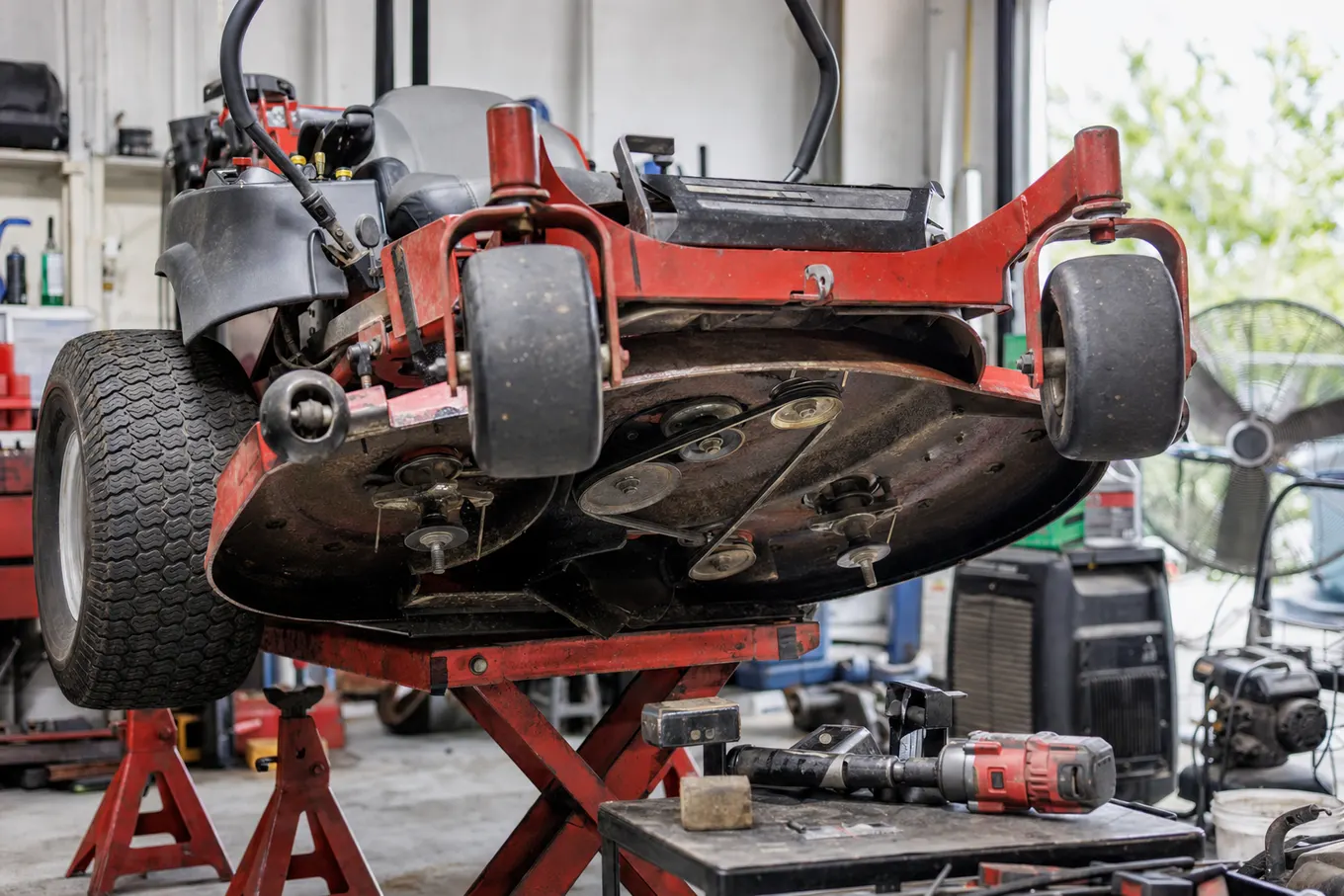
Zero turn down and grass still growing? Joe’s Small Engine Repair in Port Charlotte works on hydrostatic drives, tracking and lap bar linkage, deck spindles, electric PTO clutches and the Kawasaki, Kohler and Briggs & Stratton twins that power them. Residential machines and commercial rigs both welcome, every job quoted for your approval before work begins, and job site pickup available across our 30 mile area. Call or text (941) 555-0123 and describe what it is doing.
What We Repair on Zero Turn Mowers
A zero turn packs more specialized hardware than any other mower: two independent hydraulic circuits, a heavy fabricated or stamped deck spinning three blades, an electric clutch, and a twin usually rated in the twenties of horsepower. Here is the map of what we work on. Steering wheel machines live on the riding mower page instead.
Hydrostatic drive circuits
Pumps, wheel motors, drive belts, bypass valves, oil and filter service where fitted. Weak sides, hot fade, whine, no drive: the whole family of hydro complaints.
Lap bars, linkage and tracking
Machines that pull, lurch, wander or refuse to run straight with both bars buried. Dampers, pivots, control arms and proper tracking adjustment.
Spindles, pulleys and deck hardware
Screaming bearings, chewed belts, bent blade paths and cut quality problems, detailed further on the belt and deck page.
Twin cylinder engines
Kawasaki, Kohler, Briggs commercial twins: valve lash, carburetion, cooling, charging, one-side-down diagnosis and rebuild or replace calls.
Electrical and safety interlocks
PTO circuits, seat and bar switches, batteries and charging. Zero turns will not even crank unless the interlocks agree, and corrosion makes them disagree.
Blades and cut quality
Sharpening, balancing and blade selection for sand country, because a commercial deck with dull steel cuts like a cheap one.
Deck and belt failures get their own deep treatment on the belt, spindle and deck page, and engine internals on the small engine page. Everything below is the zero turn specific story.
Eight Zero Turn Symptoms, Translated
Zero turns communicate clearly once you know the language. Before you call, match what yours is doing against this list, because the right two sentences on the phone can shave a day off a diagnosis.
- Pulls to one side at full stick. Tire pressures first, tracking adjustment second, actual hydro wear a distant third. Cheap explanations dominate this one.
- One lever feels lazy or numb. Linkage, pivot bushings and the damper on that side, before anyone says the word pump.
- A whine that climbs with ground speed. Low or aerated hydro oil, or a unit crying about internal wear. Worth hearing early, expensive to ignore.
- Strong at 9 am, weak by 10. Heat fade: cooling fans, packed debris, aged oil. The most Florida symptom on the list.
- Deck screams at engagement. Idler bearing, clutch air gap or a belt one hot afternoon from failure.
- A ridge or mohawk down every pass. Blade rake and deck pitch are off, or the center spindle is wearing. Geometry, not engine.
- No crank with the bars in. Correct behavior, that is the neutral interlock. No crank with the bars out and brake set is a switch or battery conversation.
- Vibration you feel through the floor pan. Blade balance or a spindle bearing, and every hour you run it shortens something else's life.
How Hydrostatic Zero Turn Drives Work, and How They Fail
A zero turn has no steering wheel because it has no steering system. It steers with its drives: two separate hydraulic circuits, one per rear wheel, doing what a rudder, a throttle and a gearbox would do on anything else. Understand that and every zero turn symptom starts making sense.
Two pumps, two wheel motors, zero turning radius
Behind the seat sit two hydraulic pumps, both spun by a single belt off the engine. Each pump feeds its own wheel motor, and each lap bar tilts the swashplate inside its pump to command flow forward, backward or nowhere. Push both bars evenly and both wheels turn the same speed: the machine runs straight. Push one bar further and that wheel outruns the other: the machine arcs. Pull one back while pushing the other and the wheels counter-rotate, pivoting the mower inside its own footprint. That last trick is the entire sales pitch, and it works because the two circuits are completely independent.
Independence has a diagnostic gift inside it: each side is a witness against the other. A symptom on one wheel with the other healthy points at that circuit's pump, wheel motor, linkage or tire. A symptom on both wheels at once points at what they share, which is the drive belt, the oil supply on common reservoir systems, or the engine itself. Half of zero turn drive diagnosis is just deciding which of those two categories you are in.
Failure signs, ranked from cheap to expensive
Not every drive complaint is a dying pump, and the cheap causes outnumber the dear ones. At the friendly end: low or uneven tire pressure, which steers a zero turn more than owners believe, and tracking adjustment, which drifts over time and makes a healthy machine pull sideways at full stick. One rung up: the pump drive belt and its tensioner, which weaken with heat and load until takeoff feels lazy on both sides.
The middle of the ladder is linkage: worn damper, sloppy pivots, a control arm loose on the pump shaft. These make the machine jerky, vague or unwilling to hold neutral, and they cost hardware money, not hydraulics money. Near the top: oil that has aged out on serviceable systems, letting everything work but nothing work well. And at the expensive end: genuine internal wear, a pump or wheel motor that has scored its running surfaces and cannot hold pressure when hot.
The ladder is also our diagnostic order. We climb from cheapest to dearest and stop at the first rung that explains your symptom completely. Nobody should buy a pump because their tire was soft.
Heat: the hydro killer that Florida sharpens
Every hydrostatic system fights heat, and Southwest Florida stacks the deck. Ambient air in the mid nineties gives the oil a hot starting line. Wet season grass loads the drives hard for the entire mow. And the machine spends its life inches above ground that reflects heat back up at the pumps. Hydraulic oil that runs consistently hot oxidizes, thins and loses the film strength the rotating parts depend on, so wear accelerates quietly, mow after mow.
The system's only defenses are airflow and oil condition. Each pump wears a cooling fan, and those plastic fans lose blades to sticks and shed clippings until half the cooling is gone with nothing looking obviously wrong. Debris mats around the pumps hold heat in like a jacket. When we service a zero turn, fans, fins and the airspace around the hydros get cleaned and inspected as seriously as the engine's cooling, because down here the transmission's temperature is a maintenance item.
You can help for free: mow the heavy stuff earlier in the day, blow the drive area clean when you do the deck, and let the machine idle a few minutes after a brutal cut instead of hard shutdown. Oil temperature falls fast at idle, and the pumps appreciate it.
Oil service: reading past the phrase maintenance free
Zero turn drives come in two architectures. Commercial machines typically run separate pumps and wheel motors fed from a reservoir, with filters and published change intervals, a system designed around the assumption of service. Residential machines mostly use integrated transaxles, pump and motor sealed into one housing, and the paperwork often calls the fill permanent.
Permanent is doing a lot of work in that sentence. It means the factory expects the fill to survive the unit's designed duty: a suburban lawn, a moderate climate, a few dozen hours a year. Run that same unit on a Florida acre at ninety degrees and the oil ages on a different calendar than the brochure imagined. Where a drain and fill exists, we recommend using it on the hour schedule or earlier. Where the unit is truly sealed, we say so honestly and put the effort into what can be controlled: belt condition, cooling, load habits.
If you do not know which architecture you own, the model tag on the transaxle settles it in seconds, and checking is free when the machine is here for anything else.
Air in the circuit: why purging matters after any hydro work
Hydraulic drives assume solid oil, and air is the saboteur. Any service that opens the system, even just a fluid change, leaves air pockets that make the drive jumpy, weak or noisy until they are purged out. The symptom set is distinctive: a machine that surges and hesitates unpredictably right after work was done, or chatters in one direction, or needs a minute of operation before the drives wake up.
Purging is a specific procedure, not a hope. Wheels off the ground, bypass valves set, the controls cycled through forward and reverse in a set pattern until the oil runs solid and the response turns crisp, then the level rechecked because purged systems swallow oil. It takes patience more than genius, and skipping it is the signature of hydro work done in a hurry. Every drive we touch leaves on solid oil, full stop.
Bypass valves: moving a machine whose drives have quit
Somewhere on or near each pump lives a bypass valve, a lever or knurled rod that opens an internal passage so oil can circulate freely and the wheels can turn without hydraulic resistance. It exists for exactly one scenario: moving a machine that cannot move itself. Open both valves and a dead zero turn rolls like a heavy wagon, onto a trailer, out of the rain, off the customer's lawn. Closed, the same machine fights every inch and makes two strong adults look foolish.
Three field notes worth keeping. First, learn where yours are before the day you need them, because the manual is never nearby when a mower dies at the far fence line. Second, bumped or half closed bypass valves cause a respectable share of no drive phone calls all by themselves, so make them your first check, not your last. Third, bypass is for pushing short distances, not for towing behind anything with an engine: dragging a hydro machine at speed spins its internals without proper lubrication circulation and can ruin the exact components you were protecting. Push it, roll it, winch it gently. Never tow it.
Rebuild or replace: the honest math on pumps and wheel motors
When a circuit has real internal wear, there are three roads. Seal and gasket work, worthwhile when the failure is leakage and the running surfaces still measure healthy. Component replacement, a fresh pump or wheel motor, which is the usual answer on commercial machines because the parts exist separately and the rest of the system has life left. Or complete transaxle replacement on integrated residential units, where opening the housing costs more labor than the internals are worth.
Which road makes sense depends on the machine under the repair. A commercial rig with a strong engine and a straight deck justifies real hydraulic money, because its replacement cost is enormous and its chassis is designed for decades. An entry level machine with a tired deck may not justify the cheapest road. We lay the numbers side by side, tell you what we would do with our own money, and let you drive the decision. The quote comes before the work, always.
Pump Belts and Deck Belts Fail Differently, and It Matters
Most zero turns run exactly two belts, and confusing them costs people money at the parts counter every week. The pump drive belt loops from the engine crankshaft back to both hydro pump pulleys, usually with a spring loaded idler keeping it honest. The deck belt runs from the electric clutch out to the spindles. Same rubber, completely different lives, completely different symptoms when they fail.
A dying pump belt announces itself in the drive: sluggish response on both sides at once, a machine that creeps at full stick after twenty hot minutes, a squeal from behind the seat on engagement, and in the final act, an engine that runs beautifully attached to a mower that will not move at all. Because it drives both pumps together, it produces symmetrical symptoms, which is the clue that separates it from genuine hydro trouble on one side.
A dying deck belt tells its story in the cut: blades that engage with a screech, stall in the thick stuff, throw the belt entirely on a hard turn, or leave a smell of hot rubber hanging over a lawn that suddenly looks mowed by someone in a hurry. Deck belts also die of murder as often as old age, killed by seized idlers, dragging spindles and debris packed pulleys, which is why we autopsy the old belt before fitting the new one. The wear patterns on a dead belt read like a map of what touched it.
One buying note from the bench: belt quality varies enormously, and the bargain belt that fits is not the belt the deck was engineered around. Original spec belts carry the right cord package and length tolerance for the clutch and tension system, and on a commercial deck spinning all day, that difference is measured in weeks versus seasons. We fit belts that match the machine's duty, and the details live on the belt and deck repair page.
Why Your Zero Turn Pulls, Lurches or Wanders
The lap bars are the only conversation you have with a zero turn, and when that conversation goes bad the whole machine feels broken even if the hydraulics are perfect. Between your hands and the pumps sits a chain of pivots, rods, return springs and usually a damper per side, small hardware that carries every command you give. Commercial machines vibrate that hardware for a thousand hours. Residential machines let it rust between weekend mows. Either way, slop arrives.
The complaints sort cleanly. A machine that pulls to one side at full stick has a tracking disagreement: one pump is being commanded slightly harder than the other, and a tracking adjustment realigns them, after tire pressures are equalized, since a low tire fakes the same pull. A machine that lurches on takeoff or feels like a light switch instead of a dial usually has tired dampers, the little shock absorbers that turn your hand motion into a smooth ramp. A machine that hunts and wanders at cruise often has worn pivot bushings letting the bars drift around neutral. And bars that will not return to neutral cleanly, or that need different effort left versus right, point at bent linkage or a control arm slipping on its pump shaft.
There is a safety layer in this hardware too. The bars swung outward is how most zero turns declare neutral, and switches under that motion decide whether the engine may crank at all. A machine that will not start with the bars in, or dies when they move, is behaving correctly. A machine that will not crank no matter what may just have a corroded interlock switch, which is a five minute find on the electrical bench and a long afternoon of guessing anywhere else.
None of this work is expensive by zero turn standards, and the payoff is out of proportion to the invoice. An afternoon of linkage, dampers and a proper tracking set turns a machine you fight into a machine you steer with two fingers, which is what you paid for in the first place.
Casters, Seats and the Hardware That Rattles Loose
Nobody brags about caster wheels, and then a flat spotted caster ruins every stripe on the lawn. The front casters on a zero turn swivel freely by design, which means their bearings, both in the wheel and in the vertical pivot, do constant work with zero attention. When a caster bearing dries out or a tire develops a flat spot, the deck bounces in rhythm and the cut picks up a scalloped wave that owners chase through blades and belts before anyone looks down at the little wheel causing it. Caster tires also lose pressure quietly, and on pneumatic versions a few missing pounds up front changes deck pitch enough to see in the grass.
The seat earns a mention for two reasons. On commercial machines it is suspension hardware protecting your spine for a thousand hours a year, and its bushings and springs wear like any other part. On every machine it hides the operator presence switch, and a corroded or misadjusted seat switch produces the great zero turn mystery: a mower that dies when you hit a bump, or will not start for the lighter member of the household. We test it in minutes, and we never bypass it.
Around all of that sits the hardware a vibrating machine works on constantly: anti scalp rollers that wear through their brackets, discharge chutes that crack and get zip tied up, and the dozens of fasteners a season of mowing loosens. Part of any serious service here is simply going around the machine with wrenches, because the cheapest failure is the bolt that never got the chance to leave.
Deck Spindles Under Commercial Loads
A zero turn deck is a factory floor. Three spindles spinning blades at full rated speed, hour after hour, through grass that is wet at the bottom and sandy all the way up. The spindle bearings carry all of it, and on a commercial machine they accumulate more work in one season than a homeowner deck sees in five. When people say a zero turn cuts beautifully, they are complimenting spindles that are still round.
Sand is the local tax. Every pass pulls fine grit up into the airflow under the deck, and grit finds bearing seals with a homing instinct. Once inside, it laps the races a little every hour. The progression is reliable enough to schedule around: first a note in the deck's hum that was not there last month, then a bearing that feels warm through the housing after mowing, then blade wobble you can see in the cut, then the loud ending that takes the belt and sometimes the housing with it. Where you interrupt that sequence decides the size of the invoice.
- New noise from the deck that changes with blade speed is a spindle asking politely. It does not ask twice for long.
- Grab each blade end and rock it. Any perceptible knock at the spindle means bearing clearance where none should exist.
- Heat after mowing. A housing too hot to hold five minutes after shutdown is a bearing running dry or contaminated.
- Belt dust and glaze around one pulley often means that spindle is dragging and eating the belt to hide it.
Maintenance depends on what your deck offers. Greaseable spindles want the gun often in sand country, gently enough not to blow the seals. Sealed spindles trade grease for eventual replacement, so listening becomes the maintenance. Either way, blade balance is part of spindle life: a blade that came back from a rock unbalanced hammers the bearings with every revolution, which is why our sharpening service balances rather than just grinds, and why chronic spindle eaters get a hard look at the whole rotating assembly on the deck hardware bench.
Slopes, Water Edges and Zero Turn Safety Equipment
A repair shop sees the aftermath of physics, so permit us the serious section. Zero turns steer with their rear wheels, which means on a slick slope they do not understeer like a tractor, they let go all at once, and our landscape is quietly full of the exact slopes that matter: canal banks, retention pond edges, swale walls and the damp shaded strips beside seawalls. A machine that feels planted on dry flat grass becomes a sled the moment gravity and wet turf agree, and the water is always downhill.
The equipment on the machine takes this seriously, and so should its owner. The rollover bar on the back is not decoration, and it protects nothing when folded flat and forgotten, which is how most of them cross our lot. Run it up wherever clearance allows, and wear the seatbelt when the bar is up, because the bar and belt are a system that only works together. The interlocks, seat switch, neutral switches, PTO logic, are the other half of the safety package, and we repair them to factory behavior rather than around it. A machine that arrives with a bypassed switch leaves with a working one.
Operating advice from people who fix the consequences: mow slopes at the dry time of day, keep a mower's width or more between you and any water edge and finish that strip with a trimmer, and treat freshly rained on inclines as tomorrow's job. String trimmer labor is cheaper than any outcome a pond edge offers. None of this is legal fine print. It is the accumulated opinion of a bench that would rather sharpen your blades for years than meet your machine the other way.
Twin Cylinder Engine Service on Zero Turns
Nearly every zero turn carries a V-twin, because spinning a wide deck and two hydro pumps at once takes real power. Twins are smooth and durable, and they bring their own repair personality: two of everything that sparks, and new ways for half an engine to quit while the other half soldiers on.
The twins we see all week
The engine decals rotate through a short list. Kawasaki FR and FS twins on a huge share of prosumer and commercial machines, with FX above them on the serious rigs. Kohler twins across the Cub Cadet, Husqvarna and Toro universes. Briggs & Stratton twins, including their commercial line, on everything from entry zero turns up. Honda twins appear here and there. The architecture barely changes: air cooled ninety degree V-twin, overhead valves, one carburetor or EFI system feeding both cylinders, a charging stator under the flywheel.
That consistency is good news for repair. Parts support is deep, the failure patterns are well mapped, and a shop that lives inside these engines, which is what a mower only shop is, can move through them without relearning anything. Whatever badge is on the shroud, the diagnosis discipline is identical: prove which cylinder, prove which system, then fix the cause instead of the echo.
Finding the dead side: how a twin hides a failed cylinder
A twin with one cylinder down does not stop. It shakes, smells rich, loses its punch in thick grass and backfires through the muffler, but it keeps running, and owners often mow on it for weeks. The rough idle that smooths out at full throttle, the exhaust popping on deceleration, the power that feels like half: these are one-lung stories.
Confirming which side and why is quick, methodical work. Pull each plug and read it, since a wet black plug and a clean tan one tell the tale instantly. Check spark per cylinder, because coils fail one at a time, and heat soaked coils fail only when hot, which is why the machine cuts out twenty minutes in and restarts fine after lunch. Compression per cylinder settles whether the problem is ignition, fuel distribution or mechanical. The point of the sequence is precision: a coil is an easy afternoon, a burned valve is a deeper conversation, and they present almost identically from the seat.
Valve lash: the maintenance item nobody was told about
Overhead valve twins specify periodic valve clearance checks, and almost nobody does them until a symptom forces the issue. The classic one is hard starting, especially hot: many of these engines rely on a compression release that works correctly only when the valves are in adjustment, so lash that has drifted turns the starter's job miserable. Owners hear a starter dragging and buy batteries and starters when the engine actually needed four feeler gauge settings.
Drifted lash also costs power, mileage on the fuel tank and, in the worst case, a valve that no longer seats fully and starts burning. A lash check is quiet, unglamorous work with the valve covers off, and it belongs in the periodic service of any twin that starts hard, runs hot or has simply never had it done. We fold it into tune up work on these engines whenever the hours call for it.
Fuel systems on twins: carburetors, EFI and Florida gas
A twin's carburetor is one body with two outlets, so most fuel problems hit both cylinders evenly: surging at governed speed, starving under load, refusing to idle. Our ethanol blend fuel gums these carbs exactly the way it gums every other mower carb in the county, just with more expensive consequences, and the fix is the same discipline of cleaning, rebuilding or replacing described on the carburetor page. Twins add a few of their own tells, like an intake manifold gasket leak leaning out one cylinder only, which reads as a mystery misfire until you test for it.
Newer commercial twins increasingly run electronic fuel injection. EFI solves the varnish problem and starts beautifully, and when it acts up it asks for diagnostics rather than guesswork. We are straight with you about that boundary: mechanical, electrical and sensor level work we handle; deep proprietary programming belongs at a dealer with the factory software, and we will say so rather than bill hours poking at it.
Charging systems: why zero turn batteries live hard lives
A zero turn asks more of its electrical system than any other mower. The starter turns a big twin against real compression, the electric clutch drinks steady current the entire time the blades spin, and on many machines lights and accessories sip alongside it. Feeding all of that is a stator under the flywheel and a regulator rectifier that converts its output, and when that pair falls behind, the battery quietly becomes the donor, draining a little every mow until one morning the machine just clicks.
This is why we treat a dead battery on a zero turn as a symptom until proven otherwise. A five minute check with the engine running tells us whether the charging system is actually replacing what the clutch and starter withdraw, and it regularly catches regulator failures that would have killed the brand new battery in a month. Heat shortens battery life here regardless, but a battery that dies young and repeatedly is almost never bad luck. It is arithmetic, and the meter does not lie. The full battery and charging story lives on the electrical repair page.
Keeping a twin alive in the heat
Everything hard about Florida for a single cylinder engine is doubled on a twin: two cylinders' worth of cooling fins to pack with debris, a bigger appetite for clean air in sandy conditions, and oil working across a wider, hotter engine. The cooling path matters most. These engines pull air through a rotating screen and blow it across the fins under the shrouds, and a screen matted with Bahia seed heads or shrouds packed with clipping felt will cook an engine while the outside looks clean.
The survival kit is boring and effective. Oil and filter by the hour meter, not the calendar. The air filter checked monthly in season and replaced without sentiment. The intake screen and cooling fins actually opened up and cleaned, not just blown at from a distance. And fuel that is fresh, stabilized or both. Machines that get this treatment run the thick of August without complaint. Machines that do not become our twin cylinder case studies.
Residential and Commercial Zero Turns Are Different Machines
They look alike in a parking lot and share almost nothing under the plastic. Knowing which class you own changes maintenance, repair math and what advice you should trust, so here is the honest comparison.
Residential zero turns
- Toro TimeCutter, Cub Cadet Ultima, Husqvarna Z200 class, Ariens, John Deere Z300 class and similar.
- Integrated sealed transaxles sized for suburban lots and gentle hours.
- Stamped steel decks, lighter spindles, single layer construction.
- Twins tuned for value: fine engines that want disciplined maintenance.
- Repairs priced against a moderate replacement cost, so each big repair gets a genuine worth-it conversation.
Commercial zero turns
- Scag, Exmark, Gravely, Bad Boy, Hustler, Ferris and the fleet grade lines of the big brands.
- Separate pumps and wheel motors with reservoirs, filters and published service intervals.
- Fabricated welded decks, heavy greaseable spindles, bigger everything.
- Commercial rated Kawasaki, Kohler and Briggs twins, often with oil coolers and canister air filtration.
- Repairs priced against a very high replacement cost, so repair wins almost every time on a straight frame.
Why it matters at our counter: the same symptom leads to different advice by class. A weak drive on a commercial machine points to a serviceable circuit worth real investment. The same weakness on a residential unit gets weighed against the value of the whole mower, with the numbers on the table. And if you are a homeowner cutting serious acreage on a residential machine, we will tell you what that duty is doing to it and what the maintenance schedule needs to look like to keep the arrangement working. Ask us before you buy your next one. We see the insides of all of them, and the insides do not lie.
Zero Turn Brands on Our Lift, and What the Patterns Say
Work on enough zero turns and the brands stop being marketing and start being data: which parts arrive overnight, which units are built to open up, which machines come in worked to death versus rusted from neglect. Here is that data, translated into plain advice.
The commercial iron: Scag, Exmark, Gravely, Ferris, Hustler, Bad Boy
Commercial zero turns come to us worn, almost never broken by design. Their owners run them the way airlines run planes, and the machines are built for it: fabricated decks you could stand a truck on, greaseable spindles the size of coffee cans, pumps and wheel motors that unbolt as individual components. What they need from us is honest wear management at high hours: spindle bearings, clutches, pulleys, seals, the occasional pump, and engine work when the meter gets deep into four digits.
The repair math on these machines is friendly because everything is replaceable and the frames essentially do not die. A crew machine with a straight frame and a strong engine justifies nearly any repair on the menu, and the brands support that logic by selling every bearing, seal and lever separately. If you bought one of these used for home acreage, you bought well, and we will keep it going for a very long time.
The residential wave: TimeCutter, Ultima, Z200 series and friends
Toro TimeCutters, Cub Cadet Ultimas, Husqvarna's Z200 line, Ariens and John Deere's residential Z machines put the zero turn experience within homeowner reach, and around here they sold by the thousand. On suburban lots doing suburban duty they hold up well, and most of what we see from them is ordinary: belts, blades, batteries, carburetors, the occasional caster bearing and seat switch.
The pattern worth knowing appears when these machines work above their class. An entry zero turn mowing two sandy acres of summer Bahia accumulates commercial wear on residential components: integrated transaxles fading young, stamped decks flexing at the spindle mounts, spindle bearings cycling through faster than the owner expects. The machines are not bad. The duty is mismatched, and our advice usually focuses on maintenance rhythm and load habits that close the gap.
Parts support: the quiet difference between badges
Two zero turns can fail identically and produce very different repair experiences, and the difference is parts philosophy. Commercial brands publish exploded diagrams and sell components down to the individual bearing race. Some residential lines sell assemblies instead: not the bearing but the whole spindle, not the seal but the whole transaxle. The assembly approach simplifies manufacturing and sometimes even makes repairs faster, but it moves the invoice, and it can turn a small internal failure into a large part number.
This is why two quotes for the same symptom can differ honestly between machines, and why we always price from your exact model number rather than from the symptom alone. When an assembly only design meets a marginal machine, we say so plainly, because that combination is where repair math goes to die and where our fraction of replacement rule earns its keep.
Shopping for acreage? How we would think it through
People ask us what to buy more often than any review site would believe, and the shop's answer ignores the badge and reads the build sheet. Deck construction first: fabricated steel for rough or sandy acreage, stamped for manicured lawns. Transmission architecture second: separate serviceable pumps and motors if the hours will be serious, integrated units if they will not. Engine family third, with a bias toward the commercial rated twins whose parts we stock logic around. And spindles you can grease beat spindles you cannot, every time, in sand country.
Then the question nobody asks: who will fix it, and with what parts, in year six? A machine with deep parts support is worth a premium here, because every machine eventually becomes its parts availability. Buy the one that will still be repairable when it has earned its first big repair, and you will own it happily for decades. Ask us before you sign anything. The advice costs nothing and comes from the inside of every brand you are considering.
Lawn Crew Zero Turn Repairs: Triage, Not a Waiting Line
Around here the mowing season never closes, which means a lawn crew's zero turn has no off season to break down in. Every day it sits is a day of routes shuffled, customers called and money not made. We are a lawn mower only shop, which sounds like a limitation until your livelihood is on the trailer: the bench is not backed up behind boat motors and pressure washers, and the parts thinking is mower parts thinking all day long.
Here is how to get the fastest honest result when a work machine goes down. Call before you drive and say it is a commercial machine, because that changes how we slot the diagnosis. Describe the exact symptom and when it appears: weak left side when hot is a better sentence than transmission problems. Bring model and engine numbers, or text photos of the tags to the shop line, so parts lookups happen while the machine is still rolling toward us. And if the machine cannot be trailered right now, the pickup service grabs it from a job site or your yard while your crew keeps working with whatever still runs.
What we will not do is make promises the parts supply cannot keep. If the fix is a belt, a clutch or linkage, that is usually fast. If it is a backordered pump, you will know immediately, along with any workable alternatives. Straight information beats a cheerful guess every time when a route list is at stake. That way of operating is the whole personality of this shop, for crews and homeowners alike.
The cheaper strategy is to stop meeting us in emergencies. Commercial machines publish hour based service schedules, and a standing maintenance rhythm through the shop, oil, filters, blades, belts, spindle grease, hydro service where fitted, catches most failures while they are still cheap and scheduled instead of expensive and sudden. Crews that service on schedule call us less, which is fine by us. There are always more zero turns.
The Zero Turn Year on the Gulf Coast
A zero turn in Southwest Florida never gets a winter off, but its year still has chapters, and each one stresses different parts of the machine. Planning around them is the difference between choosing when your mower gets worked on and having the choice made for you.
March through May is the ramp. Growth accelerates weekly, irrigated St. Augustine wakes up first, and every weakness the machine carried quietly through the dry months gets amplified. This is when a belt that was marginal becomes a belt that is gone, and when the smart owners and crews have already had their machines through the bench, because the queue is short and the parts shelves are full.
June through September is combat. Daily storms mean mowing between rains, often on grass that never fully dried, and wet cutting loads decks, packs shells and doubles what the hydros and belts carry. Blades dull faster in wet sandy growth, clippings cake everything, and heat sits on the whole system. The habits that matter: scrape the deck, blow out the engine and hydro cooling areas, watch tire pressures, and treat any new noise as an appointment rather than a soundtrack. After every tropical system, walk the property before mowing it. The debris a storm hides in tall grass is the single biggest blade and spindle killer we see all year.
October through February is the payoff season. Growth slows, schedules loosen, and this is when major work belongs: hydro service, spindle overhauls, engine top end jobs, deck restoration. Crews that block out slow weeks for fleet maintenance start spring with machines that stay on the trailer schedule all year. Homeowners get the same benefit at smaller scale: a machine serviced in January never joins the April rush. Either way, the dry season is when repairs are planned instead of suffered, and our calendar is easiest to get onto.
What Zero Turn Repairs Cost, and What Moves the Number
Zero turn repair quotes cover a wide range for a simple reason: the machines do. A linkage adjustment on a residential unit and a wheel motor on a commercial diesel of a mower live in different worlds. Rather than publish numbers that would be wrong for your machine, we quote after diagnosis and before repair, every time, and the quote is shaped by four things you can understand in advance.
- Which circuit failed. Belts, dampers and switches sit at the low end. Spindles, clutches and carburetors in the middle. Pumps, wheel motors and engine internals at the top.
- Machine class. Commercial parts cost commercial money and are worth it on a commercial frame. Residential parts are cheaper, and the machine's total value caps what a repair should cost.
- Hours and history. A maintained machine with readable fasteners and clean systems takes less labor than one where every bolt fights back and every system needs sorting.
- How early you caught it. The humming spindle costs a bearing. The ignored spindle costs a bearing, a belt, a pulley and sometimes a housing. Early is the biggest discount we offer.
The framing that keeps the math honest: a healthy used commercial zero turn is worth thousands, and a new one multiples of that, so almost any repair on a sound commercial frame is a small fraction of replacement. Residential machines need the fraction checked case by case, and we check it with you, out loud, before you spend. When the answer is do not fix it, you will hear that from us first.
Zero Turn Repair for the Gulf Coast Towns Around Us
Zero turns reach us from golf course communities, island estates and half acre corner lots across four counties, by trailer and by our truck. Find your town below for drive times and local detail, or start at the service area overview.
How to think through a zero turn problem before parts get blamed
A zero turn mower gives you more clues than most owners realize. The trick is sorting those clues in the right order. A mower that pulls left is not automatically a bad hydro. A deck that cuts waves is not automatically bent. A no-start with the brake set may have nothing wrong with the engine at all. Zero turn mower repair starts by asking what the machine is doing, when it does it, and which system is being asked to work at that exact moment.
The fastest way to spend money badly is to chase the loudest symptom first. Hydros, belts, spindles, safety switches, lap bar linkages, tire pressure, deck setup, and engine load can imitate each other. A weak drive side can feel like bad tracking. A slipping belt can look like hydrostatic transmission repair. A sticky brake switch can make a perfectly good engine seem dead. We work from simple checks toward bench diagnosis so the repair follows evidence, not guesswork.
Pulls to one side even when the lap bars look matched
The owner sees this as a mower that will not hold a straight line. Both lap bars may look even, but one side keeps creeping ahead or lagging behind. The lawn starts to show banana-shaped passes, and every correction makes the next pass uglier. On a zero turn, that can be tracking adjustment, but tracking is not the first and only suspect.
The triage order starts on the ground. Tire pressure comes first because one low rear tire changes wheel speed, deck attitude, and how the machine responds to both handles. Next we check whether the parking brake is releasing fully and whether one side has debris, a dragging belt, or a linkage that is not returning cleanly. Only after the easy mechanical checks do we compare drive response under load and look harder at one weak hydro, pump linkage, bypass position, or wheel motor trouble.
Owner-level work is checking tire pressure, looking for packed grass around controls, and making sure the bypass rods are in drive position. Bench-level work is tracking adjustment under test, linkage correction, drive belt inspection, hydro fan checks, and pressure or performance diagnosis when one side fades after heat. If you force the lap bars to compensate for a real drive problem, you are just teaching your arms to hide the failure.
Creeps in neutral after the handles are released
Neutral creep is the unsettling one. You release the lap bars, expect the mower to sit, and it inches forward or backward like it has somewhere better to be. Sometimes it is only one side. Sometimes the machine moves after warming up. Either way, a zero turn that creeps should be taken seriously because parking, loading, and close trimming all depend on predictable neutral.
The first split is control adjustment versus internal drive behavior. We look at the return-to-neutral linkage, springs, dampers, pivots, control arms, debris around the linkage, and whether the lap bars are physically returning to the same stop. If the linkage is sticky, bent, loose, or packed with grit, the pump may still be getting a tiny command even though your hands are off the controls. If the linkage is correct and the drive still creeps, the bench diagnosis gets deeper.
An owner can clean visible debris around the lap bar pivots, confirm the parking brake works, and stop using the mower if it moves unexpectedly. Adjusting neutral on many zero turns is bench-level because the drive wheels may need to be safely lifted, the engine run, and both sides balanced without creating a new safety problem. A creeping zero turn is not a place for driveway improvisation with spinning tires and hopeful fingers.
Whines, slows down, or loses pull on hills after mowing for a while
A hot hydro problem often starts politely. The mower drives fine at first, then gets noisy, slows on slopes, or feels weak after the yard is half done. The owner may describe a whine, a lazy response from one handle, or a machine that used to climb a bank and now needs a running start. Heat is the clue. Cold performance and hot performance are not the same test.
The triage order starts with airflow and drive load. Hydro cooling fans need to be present and intact. Grass packed around pumps and transaxles holds heat. A slipping drive belt can mimic a weak hydro because the pump is not being driven hard enough. We also look for leaks, wrong fluid where the unit is serviceable, loose pulleys, worn idlers, and whether the mower is being asked to push through wet heavy grass with low tire pressure or a dragging brake.
Owner-level checks are cleaning visible debris, watching for oil leaks, checking tires, and stopping when the drive gets worse instead of finishing the yard out of stubbornness. Bench-level work includes belt and pulley diagnosis, hydro oil and filter service where the unit is designed for it, linkage testing, and deciding whether a pump or wheel motor is worn enough that repair value needs an honest conversation. A hot hydro rarely heals by being run hotter.
One side quits moving entirely
When one side stops, the mower may spin in circles, refuse to load, or drag one wheel while the other tries to work. It feels dramatic, and sometimes it is. Still, one dead side does not automatically mean the pump is finished. The first job is separating a drive command problem, a belt problem, and a true hydro or wheel motor failure.
The triage starts with the bypass lever or release rod. If one side is left in bypass, that wheel may freewheel instead of driving. Next comes the drive belt path, idlers, tension, pulley keyways, belt condition, and whether debris knocked something out of place. After that we look at linkage movement at the pump arm and compare both sides. If the pump is being commanded and driven but one wheel will not respond, then hydrostatic transmission repair or wheel motor diagnosis moves to the front of the line.
At home, you can check the bypass position, look for an obviously broken belt, and avoid dragging the mower farther than necessary. Belt covers and guards exist for a reason, so do not fish around moving parts with the engine running. Bench-level work is safe drive testing, belt and idler replacement, pulley repair, wheel motor checks, and pump evaluation. If the symptom points toward belts or deck drive at the same time, our belt and deck repair notes explain why one failed belt often has a cause hiding behind it.
Cuts a wavy line even though the mower drives straight
A wavy cut is not always a steering problem. The mower may track straight, the engine may sound strong, and the yard still looks like the deck is drawing water. Owners usually notice it in afternoon light when the shadows show every pass. On zero turns, deck setup, tire pressure, spindle play, blade condition, roller height, and operator technique can all leave a pattern.
The order is tires, deck, blades, then bearings. Tire pressure still matters because the deck rides with the chassis. Then we look at deck pitch, deck hangers, anti-scalp rollers, loose hardware, blade balance, bent blades, and packed grass under the shell. Spindle play is next. A spindle that feels only slightly loose by hand can move more under blade load. If the waviness shows mainly during fast turns, seat time matters too. Zero turns can cut beautifully, but they do not forgive whipping around corners with the deck loaded and one tire scrubbing sand.
Owner-level fixes include setting tire pressure, cleaning the underside safely, slowing down through turns, and replacing or sharpening blades when they are clearly worn. Bench-level work is deck leveling, spindle diagnosis, pulley alignment, roller repair, bent blade confirmation, and checking whether the deck shell or mounts are damaged. A good cut is a system result. The blade is important, but it is not working alone.
Will not start even with the parking brake set
A zero turn no-start can feel like engine trouble when the real issue is switch logic. You set the brake, sit in the seat, move the bars out, turn the key, and get a click, a silence, or a crank that stops as soon as a control moves. These machines are wired to prevent unsafe starting. That is good, right up until a sticky switch makes the mower act possessed.
The triage begins with battery condition and cable connections because weak voltage makes every safety circuit look suspicious. Then we follow the start permission chain: parking brake switch, PTO switch, lap bar or neutral switches, seat switch, key switch, fuse, solenoid, and starter command. The important part is testing the circuit instead of bypassing switches permanently. A bypassed safety switch can turn a repairable no-start into a dangerous machine.
An owner can charge and test the battery, clean obvious corrosion at the terminals, confirm the PTO is off, make sure both lap bars are in the correct start position, and listen for whether the solenoid clicks. Bench-level work is voltage-drop testing, switch verification, harness repair, starter draw checks, and replacing failed components only after the fault is proven. If the complaint smells electrical, lawn mower electrical repair is usually more about careful testing than swapping the part that looked guilty first.
That symptom-first mindset keeps zero turn repair honest. The machine may need a simple adjustment, a normal wear part, a deeper hydro diagnosis, or a value conversation before the work goes forward. The point is to climb the ladder in order. Start with the clue you can see, test the system it belongs to, and stop before a guess becomes an expensive habit.
What hard daily work does to zero turns in Charlotte County
Commercial zero turns live a different life than a homeowner mower. They do not get babied because a crew has lawns to finish, rain to dodge, and trailers to load before the day gets away. That workload does not make pros careless. It makes time expensive. The repair plan has to respect the machine, the operator, and the schedule all at once.
In our service area, commercial mowers fight heat, sugar sand, wet-season growth, coastal air, constant loading, and long days at blade speed. A small symptom that a homeowner could park for a week may cost a crew a route day. That is why commercial zero turn mower repair is not only about replacing broken parts. It is about catching wear before the mower strands the operator at the worst possible time.
What daily commercial hours do to hydros and spindles
Daily hours turn small neglect into visible wear. Hydro systems live on cooling, clean oil where serviceable, proper belt drive, intact fans, and control linkage that is not fighting itself. Spindles live on grease discipline, blade balance, clean decks, and bearings that are not asked to survive heat, impact, and sand forever. A commercial mower may still look strong while the expensive parts are quietly getting cooked.
The practical signs are familiar: one side gets weaker hot, a spindle growls after the first property, the deck leaves a rougher finish, belts dust up faster than they should, or a pulley feels hotter than its neighbor. Those are not just noises. They are schedule warnings. A crew machine can keep cutting while damage is developing, which is why waiting for total failure is usually the least convenient plan.
Owner-level work for a pro crew is consistent grease intervals, daily cleaning around hydro fans and deck tops, blade balance awareness, belt visual checks, and logging small changes before they become arguments in the trailer. Bench-level work is spindle bearing evaluation, pulley alignment, hydro performance checks, leak diagnosis, drive belt service, and deciding whether a worn commercial component is worth repairing before it takes other parts with it. Grease is cheap compared with guessing, even when nobody feels poetic about a grease gun.
The three-minute crew pre-flight that catches failures before the route
A pre-flight does not need to be a ceremony. It needs to be consistent. Before the mower leaves for a route, check five things: tire pressure by sight and feel, oil level, blade and spindle sound at engagement, belts and visible idlers, and the drive response from both lap bars. That is not a full service. It is a fast filter for problems that should not be discovered halfway through a property.
The reason those five checks work is that they catch systems under normal stress. Low tire pressure changes cut quality and tracking. Low oil can end an engine. A noisy spindle tells you the deck is already asking for attention. A belt with cracks, glazing, frayed edges, or fresh rubber dust is talking. Uneven drive response warns you before a hydro complaint becomes a trailer-loading problem.
Most of this is owner-level work for a commercial operator. The crew does not need to disassemble anything. They need to notice what changed since yesterday. Bench-level work starts when the check finds heat, looseness, noise, leaks, charging trouble, or a drive complaint that repeats after the easy causes are removed. A written note helps too. "Right side weak after lunch" is better than "mower acting weird." Weird is not a diagnosis, even though it is often accurate.
Planning maintenance around wet-season workload
Wet season is when a commercial zero turn earns money and gets punished. Grass grows fast, clippings stay heavy, and the deck spends more time loaded. Belts run hotter, spindles see more side load, hydro systems work harder, and engines pull dirty humid air through screens that need to stay clear. Scheduling the big service during the busiest stretch is possible, but it is rarely convenient.
The smarter rhythm is to handle the heavier service before the wet-season push or during a planned lull, not after the mower has already started shouting. Blades, belts, filters, oil, hydro service where applicable, spindle checks, battery and charging tests, tire checks, deck leveling, and safety switch checks all belong in the planned window. Our lawn mower maintenance page goes deeper on the prevention side because commercial machines reward boring routines.
Owner-level work is daily cleaning, fluid checks, blade swaps, grease, tire checks, and reporting small failures early. Bench-level work is the service that needs testing, lifting, adjustment, teardown, or judgment about part value. For crews, the timing matters as much as the repair. A mower down for planned work is annoying. A mower down in tall wet grass while everyone is already behind is worse.
The backup-machine math for solo operators
A solo operator with one commercial zero turn has a simple problem: if that mower is down, the business is down. That does not mean every person needs a shiny backup machine sitting ready. It means downtime should be part of the repair conversation before the failure happens. A backup can be an older mower, a smaller unit, a borrowed plan, a rental option, or a scheduling cushion. None of those are perfect. Perfect is not usually on the trailer.
The honest math is not only the cost of the repair. It is the route disruption, customer calls, weather delay, trailer logistics, and whether the mower can be moved safely. Sometimes a fast approved repair is the best path. Sometimes a planned service day prevents losing a better workday later. Sometimes a used backup makes sense because it covers emergencies even if it is not the machine you would choose for every lawn.
Owner-level planning is knowing your risk before the mower breaks: which lawns can move, who can help, how the mower gets to the shop, and whether pickup makes more sense than trying to limp it onto a trailer. For transport-heavy weeks, mower pickup and delivery can keep the repair from eating another block of time. Bench-level work is giving a clear quote, separating urgent safety repairs from planned service, and telling you when a machine is trying to become a second business expense instead of a tool.
Commercial zero turns deserve respect because they do real work. They also deserve honest limits. A mower can be strong and still need maintenance. A crew can be skilled and still miss a bearing that only complains hot. The best repair relationship is simple: report the symptom early, approve the work before it starts, and keep the machine boring enough to make money.
Zero Turn Mower Repair FAQs
One side of my zero turn is slower than the other. Is it the pump or the wheel motor?
Could be either, and you cannot tell from the seat. First we eliminate the freebies: tire pressures off by a few pounds will out-steer any hydro fault, and the tracking adjustment may simply be out. If the side stays weak after that, we look at drive belt tension, then oil level and condition, then the hard evidence: heat, noise and response under load on that circuit. Pump and wheel motor share the same oil, so a failure in one can contaminate the other, and that factors into whether we quote one component or the pair.
Can you make my zero turn track straight when both bars are all the way forward?
Yes. Tracking is adjustable on virtually every zero turn, and setting it is routine work, not surgery. Order matters though. Tires get equalized first, because a soft left rear steers the machine no matter what the linkage does. Then the adjustment brings both drives into agreement at full stick. If the machine still will not hold a line, the drift is a wear symptom, and we will tell you which side and why.
My hydros feel strong for the first half hour, then go weak. Why?
Heat. Hydraulic oil thins as temperature climbs, worn internal clearances leak more as it thins, and pressure falls away right when the afternoon peaks. The contributing suspects: oil that has never been changed on a unit that allows changing, cooling fans missing blades, and debris packed around the pumps like a blanket. Weak when hot is the most common zero turn drive complaint in this climate, and it is usually fixable when caught before the wear runs deep.
Do you rebuild hydraulic pumps and wheel motors, or just replace them?
Both, decided case by case. Serviceable commercial pumps with tired seals or scored plates can be worth opening, because the replacement part carries a serious price. Integrated residential transaxles usually get replaced complete, since the labor of surgery often exceeds the value inside the housing. We price the paths against each other and against the machine itself, then you choose with real numbers in front of you.
I run a lawn crew. What happens when I bring you a machine that is down?
Say it is a working machine when you call and describe the symptom while it is still on the trailer. We point triage at commercial equipment because the arithmetic is obvious: a mower that is not cutting is a route not getting done. You get diagnosis and a firm quote as fast as the queue physically allows, a straight answer on parts availability, and nobody pretending a backordered pump will arrive tomorrow.
The manual says my transmission is maintenance free. Is hydro oil service really a thing?
On units built with drain and fill provisions, absolutely, on the maker's hour schedule or sooner given our heat. Maintenance free on residential units means the factory judged the original fill adequate for the design life under average use. A Florida mowing season is not average use. We check what your unit physically allows, never invent service that cannot be performed, and where a change is possible it is cheap insurance on the most expensive system you own.
Why does my zero turn lurch when I ease the lap bars forward?
Smooth takeoff depends on the dampers and linkage between the bars and the pump control arms. Dampers fade, pivots wear oval, and the input turns twitchy, which you feel as a machine that jumps off the line however gently you feed it. Sometimes a pump control arm has loosened on its shaft. All of that is hardware, adjustable or replaceable for far less than hydraulics, and fixing it transforms how the machine handles.
My deck belt keeps burning up. What is eating it?
A belt that dies young is being killed by something specific. A seized or gravelly idler bearing, a spindle dragging on a failing bearing, a wrong length belt from a parts counter guess, blade engagement at full throttle every single time, or clippings packed hard into a pulley groove. Belts are the symptom more often than the disease. We find what is chewing them, or you will be back for the next one in a month.
The PTO switch clicks but the blades never start turning.
The click means the switch did its part, so attention moves downstream: whether full voltage reaches the clutch, the health of the clutch coil, its air gap setting, and finally the belt the clutch drives. Electric clutches weaken before they fail outright, engaging in the driveway and slipping the moment thick grass loads them. We test the circuit end to end instead of replacing the most expensive part on a hunch.
Can a residential zero turn handle two acres of Bahia every week?
It can. The real question is for how long. Entry machines are engineered around suburban duty: smaller pumps, stamped decks, lighter spindles, air filters sized for lawns rather than pastures. Two acres of July Bahia is commercial duty in everything but the invoice. Some owners get years out of the pairing with disciplined maintenance. Others eat drives and spindles fast. If you are shopping, ask us where the machines we see actually break.
What should my hour meter trigger, maintenance wise?
Treat the meter like an odometer. Engine oil and filter on the engine maker's hour schedule, air filter checks constantly in our dust, blades by cut quality rather than any fixed number, deck belts and spindle grease reviewed mid season, and hydro service where the unit allows it. Hours pile up quickly on Florida properties, which is how calendar based thinking quietly under services these machines.
Do you pick up zero turns from job sites or homes?
Yes, that is what the trailer is for. A zero turn that will not drive can still be loaded: the pumps carry release valves precisely so a dead machine can roll, and we arrive with ramps and straps rated for the weight. Give us the location, the ground conditions and a number for whoever is on site, and we coordinate the grab so your day keeps moving.
My zero turn quit moving entirely but the engine runs fine. What just happened?
Check two things before assuming disaster. The pump drive belt may have shredded or jumped, which kills both sides at once and costs comparatively little to fix. Or the bypass valves got bumped open, especially if the machine was recently pushed, loaded or serviced. Past those, a failed tensioner or a sheared pulley key will do it. Sudden total loss on both sides is usually mechanical and external, because pumps almost never die in stereo.
What kills zero turns fastest in Southwest Florida?
Three things, in order. Sand, which grinds spindle bearings, belt grooves and every seal it meets. Heat, which ages hydro oil, batteries and rubber on an accelerated schedule. And ethanol gas left standing, which varnishes a carburetor during even a short layoff. None of the three can be avoided here. All three can be managed, and the rhythm that manages them costs less than any single one of the failures.
How do I know if my hydro pump is going bad?
A weak hydro pump often shows up hot first. The mower may drive normally when cold, then whine, slow down, lose pull on hills, or respond unevenly on one side after mowing for a while. We still check tire pressure, bypass position, drive belt tension, cooling fans, linkage, and leaks before blaming the pump. A true pump problem should be diagnosed under load, not guessed from the driveway.
Can you adjust a zero turn that does not track straight?
Yes, if the problem is actually tracking adjustment or control linkage. Many crooked zero turns need tire pressure corrected, debris cleared, brake drag checked, or a weak drive side diagnosed before adjustment makes sense. If one hydro is fading hot, turning a rod to make the handles look even will not fix it. We test both sides first, then adjust what the mower proves is adjustable.
Do zero turn engines differ from tractor engines?
Often they are from the same engine families used on riders and lawn tractors, but the installation and workload can be different. A zero turn may run hotter, carry a larger deck, spend more time at high blade load, and pack the engine area tightly. Cooling airflow, air filtration, charging, fuel delivery, and vibration matter. The engine is familiar, but the job around it is harder.
How often should commercial spindles be greased?
Follow the mower maker's service schedule first, because spindle designs are not all the same. In commercial use, the bigger point is consistency. Grease should be part of the routine, not something remembered after a spindle growls. Sand, wet grass, heat, and long hours punish bearings. If a spindle gets hot, noisy, loose, or starts throwing belts, it needs inspection even if someone greased it yesterday.
Is a used commercial zero turn a good buy?
It can be, but condition matters more than the commercial badge. A used pro mower may have a heavier deck, better frame, and serviceable parts, or it may be the machine a crew sold right before the expensive repairs landed. Check cold starting, hot drive strength, hydro noise, spindle play, deck cracks, tire wear, wiring repairs, leaks, and service history. A strong used unit is useful. A worn-out one is just downtime with a seat.
For questions that are not zero turn specific, the general FAQ page covers the rest of the shop. For anything about your machine in particular, texting a photo and a sentence to (941) 555-0123 gets the fastest useful answer.
Put a Zero Turn Problem in Front of a Specialist
Describe the symptom, the brand and roughly how many hours are on the meter. Photos of the machine and its model tags make everything faster. Whether it is a homeowner machine that lost its cut or a crew rig that lost a side, the next step comes back to you straight.
- Diagnosis first, firm quote before any repair
- Commercial machines triaged for working crews
- Job site and home pickup: (941) 555-0123