Push Mower Repair in Port Charlotte, FL
The 21 inch walk behind is the most common machine in every garage on the Gulf Coast, and the most commonly thrown away over problems that cost little to fix. Hard starting, dead self propel, frayed cables, ugly cuts: we repair all of it, tell you plainly when a mower is not worth the money, and get the good ones back to work fast.
Push or self propelled mower acting up? Most walk behind problems, no starts, surging, weak drive, broken cables, bad cuts, are small repairs when they are handled early. Joe’s Small Engine Repair in Port Charlotte fixes gas and battery walk behinds from every major brand, quotes the exact price for your approval before touching a wrench, and turns simple jobs around quickly. Call or text (941) 555-0123 with the symptom and the brand, and you will know your next step today.
21 Inch Walk Behind Mowers: Small Machines, Serious Duty
Somewhere around 21 inches of cutting width, the industry found its sweet spot, and nearly every walk behind sold since lives there. A single small engine, one blade, four wheels, a folding handle, and either your muscle or a drive system moving it forward. Toro Recyclers, Honda HRX and HRN machines, Craftsman and Troy-Bilt units built around Briggs & Stratton engines, Snappers, Lawn-Boys, Murrays, and lately a wave of EGO, Ryobi and Greenworks battery machines: the badges differ, the anatomy barely does.
Around here that little machine works a career. A Florida walk behind cuts nearly every week of the year, breathing sandy air, digesting ethanol gas and living in a shed that hits oven temperatures by noon. The same model in Michigan naps six months annually. Yours does not, which is why walk behind problems in Charlotte County are not a sign you bought badly. They are mileage.
The economics of this class are worth saying out loud. These are the least expensive mowers to buy, which tempts people to replace instead of repair, and yet the common failures sit at the cheap end of everything we do: a carburetor service, a cable, a belt, a blade. The frustrating truth is that thousands of fundamentally healthy mowers get dragged to the curb every year over an hour of shop work. Our job on this page is to help you tell the difference between a mower that is done and a mower that is merely annoyed.
The class has edges worth knowing. Below it sit the bare bones push units, light decks and small engines that suit tiny yards and tight budgets, and we service them with honest advice about what repairs their price tags support. Above it, two branches climb: the wide walk behinds around 30 inches, like Toro's TimeMaster line, which mow like a small rider and wear their belts and drives accordingly, and the true commercial 21s that lawn crews run, heavier decks, commercial engines, parts built to be replaced rather than machines built to be discarded. High rear wheel models deserve a note too: those big wheels roll our sandy, bumpy yards beautifully, and their bushings wear just like the small ones, only with more leverage working on them.
All of it lands on the same bench here. The point of naming the class is simple: if you own anything with a handle you walk behind, gas or battery, budget or commercial, this page is about your machine, and the shop two steps from this website works on it every single week.
Everything We Repair on Walk Behind Mowers
If it bolts to a walk behind, it crosses our bench eventually. The six categories below cover nearly every job, and the linked guides go deeper on the big ones.
Starting problems
No fire, five pull mornings, starts then stalls. Fuel, spark and compression sorted in order, without parts roulette.
Read the guideCarburetors and fuel
Surging, hunting, dying under load. Ethanol varnish is the county's favorite mower disease, and cleaning it out properly is ours.
Read the guideSelf propel drive systems
Belts, gearboxes, pinions, wheel gears and drive cables on front, rear and all wheel drive machines. Full section below.
Cables, controls and handles
Bail levers, drive controls, throttle cables, handle hardware and the safety systems built into all of it. Covered below.
Blades and cut quality
Sharpening, balancing, adapters and the deck side reasons a mower tears grass instead of cutting it.
Read the guideTune ups and oil service
Oil, plug, filters, blade and a full go over that keeps a walk behind out of the repair queue entirely.
Read the guideQuick Translations for Common Walk Behind Complaints
Years of intake conversations compress into this list. Find the sentence you were about to say on the phone, and you will already know roughly where the problem lives before you call.
- Only runs while I keep pressing the primer. The carburetor jets are varnished shut and the engine is living hand to mouth. A cleaning fixes it.
- Runs ten minutes, dies, starts again after a rest. Classic clogged fuel cap vent or a heat soaked ignition coil. Both cheap, both testable.
- Grass tips look white and shredded a day after mowing. The blade is dull or rock bitten and tearing instead of slicing. Sharpening day.
- Drive only works if I lean on the handle. Front drive wheels are unloading, and their gears are probably part worn already.
- Handle buzzes until my hands go numb. Blade balance or a bent crankshaft adapter. Stop mowing and have it checked, vibration never travels alone.
- Huge smoke cloud at startup, then it clears. Oil got where oil should not be, usually from tipping or overfill. Often no damage done yet.
- The starter rope rewinds slowly or hangs limp. Recoil spring fatigue. Rebuildable, and better fixed before the rope stays out for good.
- Self propel grabs with a bang instead of easing in. Drive cable free play is gone, and the system slams engaged. An adjustment away from pleasant.
Self Propelled Mower Repair: Front, Rear and All Wheel Drive
Self propel is the feature people pay extra for and understand least. It is also the system most likely to quit in a walk behind's middle age, and the system most worth fixing when it does. Here is how the drive works, how the layouts differ, and where the sand gets in.
How the power gets from the crankshaft to the wheels
Every gas self propelled mower starts the same way: a small pulley on the bottom or top of the engine crankshaft drives a belt, and the belt turns a compact gearbox, the transmission. From there, shafts or gears spin the driven wheels through little pinion gears that mesh with teeth molded or cut inside each wheel. Squeeze the drive control on the handle and a cable pulls the system into engagement, either by tensioning the belt or by engaging the gearbox internally.
Follow that power path and you have the entire failure map. Belts stretch, glaze and snap. Cables stretch and seize. Gearboxes wear or strip. Pinions and wheel gears grind each other down, especially with sand in the mix. Nothing on the list is exotic and nothing is expensive by mower standards, which is why a dead drive should never be the reason a good machine gets replaced. Diagnosis usually takes minutes: we watch what moves, what slips and what stopped showing up for work.
Front wheel drive: light, cheap and picky about traction
Front drive puts the gearbox on the front axle, which keeps cost down and makes turning effortless: tip the mower back an inch and pivot, no clutch needed. On a small flat yard with lots of obstacles it is a fine layout. Its weakness is physics. The drive works only while weight sits on the front wheels, and everything about real mowing conspires to lift them: a filling grass bag hanging off the back, an uphill push, the bounce of rough ground, soft sand letting the nose wander.
The wear pattern matches. Front drive machines spin their wheels more, so their pinions and wheel gears chew faster, and owners compensate by pressing down on the handle, which lifts the front even more. When a front drive mower comes in weak, we check the wheel gears first, because those teeth are the system's fuse. If your lawn is bigger, softer or hillier than the machine expected, that is worth a conversation before the same wear repeats.
Rear wheel drive: traction where the weight already is
Rear drive costs more to build because the power has to travel further, and it is worth every penny on Florida ground. The machine's engine weight and the downward pressure of your hands both land near the rear axle, so the driven wheels stay planted when the bag fills or the ground goes soft. Bagging, slopes, thick summer growth: rear drive handles all of it with less wheel spin, which also means slower gear wear.
Its repairs are the same parts list, just arranged differently: belt runs are longer, some models carry the gearbox high and drive through shafts, and premium machines add variable speed systems with their own pulleys and linkages. Toro's Personal Pace deserves a mention, since it sets speed by how hard you push the handle: clever, comfortable, and dependent on a spring and linkage assembly that wears into either lurching or laziness. We see plenty and know their moods.
All wheel drive and variable speed machines
All wheel drive walk behinds, a Husqvarna specialty that others have joined, drive both axles so the mower claws through the conditions that defeat single axle machines: washboard yards, swale banks, wet slopes, loose sand. The price is component count. Two axles' worth of drive hardware, more belt length, more cables, and a differential like action that has to let wheels slip at different speeds through turns.
More parts mean more places to wear, and AWD machines reward owners who fix small symptoms early. A slipping AWD mower dragged along for a season tends to arrive needing wheels, gears and belt together, where the same machine at first slip needed an adjustment. Variable speed versions add a speed selector and its cable to the checklist. None of it is a reason to avoid the layout: on the properties that need AWD, nothing else works as well. It is simply a machine that pays back attention.
The usual suspects: belt, cable, pinions, wheel gears
Four parts cause most drive complaints, and each has a signature. A stretched or glazed belt gives you a mower that drives on flat ground but gives up under load, often with a faint rubber smell. A slack cable makes engagement feel mushy, like a clutch that never fully releases or grabs, and adjustment alone often cures it. Worn pinion gears click and skip under power. Stripped wheel gears are the classic ghost: the transmission spins, the pinions spin, and the wheels freewheel because the plastic teeth inside them are gone.
Wheel gears deserve their own sentence because they are designed to be the cheap sacrifice. Makers mold them into replaceable wheels or inserts precisely so the expensive gearbox survives, and swapping them is quick work. The mistake is mowing on a skipping drive for months, because metal pinions running over stripped plastic eventually take the gearbox with them. Early is cheap. It is the theme of this whole page.
Why sand makes drive work a Florida staple
The drive system lives at ankle height in a cloud of whatever the blade kicks up, and here that cloud is fine sugar sand. It dusts the belt and pulleys, packs into the wheel hubs, and works through dust covers into the gear mesh, where it becomes grinding paste bonded with grass juice. Northern mowers wear their drives out. Florida mowers sand them down.
You cannot seal sand out entirely, but habit slows it beautifully. Blow or brush off the wheels and drive covers after mowing rather than hosing them, since water floats grit deeper in. Keep wheel bolts snug so the hubs do not wallow. And when the drive comes in for any repair, we clean the whole path and lubricate what the maker intends, not just the broken part, because the sand that killed one gear is already sitting inside its neighbors.
The Handlebar Is a Control Panel, and It Wears Out
Everything you tell a walk behind mower travels down a cable. The bail cable runs the flywheel brake and ignition. The drive cable engages the self propel. Older machines add a throttle cable to the list, and some add a blade control or speed selector. Each is a steel wire sliding inside a plastic lined sheath, a beautifully simple design with one enemy this close to the Gulf: moisture finds its way into the sheath, and the wire starts to drag, then bind, then freeze.
Cable problems announce themselves as effort. A bail that takes two hands to hold down. A drive control that engages six inches into the squeeze instead of two. A choke or throttle that no longer reaches its stops, so the engine starves or races. People adapt to these changes so gradually they stop noticing, until the cable finally snaps mid mow, usually at the little Z bend where the wire hooks its lever, because that is where flex concentrates.
The repair conversation is refreshingly cheap. Cables are inexpensive on nearly every model, adjustment is often all a mushy control needs, and the job includes setting free play correctly, since a cable set too tight drags its mechanism all day and wears it early, while one set too loose never engages fully and slips. We also look hard at what the cable connects to: pivot points rusted stiff, springs stretched into uselessness, plastic lever housings cracked around their mounting screws. Handle hardware loosens with every hour of vibration, and a wobbly handle chews through cables faster than anything.
One habit protects all of it: store the mower out of the rain and off the damp ground, and work the controls through their travel now and then in the off weeks. A cable that moves regularly rarely seizes. One that sits wet through a Florida summer arrives at our counter every week, attached to an otherwise perfect mower.
Wheels, Adjusters and the Geometry of a Clean Cut
A walk behind's cutting height is nothing more than the distance between four wheels and one blade, which means the wheels are precision parts wearing a commodity part's reputation. Each one rides on a bushing or bearing that sand infiltrates, a bolt that vibration loosens, and a height adjuster whose cam and detent teeth soften with years of clicking. Let any corner develop slop and the deck stops sitting where the adjusters claim it does.
The lawn prints the evidence. A deck low on one side shaves a lean into every pass, visible as light and dark lanes that no amount of blade sharpening changes. A wobbling wheel bounces its corner rhythmically, and the blade records the bounce as a subtle wave. Driven wheels add a second layer, because their internal gears and ratchets wear along with the bushings, and a drive wheel that is both loose and skipping shakes the whole machine while it mows crooked.
The repairs are among the cheapest we do: wheels, bushings, shoulder bolts and adjuster hardware are inexpensive on nearly every common model, and replacing them restores the deck's true stance in one visit. While the wheels are off we check what lives behind them, drive gears, dust shields, axle bosses, because that neighborhood wears as a group. There is also one measurement people forget: all four adjusters should agree. Decades of one lever getting bumped at the shed door leaves plenty of mowers cutting on a permanent slant their owners stopped seeing years ago. Fresh eyes and a flat floor take five minutes and fix a decade.
Flywheel Brakes, Bail Levers and Why Your Mower Dies When You Let Go
Release the bail on any modern walk behind and two things happen at once: a brake pad clamps the flywheel, and the ignition grounds out. Engine stops, blade stops, all within a few seconds. That system has been required on walk behind mowers since the early 1980s, and it exists because of emergency room statistics, not lawyers' imaginations. A blade at full speed does not care whether what enters the deck is grass, a hand chasing a stuck chute, or a foot that slipped on a wet slope.
Like any mechanical system, it wears, and its failures point in two directions. Failing unsafe means the blade takes too long to stop after release: a worn brake pad, a stretched cable, a lazy return spring. You can hear this one, the engine winding down slowly instead of stopping crisply. Failing annoying means the brake drags or the ignition grounds when it should not: a mower that is hard to pull start because the pad never fully lifts, or an engine that dies randomly as a chafed kill wire kisses the frame over bumps. That second fault masquerades as a fuel problem constantly, and finding it is a rite of passage in no start diagnosis.
Premium walk behinds offer the graceful alternative: a blade brake clutch, which separates blade from engine so releasing the bail stops the blade while the engine keeps idling. No restart to empty the bag, no re-pull at the flower bed. It adds a clutch mechanism worth maintaining, and on machines that have one we service it as part of any deck or drive work.
What we will not do is help defeat any of it. Zip ties on bail levers and bypassed kill switches show up on machines people bring us, and they come off before the mower leaves. A safety system in adjustment is invisible: the mower starts easily, runs until you let go, and stops fast. If yours does anything else, the fix is small, and it is the least optional repair on this page.
Getting a Clean Cut Out of a 21 Inch Deck in Florida Grass
A walk behind deck is a small wind machine. The blade does the cutting, but airflow does the lifting, the recutting and the discharging, and every cut quality complaint we hear is really a question about that airflow. Mulching chokes the deck on purpose, sealing the chamber so clippings recut until they vanish. Bagging depends on suction strong enough to throw material up a chute. Side discharge just wants the exit clear. Each mode asks something different from the same deck, and each fails differently when the system is off.
Blades are mode specific too, which surprises people. A mulching blade carries extra cutting surface and curves that keep clippings circulating; a high lift blade builds the vacuum that bagging needs; and running the wrong one explains plenty of mowers that bag poorly or leave trails no matter how sharp the edge is. Sharpness still rules everything: our sand dulls an edge in weeks during the growing season, and a dull blade bruises grass tips that brown by morning, the signature our sharpening service exists to erase.
The grass itself sets the last rules. St. Augustine wants to be cut tall, near the top of the deck's range, and punished lawns around here are usually just lawns cut too short into summer sun. Bahia sends up seed stalks that fold under a slow dull blade and pop back up behind the mower, which is why late summer Bahia rewards sharp steel and a slower walking pace. And no deck mode survives a chamber packed with an inch of dried buildup: scraping the underside is not cosmetic, it is aerodynamic maintenance. Sharp blade, clean chamber, right mode, sensible height. That combination fixes most ugly lawns without a single new part.
Why Walk Behind Mowers Refuse to Start in Charlotte County
A healthy walk behind should light on the first or second pull, every time, even in February. When it stops doing that, the cause lives in one of four places, and our humidity, our gas and our storage habits decide which one is most likely this month.
Fuel gone stale in a tank the size of a milk jug
A walk behind carries so little fuel that whatever is in the tank is usually whatever has been in the tank for months, and months is all our heat and humidity need to sour a small carburetor. The bowl under a walk behind carb holds barely a mouthful, its jets are drilled fine, and the varnish that forms as gas ages closes them like arteries. The mower still fires on the priming charge or the choke's rich mixture, then starves the second it has to feed itself.
The tells are specific: starts with drama then dies in seconds, runs only with repeated priming, surges at idle like it is breathing hard. One more local wrinkle: the vent in the fuel cap clogs with dust and grass chaff, pulling a vacuum on the tank as the engine runs, and the mower dies after ten or fifteen minutes then restarts fine once the cap has been off. The full story of cleaning, rebuilding and preventing all of this lives on the carburetor service page.
Autochoke, primers and the no choke generation
Somewhere in your mower's design, an engineer decided how a cold engine gets its rich starting mixture, and each answer fails its own way. Primer bulb machines want two or three presses; when the bulb cracks from sun and age or its little hose splits, the priming charge never arrives and cold starts turn into a workout. Manual choke machines are simple and mostly suffer linkage problems.
The newer autochoke engines, common on Briggs powered machines, use a thermostatic or vacuum operated system to choke themselves, and when that system sticks the symptoms confuse everyone: perfect cold starts but flooded hot restarts, or the reverse, an engine that needs a warm afternoon to wake up. People fight these for a season before bringing them in. On the bench, with the blower housing off, the choke's actual behavior is visible in a minute, and the fix is usually adjustment or a modest part, not a new carburetor.
The pull that fights back: recoils, compression and oil
Starting problems are not always about fire. Sometimes the pull itself has gone wrong. A recoil starter is a spring, a rope and a pair of pawls, and each has a retirement plan: ropes fray at the guide hole, springs lose their snap so the handle droops instead of returning, pawls wear until the pull spins without catching. All are repairable, and a recoil rebuild is honest, satisfying work.
A pull that is suddenly hard tells a different story: grass packed against the blade, a dragging flywheel brake, or liquid where liquid should not be. Tip a mower the wrong way and oil migrates into the cylinder or soaks the air filter, hydrolocking the works or smoking like a chimney on restart. And a pull that is suspiciously easy, with no resistance at all, is the one we take seriously on arrival, because it can mean compression has left through a stuck valve, a blown head gasket or worse. Easy, hard or broken, the pull is data. Tell us which one you have when you call.
Spark, plugs and the kill circuit that lies
Walk behind ignition is wonderfully simple: a magnet on the flywheel, a coil beside it, a plug in the head, and a kill wire that grounds the coil when the bail is released. Simple, but each piece has a Florida failure mode. Plugs foul black from rich running behind a dirty air filter. Coils fail with heat, running fine for twenty minutes then dying until they cool, a pattern owners describe as the mower having opinions.
The kill circuit is the sneak. Its wire runs from coil to handle along the engine and deck, vibrating constantly, and wherever the insulation chafes through, the engine grounds out and quits as if the fuel ran dry. Because the fault is intermittent and invisible, it gets misdiagnosed as carburetion over and over. We test spark properly, under load and when hot, before any fuel system gets blamed. It is a two minute discipline that saves whole afternoons, and it is step one of the no start process here.
When a Push Mower Is Worth Fixing, Honestly
This is the category where the repair or replace question gets asked most, because walk behinds are the cheapest mowers to buy new. It deserves a real answer instead of a sales pitch in either direction, so here is the framework we use across the counter, and we will run it on your machine for free when you call.
- The deck decides first. A walk behind is its deck. Surface rust and ugly paint mean nothing, but soft steel, flex or holes near the blade path end the conversation, because nobody should stand behind a deck that can let go of a blade tip.
- Compression is the second vote. An engine that pulls back firmly has life in it, and everything around a healthy short block is economical to fix. An engine that spins limply needs internal work that walk behind economics rarely support.
- Pedigree moves the line. A commercial grade or premium machine justifies repairs an entry unit does not, because you are preserving hundreds of dollars of remaining machine instead of dozens.
- Count the failures, not the years. One clear fault on an otherwise tight mower is a repair. Three unrelated systems failing together is a machine announcing retirement, whatever the calendar says.
In practice, most of what disables walk behinds lands squarely in worth it territory: fuel systems, cables, belts, wheel gears, blades, recoils. These repairs cost a small slice of any replacement worth owning, and the repaired mower is a known machine rather than a lottery ticket. Where the math genuinely fails, usually rotted decks or dead short blocks on entry level units, we say so before you spend a dollar, and we can often point you at what to buy instead so the next mower survives Florida better.
A word on doing it yourself, since walk behinds invite it: air filters, plugs and blades are honest driveway jobs if you disconnect the plug wire and respect the blade. Carburetor internals, drive gearboxes, recoil springs and anything touching the crankshaft reward experience and proper tools, and half our funniest intake conversations start with a coffee can of parts that used to be a carburetor. No judgment either way. Just know where the line is for you, and we will meet you on whichever side of it you land.
The Engines on Walk Behind Mowers, Family by Family
Whatever brand is printed on your mower's deck, the engine on top comes from a short family tree, and each branch has habits we know by heart. Knowing which engine you own tells you half of what it will ever need.
Briggs & Stratton: the engine most of Florida mows with
From the older Classic and Quantum era to the current EXi generation, Briggs singles power more walk behinds in our service area than every other engine combined. Their virtues are the practical kind: parts for even decades old versions remain cheap and everywhere, the designs are simple enough to service economically, and the engines forgive neglect that would kill fancier machinery.
Their needs are equally predictable. The diaphragm style carburetors on the older tank mounted engines age out and want rebuilding, the float bowl carbs on newer ones drink our ethanol gas with the usual varnish consequences, and the paper air filters clog fast in sand season. The newer engines advertise never needing an oil change, just topping off, and our climate disagrees: oil that never leaves also never takes its contamination with it, so we change it anyway at service time. A Briggs with clean oil, clean air and fresh fuel is honestly hard to kill.
Honda GCV: the quiet overachiever
The GCV series, and the commercial GXV above it, brought overhead cam smoothness to lawn mowing, and owners notice: easy pulls, low noise, and fuel sipping habits that make the tiny tank last. These engines routinely outlive the decks under them, which is why so many Honda powered mowers are worth repairing well past the age where lesser machines retire.
Their service personality has two headlines. The carburetors are beautifully made and completely mortal against stale ethanol fuel, with float valves that stick after storage and jets fine enough to close on a season of neglect, so fuel discipline matters more, not less, on a Honda. And the valves are adjustable and occasionally need it, which shows up as harder pulling and lazy starting on high hour engines. Both jobs are routine here, and both restore that first pull start the badge promised.
Kohler, Loncin and the newer names on value machines
Walk the mower aisle today and you will meet engine names that were not there fifteen years ago: Kohler singles on mid tier machines, Loncin and other overseas built engines powering value brands, sometimes badged with the mower maker's own name. The engineering is generally sound, modern emissions era design, decent castings, and they start and run well when maintained.
The honest differences show up in the support system. Parts diagrams can be thinner, some components come only as assemblies, and a few of the house branded engines take detective work just to identify. None of that makes them disposable: the common wear items, plugs, filters, blades, cables, carburetors, are almost always obtainable. It does mean the repair or replace math occasionally turns on parts availability rather than mechanical condition, and when your machine sits in that spot we will tell you before any money moves.
Splash lubrication: the oil truth every walk behind owner should know
Walk behind engines have no oil pump and no oil filter. A little dipper on the connecting rod slaps through the sump with every revolution, flinging oil at everything that needs it. The system is brilliantly simple and utterly dependent on one variable: the oil actually being there, at the right level, in usable condition. There is no pressure gauge, no warning light on most models, and no second chance. The first symptom of oil starvation in a splash lubed engine is frequently the last sound the engine makes.
The practical rules follow directly. Check the dipstick often, on level ground, because a quarter quart matters in a sump this small. Do not overfill, since extra oil gets flung into the cylinder and burned as smoke, or blown into the air filter through the breather. Respect slopes: long passes across a steep grade can pull oil away from the dipper on some designs, which is one more argument for mowing serious inclines with deliberation. And change it by hours, not seasons, because with no filter in the circuit, the oil is the filter, holding every particle it has captured until you drain it away. Cheap oil changed often beats premium oil left in place. That one habit, more than any other, decides which walk behinds reach old age here.
Two strokes and the old Lawn-Boys: the survivors
Every so often a two stroke walk behind rolls in, usually a Lawn-Boy with decades of service behind it, trailing that unmistakable blue haze and a devoted owner. These engines earned their following: light, torquey, nearly nothing inside to wear out, happy on mixed fuel through conditions that stall four strokes. Emissions rules ended their production, which made the remaining fleet a small brotherhood.
We service them gladly within honest limits. Consumables and tune parts can still be found, carburetors can be rebuilt, and a healthy old two stroke will keep mowing indefinitely on fresh mix and a clean exhaust port. The constraint is the deep parts bin: crankshafts, coils and model specific castings are drying up, so a major failure becomes a hunt with no guaranteed ending. If yours still runs, keep it running with real maintenance. If it just suffered something major, we will give you a truthful read on the odds before you invest in the search.
Battery Powered Walk Behind Mowers: What We Service
Battery walk behinds stopped being a novelty around here years ago. EGO leads the parade through our door, with Ryobi, Greenworks and Kobalt close behind, and in the newer neighborhoods, where garages have outlets closer than gas cans, they are often the only mower on the street. They suit Florida in real ways: no carburetor for our gas to varnish, instant starts after storm delays, and quiet enough for early mowing before the heat arrives.
They still live a mower's life. The blade hits the same sprinkler heads, the deck packs with the same wet St. Augustine, wheels and height adjusters wear the same, and self propelled versions carry drive belts, gears and cables with the same appetites as their gas cousins. All of that is normal work for us: blades, adapters, decks, wheels, drive systems, handles, switches and safety interlocks on every major battery brand.
Where we draw an honest line is inside the sealed electronics. Battery packs, controllers and chargers are proprietary parts, built unserviceable on purpose, and pretending otherwise wastes your money. When a pack or a control board is the problem, we tell you exactly that, what the replacement part costs through the manufacturer, and whether the machine's age makes that sensible. Sometimes it does. Sometimes the honest answer is that the mower was priced around its battery, and the battery is the mower.
A quick note on the quirks, because battery mowers fail in ways gas owners do not expect. Most will refuse to run unless the handle is fully unfolded and latched, a hidden interlock that generates a steady stream of dead mower calls that end in one click. Safety keys and start buttons corrode in outdoor storage exactly like any other contact. And a mower that stops dead the instant the blade meets thick grass may simply be protecting a healthy pack from an overload, not dying. Before assuming the worst, check the handle latch, the key, and the height setting. If it is genuinely misbehaving after that, bring it in.
Two habits double a pack's Florida life, and they cost nothing. Store the battery indoors in conditioned air, never in a shed that spends every afternoon at oven temperature, and never leave it baking on the charger in that shed either. And keep the blade sharp, because a dull blade is a load problem, and load is heat, and heat is the thing lithium hates most about living here.
A Florida Maintenance Rhythm for Walk Behinds
A walk behind that never visits the repair queue is not lucky, it is maintained. Because our mowing never really stops, the northern habit of one spring service does not fit; the machine needs smaller attention, more often. Oil wants checking monthly and changing by the engine's hour schedule, which a year round Florida lawn reaches long before winter. The air filter, working in a sand cloud, wants a look every few mows. The blade wants attention whenever the grass tips look torn instead of cut. The deck's underside wants scraping before buildup turns to armor plate.
If that sounds like a list you will not get to, that is precisely what our tune up service and the broader maintenance program exist for: one appointment that covers oil, plug, filters, a sharpened and balanced blade and a full inspection of cables, drive and safety systems, timed to our seasons instead of a northern calendar. Walk behinds that come in yearly almost never come in on a breakdown, and a breakdown that never happens is the cheapest repair this shop offers. And if hauling even a walk behind is a problem, the pickup service grabs those too when the route allows.
Fuel and Storage Habits That Decide a Walk Behind's Fate
Most walk behind repairs are born weeks before the symptom, in two places nobody thinks about: the gas can and the storage spot. Fix the habits in those two places and you will meet us mostly for blades and tune ups, which is the relationship everybody prefers.
Start with the can. Gasoline begins aging the day it is pumped, faster in heat, faster still once the ethanol in it starts collecting moisture out of our air, and a five gallon can that takes four months to empty is quietly feeding your mower fuel that no engine deserves by month three. The walk behind fix is to think small: buy fuel in amounts you will burn within several weeks, treat the can the moment you fill it if it will live longer than that, and date the can with a marker so the guessing stops. The mower's own tank counts as a second, smaller can with all the same rules.
Then the storage spot. A Florida shed in July is an oven that cycles to soaking humidity every night, and it ages fuel, rubber and plastic on fast forward. Worse for the machine is the open lanai or the spot behind the house, where nightly damp settles on the deck, wicks into cables and freezes pivots one molecule of rust at a time. The mower does not need climate control. It needs a roof, airflow, and to be put away dry, with the deck's underside knocked clean so damp clippings are not composting against the steel all week.
Two Florida specials round it out. If a storm surge or a flooded yard ever puts water over the engine, do not try to start it, that pull can turn a recoverable soaking into bent internals, and bring it in promptly instead. And if you leave for the summer months, spend ten minutes before you go: fuel run dry or stabilized, oil fresh, machine stored dry and covered. Every fall our bench fills with mowers that skipped those ten minutes, and the invoice is always bigger than the errand was.
Dropping Off a Walk Behind: The Whole Routine
Walk behinds are the easy ones logistically, and the routine is short. A call or text first means we know you are coming and can ask the two or three questions that speed everything up: what it is doing, what brand and roughly what age, and whether anything has already been tried. Leave whatever fuel is in the tank where it is, because seeing the fuel's condition is diagnostic gold, and do not clean the machine up for us. Caked grass, oil weep patterns and that one suspiciously shiny new part all tell true stories a pressure washer would erase.
At the shop, the mower gets logged with your symptom description, and the diagnosis follows in queue order, working machines and simple jobs moving as the bench allows. You get a call or text with what we found and one firm number, and nothing happens to the mower until you answer it. Approve, and the repair proceeds with the parts the machine actually needs. Decline, and you collect the mower with an honest explanation and no hard feelings; sometimes the right answer is the one covered in the worth fixing section above, and we would rather lose a repair than sell a bad one.
When the work is done, the mower gets run, cut tested and put back the way it arrived, handles folded if that is how it came. If getting here is the hard part, no truck, no ramp, a mower that will not fit the sedan after all, ask about pickup and delivery when you call. The route covers walk behinds more often than people assume, and it beats wrestling a greasy deck over upholstery.
Walk Behind Mower Repair, Town by Town
Push mowers fit in a trunk, which is why they arrive from every direction: older bungalow streets, canal neighborhoods, snowbird communities and the new builds. Your town's own page is below, and the service area page maps the entire radius.
What your push mower is trying to tell you
A walk-behind mower usually gives you a pretty honest complaint before it quits completely. The trouble is that the complaint comes through your hands, your ears, and the way the grass looks behind you. The rope feels wrong. The mower pulls like a shopping cart with one bad wheel. The bagger suddenly acts lazy. That is useful information if you slow down and read it.
Push mower repair is not only about the engine. A 21-inch mower is a small machine with a lot of jobs happening at once: the blade has to spin true, the deck has to move air, the controls have to release and pull cleanly, and a self propelled system has to move the mower without dragging you across the yard. In Port Charlotte heat, with sandy soil and grass that can go from polite to jungle in a week, little problems show up fast.
The rope got hard to pull
What you feel is simple: the starter rope that used to pull with a firm rhythm now yanks back, stops halfway, or needs two hands and a few words you would not put on a church bulletin. Sometimes the engine still starts. Sometimes the rope barely moves and the mower feels locked.
The usual causes are not all the same. A healthy engine has compression, so some resistance is normal. Bad resistance can come from a deck bind where packed grass, a stick, a bent blade, or a blade adapter is stopping rotation. It can come from the flywheel brake dragging because the bail cable is not releasing the brake fully. It can also be hydrolock, where fuel or oil has found its way into the cylinder and the piston cannot compress liquid.
What we do is separate blade load from engine load. The mower is made safe first, then the deck and blade area get checked for anything physically locking the crank. The bail cable and brake arm need to move fully. If hydrolock is suspected, we do not keep hauling on the rope like we are starting a boat motor at the ramp. We check the plug, cylinder, oil, carburetor float, and tipping history.
What makes it worse is forcing it. Pulling harder can bend parts, flood the engine more, or hide the original clue. If the rope suddenly got hard after the mower was tipped, after it hit something, or after it sat with the fuel valve situation wrong, stop and have it checked before a small repair turns into a crankshaft conversation.
The mower moves slower than you do
A self propelled mower should take weight off your shoulders. It should not make you walk like you are pushing furniture through wet carpet. Owners usually describe this as weak drive, slipping drive, one wheel pulling, or the mower needing a shove even with the drive handle squeezed.
The common suspects are the drive belt, drive wheels, pinion gears, and cable adjustment. Belts stretch and glaze. Rear drive wheels wear the teeth molded into the inside of the wheel. Pinion gears lose bite or get packed with gritty debris. The cable can stretch enough that the handle moves but the transmission is never fully engaged. On some mowers, the engine sounds fine because the cutting side is still doing its job. The drive side is the lazy one.
We check the simple adjustment before assuming the transmission is dead. A cable with the wrong free play can feel like a major failure. Then we look at wheel teeth, gear engagement, belt tension, belt condition, axle bushings, and debris around the drive cover. On sandy lots, fine grit works into the drive area and turns moving parts into little grinding projects. That is not a personality trait. That is Southwest Florida soil getting into a small mechanism.
What makes it worse is continuing to run the drive while it slips. Slipping polishes belts, rounds teeth, and overheats parts that were only half engaged. If the mower still cuts but the self propel is weak, bring it in before the cheap part wears out the expensive part.
The vibration numbs your hands
Heavy vibration is one of those symptoms you should not negotiate with. A little engine buzz is normal. A handle that makes your fingers tingle, rattles the bag frame, or walks hardware loose is not normal. It is the machine telling you something is spinning out of balance or something that should be tight is not.
The first place most people look is the blade, and that is reasonable. A blade can be bent, sharpened unevenly, cracked, caked with dried grass, or installed with the wrong hardware stack. Blade balance matters because a push mower blade is a long spinning lever. A small weight difference at the end gets loud at mowing speed. If the mower hit a root, paver edge, sprinkler head, or piece of buried concrete, the blade adapter can bend too. On some impacts, the crankshaft itself has to be checked.
Loose handle bolts and deck hardware can make a vibration feel worse than it is, or turn a mild issue into a noisy one. We inspect the blade, adapter, mounting surfaces, keyways, engine mounting points, handle fasteners, and deck condition. If the blade needs attention, we connect the symptom to proper blade sharpening and balancing instead of grinding one side until it looks sharp and hoping the handle calms down.
What makes vibration worse is mowing one more yard to see if it goes away. It usually does not. Vibration loosens bolts, cracks brackets, damages bearings, and can make safety parts unreliable. Shut it down, especially if the vibration started suddenly after an impact.
The engine surges at idle but smooths out at full throttle
This one sounds like the mower is hunting for a decision. At low speed it revs up and down, coughs, or rolls in a little rhythm. Then you push into thicker grass or run it at mowing speed and it seems better. That does not mean the problem fixed itself. It often means one fuel passage is dirty enough to complain at light load but still feeds enough at higher airflow.
The pilot circuit and small carburetor passages are common culprits. Old E10 fuel leaves varnish in places you cannot clean with wishful thinking. The float bowl can hold enough fuel for the engine to run, while the tiny low-speed circuit stays partly restricted. Air leaks, governor spring issues, and dirty filters can join the party, but that lean low-speed surge is a classic carburetor clue.
We check fuel quality, bowl condition, jet passages, gaskets, intake sealing, throttle linkage, and governor behavior. Sometimes cleaning makes sense. Sometimes the carburetor is corroded or warped enough that replacement is the honest answer. Good lawn mower carburetor repair is not spraying cleaner at the outside and declaring victory. The small passages that meter fuel are where the trouble lives.
What makes it worse is storing the mower with stale fuel, repeatedly choking it to keep it alive, or adjusting the governor to cover up a fuel problem. The engine may run smoother for a moment, but the cause is still sitting in the carburetor like old syrup in a coffee straw.
The mower has a one-wheel-low limp
This complaint usually shows up in the lawn before the owner notices the mower. One side cuts lower. The mower rocks over uneven ground. The handle feels tilted. You see diagonal scalping or a little step between passes, then you look down and one wheel is not sitting where the other three are.
Height adjusters on push mowers live a rough life. They get kicked by roots, dragged through sand, packed with damp clippings, and shoved into storage corners. The adjuster plate can bend, the notches can wear, the spring can lose tension, and the axle area can wallow out. A bent axle bolt or worn wheel bushing can make the deck corner sag even when the height lever says everything is even.
We compare all four corners, not just the obvious wheel. The deck shell, adjuster brackets, axle bolts, bushings, wheel hubs, and latch notches all need a look. On self propelled mowers, a sagging drive wheel can also change how the drive engages. That means the cut quality problem and the hard-to-push problem may be related.
What makes it worse is mowing with the corner dragging low. The mower scalps the high spots, the blade sees more dirt and sand, and the adjuster hardware gets hammered every time that corner hits a bump. If one wheel setting will not hold, do not keep clicking it back into place and hoping the lawn stops noticing.
The bag stopped bagging
A bagging mower depends on airflow. The blade does not only cut. Its sail has to lift grass, move clippings through the chute, and keep enough air moving that the bag fills instead of coughing clumps at the doorway. When the bag stops working, people often blame the bag first. Sometimes the bag is dirty. Often the mower has lost the airflow it needs.
The usual causes are a dull or wrong blade, a clogged chute, damp grass packed under the deck, a bag screen that cannot breathe, or mowing too low in heavy St. Augustine. A mulching blade may not bag as well as a high-lift bagging blade on certain decks. A dull edge can also leave grass long and heavy, so the deck has to move more material with less lift. That is asking a tired fan to move wet towels.
We clean the deck path, inspect the chute, check the bag mesh, identify the blade type, and look at blade condition. If the engine is bogging, we also check whether low blade speed is part of the issue. Bagging problems can be cutting problems, airflow problems, engine power problems, or all three packed together under the deck.
What makes it worse is mowing wet grass and letting the underside dry into a green plaster layer. Once that layer hardens, the deck shape changes and the blade cannot move air the way it was designed to. The fix may be as simple as cleaning and the correct blade. It may also reveal a deck that has been quietly rotting under months of damp clippings.
How to make a walk-behind mower last
A good walk-behind mower can earn its keep for a long time in Southwest Florida, but it will not do it by accident. Our mowing season is long, the garages are hot, the air is damp, and the grass can hold enough moisture to turn the underside of a deck into a compost bin. You do not need to pamper the mower. You do need a few habits that respect where the machine lives.
The goal is not to make maintenance complicated. It is to stop the boring failures from stacking up. A push mower that starts cleanly, rolls straight, cuts level, and stores dry is already ahead of most of the machines that arrive angry. The following habits are the kind that keep walk behind mower repair from becoming a yearly ritual.
The wash-and-dry ritual after wet mowing
Deck rinsing can help, but it is not magic. If the mower has a washout port, use it the way the manual says and do not assume the inside is spotless afterward. Wet clippings hide in corners, around the rear door, near the chute, and along the deck lip. A rinse that leaves a wet mat behind can actually give rust a better place to start.
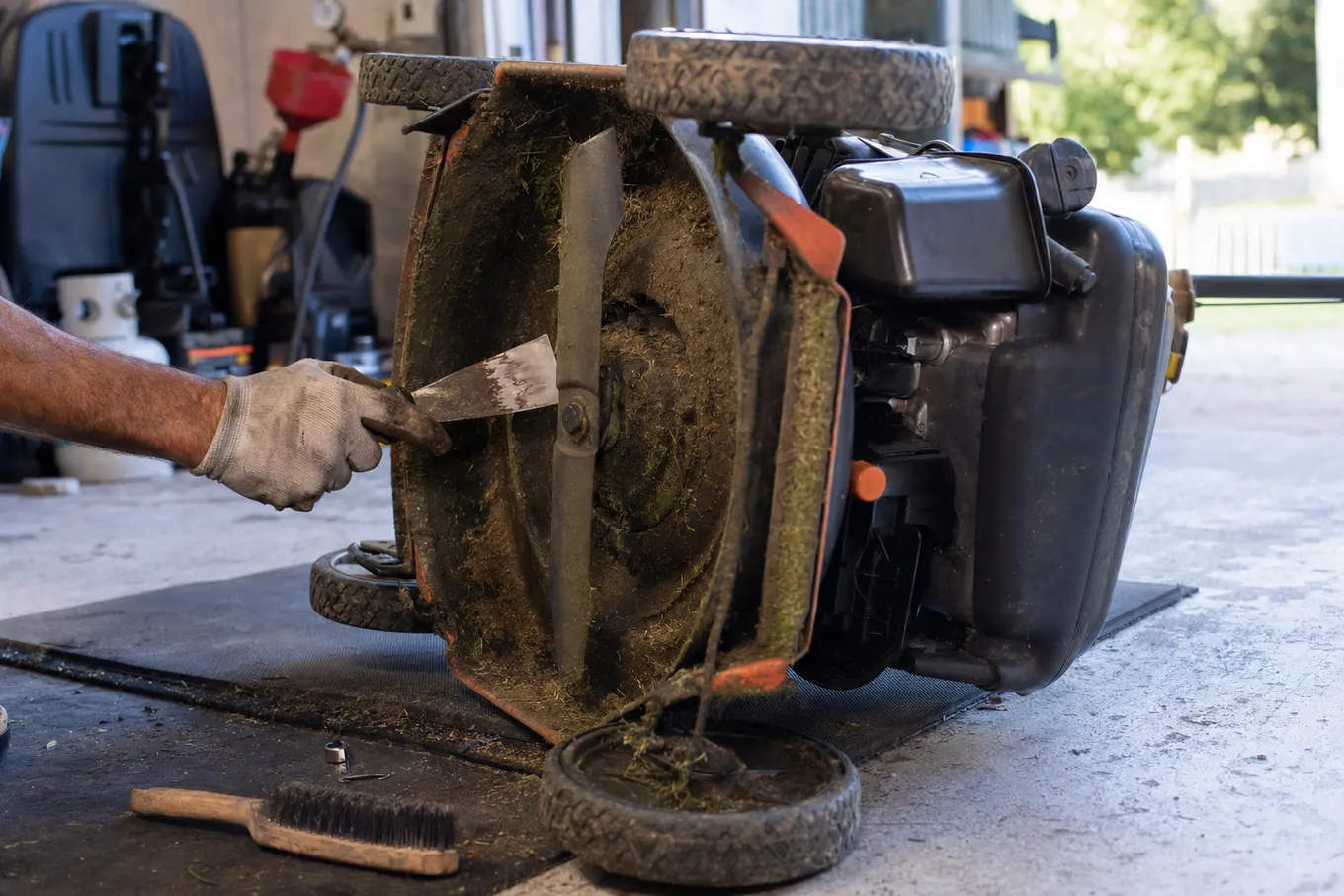
The safer habit is clean, inspect, and dry. Let the engine cool, make the mower safe, remove the spark plug wire on gas models, and keep hands away from the blade edge. A plastic scraper is usually enough to remove packed grass without chewing the paint off the deck. If you rinse, give the mower time to dry before it goes into a closed garage.
Southwest Florida punishes parked moisture. Wet St. Augustine and Bahia clippings hold water against steel. Salt air near the coast does not improve the mood. Once paint is worn away by sand or blade wash, that wet grass has bare metal to work on. Rust around the discharge door, rear flap, wheel mounts, and deck seam can change airflow and weaken the shell.
What makes this habit stick is timing. Clean the deck after the ugly mow, not three weeks later when the grass layer has turned into roofing material. If the mower is going to sit while you travel, dry storage matters even more. For a fuller seasonal routine, our lawn mower maintenance guide covers the bigger schedule, but the deck cleanup is the everyday one that pays off quietly.
Wheel and height-adjuster care on sandy lots
Sand does not look dramatic until it gets inside moving parts. Push mower wheels, bushings, drive gears, axle bolts, and height adjusters all live close to the ground. Every pass through a sandy patch gives grit another chance to work into the corners. Add wet clippings and the mess starts acting like rubbing compound.
Walk around the mower once in a while and lift each corner lightly. The wheel should not wobble like a loose drawer knob. Height levers should latch cleanly and stay latched. Drive wheels on self propelled mowers should have good tread and healthy teeth inside the wheel, not rounded plastic that only pretends to grab.
Do not oil everything blindly. Some spots collect grit worse when they are wet with the wrong lubricant. Cleaning debris away from adjuster notches and wheel areas often helps more than soaking them. If the mower has service points called out by the manufacturer, follow those. If it does not, keep the area clean and watch for looseness before it becomes a deck-level problem.
Cut quality depends on the wheels more than people think. If one wheel is wobbling, one height adjuster slips, or one rear drive wheel is wearing faster, the deck is not traveling level. The engine can be perfect and the lawn can still look wrong because the blade is being carried crooked across the yard.
Storing it in a Florida garage
A Florida garage is not gentle storage. It is hot, humid, and often full of salty air, fertilizer dust, fuel cans, cardboard, and whatever blew in during the last storm. The mower may be out of the rain, but it is not in a museum. Heat cooks batteries, hardens rubber, dries fuel, and makes stale gas smell even worse than usual.
Fuel state matters most when the mower will sit. If you mow every week, fresh fuel moving through the machine is usually fine. If the mower will sit through a snowbird stretch, vacation, illness, or a long rainy gap, think before parking it with fuel aging in the carburetor bowl. Stabilized fuel has to reach the carburetor to help there. Running the tank dry has its own proper method too. Guessing is how little carburetors become clogged lessons.
Store the mower clean and dry, not grass-packed and steaming. Keep it where rain cannot blow onto the deck. Do not park it nose down in a puddle path. If it is a battery walk-behind, follow the battery storage instructions, especially around charging and heat. A pack left cooking in a garage can lose life even if the mower itself is fine.
Florida storage also means pest and corrosion checks. Look around the air box, cooling shroud, cable ends, bail handle, and folding handle joints. A quick look before mowing after a long sit can catch a nest, a sticky cable, or a loose fastener before the mower is hot and halfway through the yard.
The parts worth replacing before they ruin your day
Some parts are cheap insurance. A blade should be sharpened or replaced on a sensible schedule, and many homeowners are better off treating the blade as a seasonal item if the yard is sandy or the grass is tough. A clean air filter matters because small engines breathe close to dust and clippings. A spark plug is not glamorous, but it is easy to inspect and cheap compared with chasing a hard-start complaint for half a Saturday.
A proper lawn mower tune-up is not a ceremony. It is a chance to catch the boring stuff: dirty filter, tired plug, cable stretch, blade damage, old fuel, loose hardware, wheel wear, and deck buildup. The mower leaves easier to start and easier to push because the whole machine was looked at, not just the part that made the loudest complaint.
Other parts can often run until they give a real symptom. Wheels, cables, recoil ropes, bags, drive belts, and height adjuster pieces do not always need replacement on a calendar. Watch them. If the rope is fraying, the cable is stretched to the end of its adjustment, the drive belt is glazing, or the wheel teeth are rounding off, do the repair before failure strands the mower in the middle of a hot yard.
The honest line is this: proactive service is good when it prevents a predictable breakdown, but replacing half a mower just because the calendar changed is not smart. We look for wear that is actually there. A mower should get the parts it needs, not a shopping cart full of guesses.
A good 21-inch mower is one of the best money-per-year machines in lawn care when somebody maintains it. It is small enough to store, simple enough to service, and useful on yards where a rider would be overkill. Let it sit with stale fuel, wet grass packed under the deck, a dull blade, and loose wheels, and it will feel worn out before its time. Keep it clean, dry, sharp, fueled correctly, and checked once in a while, and that same walk-behind can stay boring in the best possible way.
Push Mower Repair FAQs
Why is my self propelled mower suddenly slow, like it is dragging an anchor?
The drive has lost its grip somewhere between engine and wheels. On most machines the suspects line up as a stretched drive belt, a cable gone slack so the system never fully engages, or wheel drive gears with teeth worn to nubs by years of sand. Cable adjustment is cheap, belts are reasonable, and even transmission work on a walk behind stays modest. Slow is fixable. Do not spend a summer shoving a self propelled mower out of stubbornness.
Is front wheel drive or rear wheel drive better on our sandy lawns?
Rear drive earns its price here. A front drive mower loses traction whenever the nose goes light, which happens every time the bag fills or the front wheels drop into soft sand. Rear drive keeps pushing because the machine's weight sits over the driven wheels. Front drive still suits small, flat yards with constant turning. If your lawn has soft spots, a slope toward a canal, or a bagger you actually use, rear drive is the honest recommendation.
Why does the engine shut off the second I let go of the handle?
Because it is designed to. The bail on the handle controls the flywheel brake and ignition ground, the system that stops the blade within seconds of your hands leaving the mower. Federal safety rules have required it for decades, and for good reason: the alternative was people reaching under running mowers. If you want the engine to keep running while the blade stops, that feature exists and is called a blade brake clutch, found on premium walk behinds. What is never the answer is tying the bail down.
The starter cord will not pull at all. Is my engine seized?
Usually not. Walk through the cheap causes first: a blade locked by packed grass or a hidden stick stops the crank cold, and a flywheel brake dragging on a seized cable fights every pull. A cylinder that swallowed oil or fuel after tipping locks things too, and that is recoverable. Genuine seizure from running out of oil does happen, and a quick look with the plug out tells the story. Bring it in before forcing anything. Yanked hard enough, recoil starters break as well.
My mower only starts if I prime it five or six times. What does that mean?
The carburetor is not holding or receiving the fuel it should, so your thumb is hand delivering every drop the engine burns at startup. Varnish from stale gas choking the main jet, a pinholed primer line, or a tired primer bulb all produce the same morning routine. It worsens until the mower will not start at all, so fix it at the annoying stage instead of the dead stage.
The drive wheels click and slip when I pull the mower backward. Normal or broken?
A ratcheting click while pulling backward is normal on most self propelled machines: the wheels freewheel in reverse on purpose so the drive does not fight you. Broken sounds different. Grinding or skipping while driving forward, wheels that spin without pulling, or one wheel doing all the work points at worn pinion gears, stripped wheel gears or a failing transmission, all of which are routine walk behind repairs.
Can you replace just a broken drive cable or bail cable?
Yes. Cables and controls are bread and butter walk behind work. We fit the correct cable for the model, set the free play so engagement is crisp without dragging, and inspect whatever the cable operates while we are in there, because cables rarely fail alone. Rusted pivots and bent brackets ride along on many cable jobs, and catching them then saves a second trip.
My battery mower shuts down halfway through the yard and flashes at me.
The flashing is the mower protecting itself, and the usual reasons are heat and load. A pack cutting thick summer growth in ninety five degree sun can hit its thermal limit and rest until it cools. Wet or overgrown grass can also demand more current than the system will sustain, especially behind a dull blade. A sharp blade, a higher deck setting and an earlier mow solve a surprising share of these. If it keeps quitting on light duty, the pack or its electronics are aging, and we will give you a straight read.
Is an older Honda or Toro walk behind worth repairing?
Almost always, and they are machines we enjoy saving. That generation of premium walk behinds carries engines and decks built beyond their price class, and parts support is still excellent. A carburetor, a drive service or fresh cables on one of those is money invested in a mower that intends to outlive several disposable replacements. The one exception is deck rot, which respects no brand. If the shell has gone soft, we show you rather than sell you.
Any tricks to hauling a push mower in an SUV without making a mess?
Run the tank low, or shut the fuel valve if the mower has one, and keep the machine level if you possibly can. If it must tip, tip it with the air filter and carburetor side up so oil stays out of places oil should never reach. Fold the handles, lay cardboard under a caked deck, and never rest a mower on its carburetor side no matter how short the drive. A good share of the smoking mowers we see each month started smoking on the ride over.
Why does my mulching mower leave clumps all over the lawn in summer?
Summer St. Augustine grows faster than a mulching deck can recut it, especially mowed wet after an afternoon storm. A dull blade tears instead of chopping, a deck lined with old buildup kills the airflow mulching depends on, and taking too much height in one pass overloads the whole system. Sharpen, scrape the underside, raise the cut, mow dry when the weather allows, and in the fastest weeks switch to side discharge or the bag. The mower is usually fine. July is simply July.
My wheel height adjusters are floppy and the mower cuts crooked. Fixable?
Fixable and common. Adjuster levers, cam brackets and wheel bolts wear oval after years of sandy vibration, and once one corner rides low the whole cut leans with it. Parts are inexpensive on most models, and with the wheels off we also check the drive gears hiding behind them, which wear on the same schedule. A mower that sits square cuts square, and this is one of the cheapest transformations on our bench.
Is it safe to keep mowing with a bungee cord holding the bail handle down?
No, and we would rather fix the real problem than admire the workaround. The bail exists so the blade stops when your hands leave the mower. Hit a sprinkler head and let go, or lose your footing on a wet slope, and those seconds of spinning blade matter. A bail that will not stay engaged usually means a seized cable or a bent lever, a small and honest repair. Keep the safety system between you and the blade working.
Why does my self propelled mower feel heavy to push?
Usually the drive system is dragging or only half working. A stretched cable, worn belt, packed drive cover, bad wheel bushing, or rounded drive wheel teeth can make a self propelled mower feel heavier than a plain push mower. Shut the drive off and see if it rolls freely. If it still fights you, check wheels and axles before blaming the transmission.
Can a push mower blade be put on upside down?
Yes, and it happens more than people like to admit. The cutting edge and lift sail have to face the correct direction for that deck. An upside-down blade may still spin, but it cuts poorly, bags badly, and can make the mower seem weak. If the cut changed right after blade service, stop and verify the blade orientation before mowing more.
Why does my mower cut better in one direction?
Direction-sensitive cutting often points to airflow, blade condition, deck pitch, or wheel height. The mower may lift grass better when moving one way across the lawn, especially in bent or damp St. Augustine. A dull blade, clogged deck, low corner, or wrong blade style can exaggerate it. Photos of the bad pass help because the pattern tells us where to look.
What push mower height setting is best for Florida grass?
Do not scalp it just to mow less often. Many Florida lawns do better with a higher cut, especially St. Augustine, because the grass keeps more shade at the soil and the mower does not have to chew through as much stem at once. Bahia seed stalks still need regular mowing. The right height depends on the grass type, yard roughness, and how fast it is growing.
Why is my rear wheel drive slipping on wet grass?
Wet grass reduces traction first, but worn drive wheels make it much worse. Rear wheel drive depends on wheel tread, internal gear teeth, belt tension, and cable adjustment. If the wheels spin, chatter, or pull unevenly on damp grass, the mower may need drive wheels or adjustment. Mowing very low in wet turf also loads the blade and steals power from the drive.
Broader questions about pricing, turnaround and the shop live on the main FAQ page. For your specific machine, skip the reading and call (941) 555-0123.
Get Your Walk Behind Back to Work
A minute on this form beats an afternoon of guessing. Say what the mower does, what it refuses to do, and which brand is on the deck. A photo of the machine or its model plate helps us have parts thinking done before you arrive.
- Exact price approved by you before any work
- Honest fix-or-replace advice on the cheap machines too
- Faster by phone: (941) 555-0123