Lawn Mower Pickup & Delivery in Port Charlotte, FL
A riding mower that will not run is several hundred pounds of stationary frustration, and most homeowners own exactly zero trailers. So we solve that part too: call or text, we arrange a time window, load your mower, fix it right in the shop, and bring it back cutting. You never leave the driveway.
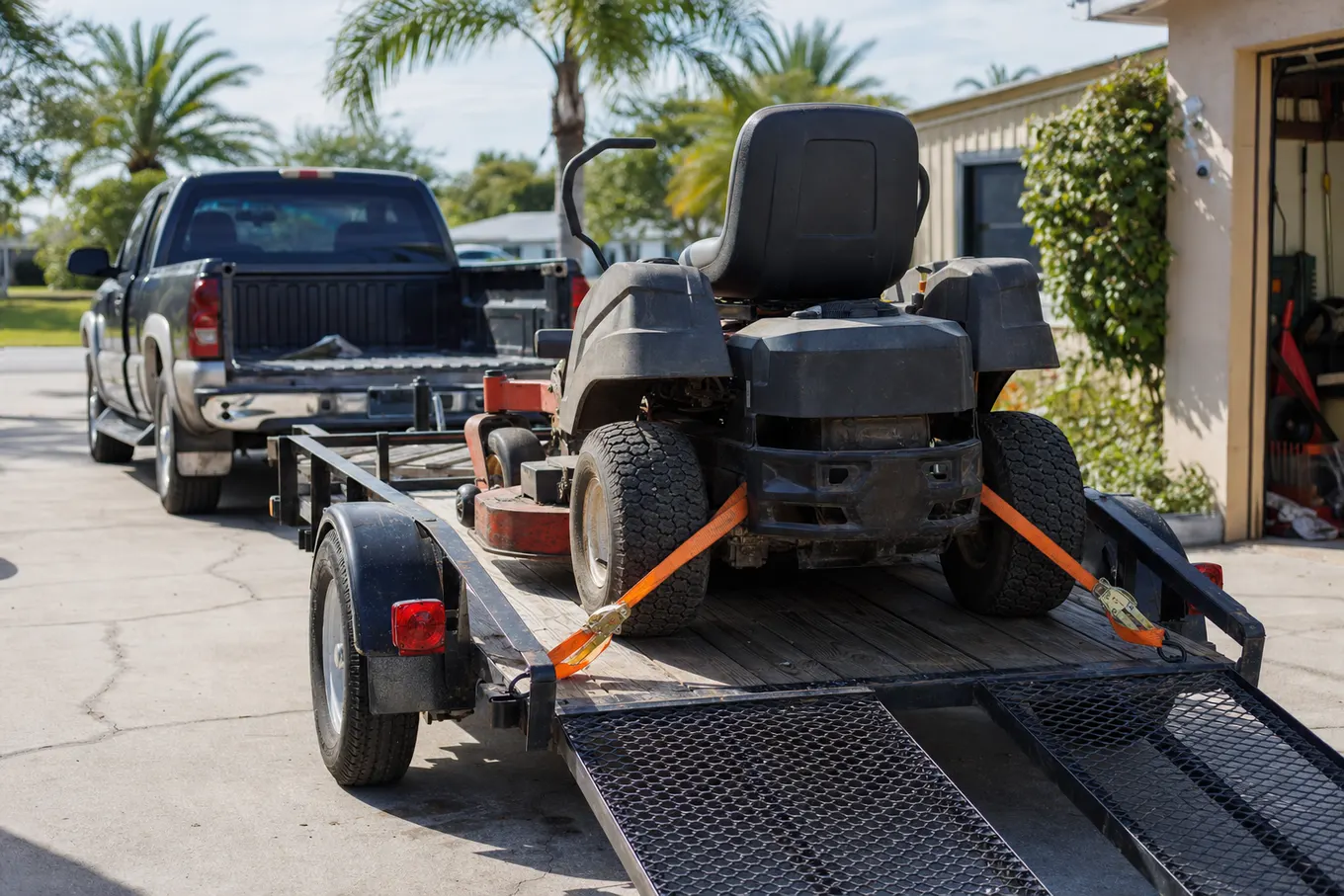
Looking for lawn mower pickup and delivery near Port Charlotte? Joe's Small Engine Repair collects riding mowers, zero turns and walk behinds from homes across Charlotte, Sarasota, DeSoto and Lee counties, repairs them at our shop with real tools and real parts, and returns them running. Call or text (941) 555-0123 to arrange it: you get a time window and any trip details up front, and a repair quote to approve before a single part goes on.
How Mower Pickup and Delivery Actually Works
No portals, no dispatch software asking for your mother's maiden name. The whole system is a phone number and a straight sequence of steps, refined by a lot of driveways.
- You call or text (941) 555-0123. Describe the machine and the symptom in whatever words you have. "Cub Cadet, cranks forever, never catches" is plenty. A photo of the mower and its model sticker helps us arrive prepared and often speeds up the parts side before the mower ever reaches the bench.
- We arrange the trip together. You get a time window that fits the route, plus any trip details spelled out before anything is booked. This is where you flag gate codes, narrow gates, soft ground, dogs, or the fact that the mower lives behind the shed. Surprises are for birthdays, not pickups.
- You stage the mower, or just tell us where it sits. Rolling it somewhere reachable is helpful but not required. If it cannot roll, that is fine, moving immovable mowers is a skill we practice weekly.
- We load it properly. Ramps set to a sane angle, machine strapped at its strong points, blades disengaged, fuel accounted for. Loading is where driveway improvisation dents hoods and shins, so this step is why you called professionals.
- Diagnosis happens at the shop, then your phone rings. The mower goes on the bench and gets tested rather than guessed at. You hear what failed, what it costs to fix, and what we noticed that can wait. Nothing gets repaired until you approve the number.
- The work gets done and verified. Repairs, then the checks that prove them: starting behavior, charging output, blade engagement, a test cut where the job calls for it. The mower earns the return trip.
- Delivery and a walkaround. We bring it back on the arranged window, unload, and show you what was done, the old parts if you want to see them, and anything worth watching down the road. Then you mow, and we disappear until the next time something coughs.
First-time customers are often surprised how little they have to manage. That is the point of the service. You provide a phone number and a decision on the quote, and logistics are our department.
If you are the type who likes a script, here is the perfect opening text, fill in your own blanks: the machine and brand, what it does when you try to use it, your cross streets or neighborhood, and one photo. Something like "Husqvarna rider in Gulf Cove, blades quit engaging yesterday, gate code 4321, photo attached" contains every fact a pickup needs and takes under a minute to send. We will take it from there, and yes, an actual human reads it.
Why Shop Repair Beats Driveway Repair
Mobile mower repair sounds ideal: the mechanic comes to you, no hauling at all. We offer pickup instead of driveway wrenching on purpose, and the reasons are worth spelling out, because they are the difference between a repair and a revisit.
Diagnosis needs instruments, and instruments live at the shop
Finding the true cause of a mower problem is measurement work. Compression and leak-down testing to judge an engine's health. Load testing a battery instead of trusting its voltage. Checking charging output at running speed. Ultrasonic cleaning for a varnished carburetor. Measuring blade tip height to level a deck. None of that fits meaningfully into a van parked on a slope in the rain, which is why driveway diagnosis leans so hard on educated guessing.
Guesses cost money precisely because they are cheap to make. The bench lets us test in a fixed order under controlled conditions, and testing is what separates "we replaced the carburetor and it still surges" from "here is the vacuum leak that was causing it." The mower comes to the instruments because the instruments cannot come to the mower.
The parts shelf turns two visits into one
Mower repairs have a habit of revealing themselves in layers. The no-start that began as stale fuel also needs a plug, and the plug reveals a filter, and while the deck is off, one idler bearing turns out to be crunchy. At the shop, the common consumables and wear parts are steps away, so the extra findings get handled inside the same approved quote and the same stay.
In a driveway, every discovery beyond what fit in the van becomes a second appointment, a second trip charge somewhere in the math, and a mower that spends another week broken in the garage. Multiply that by Florida traffic on US 41 in season and mobile convenience quietly becomes the slow option. One haul, one complete repair, one return beats three friendly visits every time.
Florida weather votes against driveway wrenching
Half the year, outdoor repair here means racing the afternoon storm with electrical connectors open and parts laid out on a towel. The other half, it means asking someone to do patient diagnostic work while kneeling on 95 degree pavement, which is a fine way to get fast answers instead of right ones. Rain, glare, sweat and mosquitoes are not a quality program.
The shop takes weather out of the equation: consistent light to spot a hairline crack in a fuel line, a dry floor for tracing an electrical fault, and no thunderhead on the radar deciding when the job is finished. Your mower gets fixed by a person working in conditions where careful work is possible. That shows up in the result, even though you never see it happen.
Repairs get tested before they come back to you
The quiet advantage of shop repair is what happens after the fix: the machine gets run, warmed, engaged and pushed the way your lawn will push it. A carburetor job gets proven through its full throttle range. An electrical repair gets its whole circuit measured again under load. A belt and deck job gets spun up and cut-tested rather than declared victorious in theory.
Driveway work, by its nature, tests on your lawn, on your time, with you as the quality department. When the fix holds, fine. When it does not, the callback happens on your schedule and your patience. We would rather find the weak spot ourselves before the trailer heads back your way, and the return trip is our incentive to be sure: hauling a mower back twice teaches a shop thoroughness faster than any slogan.
Where mobile-style help genuinely makes sense
Honesty cuts both ways, so here is the other side. Some situations do not justify a round trip: a question we can answer over the phone, a machine so far gone that hauling it would waste your money, or a two minute adjustment we can sometimes handle at the tailgate during a delivery already headed your way. When your call sounds like one of those, we say so, and you keep your money.
And if you have the trailer and the inclination, direct drop-off at the shop is always welcome and skips the logistics entirely. Pickup exists for everyone else: the rider with no way to travel, the household with no truck, the crew that cannot spare a person to drive. It is a bridge to the bench, because the bench is where the quality is.
Riding Mowers and Zero Turns: What This Service Was Built Around
Walk behinds hitch rides on our routes all the time, but the trailer earns its living on the big machines. The math of riders and zero turns makes pickup less a convenience and more the only sensible plan.
Start with mass. A lawn tractor runs several hundred pounds, a zero turn more still, and none of it is shaped for lifting. Moving one without a proper trailer means borrowed ramps at the wrong angle, a pickup bed that sits too high, and a machine that cannot power itself up the incline because the reason it is traveling is that it does not run. Every season we hear a new version of the driveway loading story that ends with a dented tailgate, a crushed toe or a rider on its side in the grass. The equipment and the technique are the whole difference, and bringing both to your house is the service.
Then consider what these machines are worth and what tends to fail on them. A riding mower or zero turn is a four-figure investment whose common failures, dead 12 volt systems, worn deck bearings, hydro drive issues, tired engines, are exactly the repairs that demand bench instruments and a parts shelf. A machine like that deserves better than parking lot diagnostics, and its owner deserves better than hauling logistics designed around hope. The pickup model exists so the heaviest machines get the most thorough version of repair with the least effort from the person who owns them.
Zero turns add their own wrinkle: width. Many will not pass a standard fence gate, some barely fit a single trailer lane, and their hydro transmissions lock the wheels when the engine is off unless the release rods are set. None of this is a problem for a crew that handles them weekly, which is the quiet argument for making your dead zero turn our logistics problem instead of yours.
And yes, the small machines ride too
None of this excludes the 21 inch crowd. Push and self propelled mowers join pickup runs constantly, usually piggybacked on a route already passing the neighborhood, and for households without a vehicle that can swallow a mower, or for anyone who should not be lifting one into a trunk, the service matters just as much at this size. A walk behind that will not start weighs a lot less than a rider and exactly the same amount more than a working lawn can tolerate. If the machine needs the bench and cannot get there, that is the entire qualification.
Who Gets the Most Out of Pickup and Delivery
Anyone can use it, but a few situations practically require it. Most of our pickup calls come from one of these six.
Riding mower owners without a trailer
The core case. A lawn tractor is trivially easy to own and nearly impossible to transport without equipment. When it dies, pickup is the difference between a repair this week and a machine that sits broken until a friend with a trailer owes a favor.
Zero turn owners
Heavier than they look, wider than most gates, and worth too much to improvise with. Zero turns ride our trailer more than any other machine class, and hydro release valves and proper straps mean even a dead one loads without drama.
Seasonal residents
Coordinate a pickup before you fly back and the mower that sat all summer gets collected, revived and returned before your first weekend home. The whole arrangement happens by phone and text from wherever you are.
Households without a truck
Plenty of Florida garages hold two sedans and zero tow vehicles. Even a push mower that needs the shop can hitch a ride when we are routing through your area, and a rider is no obstacle at all.
People whose weekends are spoken for
Borrowing a trailer, finding ramps, loading, hauling, unloading, twice. That is most of a Saturday. One phone call replaces all of it, and the mower comes back fixed while you did literally anything else.
Lawn crews with a machine down
A commercial mower that stops working stops earning. Tell us it is a crew machine when you call and we treat the whole cycle, pickup, diagnosis, quote, repair, return, with the urgency that fact deserves.
What to Have Ready Before We Arrive
Pickups run smoothest when a few small details are settled in advance. None of this is required, all of it helps, and the whole list takes less time than finding your keys.
- Access, solved in advance. Gate codes shared by text, community guardhouse warned, side gates unlocked, and any four-legged security staff indoors for the window. Access hiccups are the number one thing that stretches a pickup.
- The key, in the mower or taped to it. A machine we can attempt to start tells us things a silent one cannot, sometimes before it leaves your driveway.
- The fuel situation, described. Full tank, empty tank, or "whatever was in it since spring" are all fine answers. We just want to know which one we are securing for the road.
- A photo of the model sticker. Usually under the seat, on the frame rail or on the deck. Texting it ahead lets parts research start before the mower does.
- The story, in a sentence or two. What it did last, what changed, what you already tried. The story steers the first hour of bench work more than any single test.
- A clear path. If the mower can be rolled to the driveway or the garage mouth, wonderful. If not, tell us what stands between it and the street and we bring the solution along.
One measurement worth taking for backyard machines: the gate. Walk gates around here often run near three feet, and a riding mower's deck usually needs more than that, so knowing the number before we roll saves everyone a scenic detour through problem-solving. And if your mower lives on soft ground after a wet week, mention it, wet sugar sand has opinions about trailers, and we route around those opinions with plywood and experience.
Loading Mowers That Refuse to Cooperate
A fair share of pickup calls start with an apology: it will not start, it will not roll, it is wedged behind the pool cage, I am so sorry. No apology needed. Dead machines are the reason the service exists, and each flavor of dead has its own answer. A mower that cranks but will not run rolls and steers fine, so it loads like any other. A rider with a seized engine still rolls in neutral once the parking brake and blade linkages are set right. Zero turns look hopeless when their hydros lock the wheels, but nearly every model hides freewheel release rods or levers exactly for this moment, and knowing where each brand tucks them is part of the job description.
Flat tires get aired from the kit on board, or moved on skates when a bead will not seat in the driveway. Machines sunk in soft ground come out with boards, straps and patience rather than horsepower and rutted lawns. Mowers pinned in crowded sheds get walked out inches at a time, the same way piano movers work. The one thing we ask is the truth on the phone: a mower described as "runs rough" that actually has not moved since March gets the wrong equipment sent to it. Describe the worst honestly and the pickup will look easy, which is the best trick in the whole trade.
A special mention for the machines nobody chose: the rider in the shed of an inherited house, the mower left behind by a previous owner, the project machine a spouse has been promising to fix since two hurricanes ago. Those get collected too, sight unseen if needed, and assessed at the bench with the same honesty as anything else. Some wake up beautifully with fuel system work and a battery. Some are organ donors. Either way you get a straight verdict and your shed back, which for some households is the more valuable half of the deal.
Once aboard, dead or alive, every machine gets strapped at its frame rather than its steering wheel, blades and fuel secured, and hauled the boring, careful way. The goal is a mower that arrives at the bench with exactly the problems it left home with, and not one more.
What Happens While Your Mower Is at the Shop
Most repair customers stand at a counter at least once. Pickup customers might never see the shop at all, so the whole relationship runs on communication, and we build the process around that fact.
Your mower arrives with its story attached, the one you told when you booked, because the symptom description rides along with the machine like a hospital chart. Diagnosis follows the same discipline every machine here gets: verify the complaint first, then test systems in order until the cause is proven rather than suspected. Along the way we note the things you did not call about but would want to know, the belt showing its age, the front tire losing air, the deck carrying more rust than it should. Findings become a list, the list becomes prices, and then your phone rings.
That call is the heart of the remote arrangement. You hear the cause in plain words, the exact cost to fix it, and the honest sorting of everything else: needs doing now, smart to do while it is here, safe to skip. You say yes to what makes sense and no to what does not, and the invoice at delivery matches the conversation, item for item. If photos help the decision, we send them. If the verdict is that the machine is not worth its repair, you hear that too, along with your options, before the bill exists instead of after. Distance changes the logistics of trust, not the substance of it, and this shop was built to be trusted at any distance (941) 555-0123 can reach.
Pickup and Delivery Across the 30 Mile Circle
The trailer works the same territory the shop serves: four counties' worth of lawns centered on Port Charlotte. Runs get grouped by direction, which is why knowing your town helps us quote a window quickly: a machine in Nokomis rides the same planning as its neighbors in Venice, and an Arcadia pickup pairs naturally with Lake Suzy or Babcock Ranch. Every community below links to its own local page with drive times and neighborhood details, and the full service area page maps the whole picture. Do not see your town? Call anyway, edges are negotiable.
Close to home: the Charlotte County core
These are our shortest runs, wrapped around the harbor and the Peace River, minutes from the shop by US 41 or Kings Highway. Machines from these neighborhoods often ride to the shop and home again with impressive speed simply because the miles are small, and they are the easiest addresses to slot into a same-week window. If you are on this list and the mower quit this morning, call today rather than assuming the calendar is against you.
North into Sarasota County
North Port's quarter-acre lots and the Venice corridor keep this route busy twelve months a year, with US 41 and I-75 both feeding it. The snowbird calendar gives it a second rush every fall, when returning residents from Warm Mineral Springs to Nokomis discover what six parked months did to fuel systems and batteries. Booking your pickup before you fly south, or the week you land back, puts you ahead of that wave instead of inside it.
West to the coast and the islands
Salt air country, reached by SR 776 through Englewood and Placida Road down the Cape Haze peninsula. The coastal towns send us more corrosion and electrical work than anywhere else, and pickup earns its keep out here: hauling equipment across the Boca Grande causeway means a toll every trip, which is exactly the kind of detail we settle with you up front. For an island machine, one arranged round trip beats owning the problem yourself twice over.
East and south: ranch country to the Caloosahatchee
Arcadia acreage mowers working real ranch land, brand new lawns establishing at Babcock Ranch, and the huge homeowner base of Cape Coral and the Fort Myers area anchor our longest runs, out Kings Highway, down Burnt Store Road and across the river districts. Distance changes the logistics a little, the time window conversation covers it, and the standard of work does not move an inch. Pine Island machines cross the Matlacha bridge on our trailer so they do not have to cross it on yours.
Scheduling, the Honest Version
Websites love to promise exact pickup times and flat everything. We would rather tell you how it really works. Pickup runs get built around routes, because collecting three machines along one corridor beats three separate crossings of the Peace River, and routing is what keeps the service affordable for everyone. So the arrangement is always the same shape: you call or text, we look at where you are and what the week looks like, and you get a time window plus any trip details up front, before anything is committed. If the window does not suit you, we keep talking until one does.
A few things genuinely move the timing, and you deserve to know them. Distance is the obvious one, a Cape Coral or Osprey run takes planning that a Charlotte Harbor hop does not. Island trips involve bridges, and one of them collects a toll, which is part of why trip details get discussed before we book rather than discovered after. Season matters too: the first hot weeks of spring and the weeks after a big storm fill the calendar fastest, and calling early in the day or early in the week buys you options. None of this is complicated. It is just the truth, stated in advance, which we have found to be a surprisingly rare business strategy.
Can it ever happen fast? Sometimes remarkably so, when your address sits along a run already rolling that direction, and we will tell you on the spot if that luck applies to your day. What we will not do is promise a universal turnaround on a webpage that cannot see this week's calendar. The reliable version is simple: the sooner you call, the sooner you are on the board, and the window you agree to is a window we keep.
Storm Season Pickups: Flooded and Storm-Damaged Mowers
This part of Florida knows what a serious storm leaves behind, and mowers are on the casualty list every time. The single most important thing to know: if water got to your mower, whether surge, a flooded garage or days of standing rain, do not try to start it. Water sitting in a cylinder or the oil does its worst damage the moment an engine tries to run, and machines have been finished off by an optimistic test crank that a careful teardown would have saved. Leave the key alone, tell us what the water reached, and let it travel to the bench as a patient instead of a gamble.
Storm aftermath also reshapes the work itself. Yards fill with hidden debris that bends blades and eats spindles for months after the cleanup looks done, and the mowing that follows a hurricane is the hardest mowing of the year. Our routes flex during those stretches too: roads close, bridges meter traffic, and the calendar fills with neighbors in the same situation, so windows can run longer than normal and we say so plainly when you book. What does not change is the arrangement: honest details up front, a machine hauled with care, and a straight verdict on what the water or the debris actually did, including the times the kindest answer is an insurance photo rather than a repair.
Delivery Day: What Comes Back With Your Mower
The return trip is not just freight. The mower comes off the trailer started and warm, because delivering a machine we have not just run would be theater. You get a plain-language rundown of what was done and why, the invoice that matches the quote you approved, and the old parts if you asked to see the evidence, which we genuinely encourage: a glazed belt or a corroded cable end explains itself better than any paragraph. If anything came up that can safely wait, a tire holding low pressure, a belt in its final season, you hear about it now, priced and unhurried, so the next decision is yours to plan instead of an ambush.
Then comes the useful minute: any adjustments to fit you, cutting height set for your lawn, and your questions answered while the machine is sitting right there. Owners who want a quick refresher on between-service care, fuel habits or battery maintainers get it on the spot. The trip ends the way the whole service is designed to end, with the mower cutting your grass the same day it comes home, and the trailer already headed toward somebody else's problem.
Pickup or Drop-Off: Choosing the Right Door
Every mower ends up on the same bench, so the choice is purely about logistics. Drop-off is the move when you already own the transport: a push mower in a trunk, a rider on a landscape trailer you have anyway, a quick blade sharpening where you would rather wait out a fast turnaround than schedule two trips. The shop sits in Port Charlotte within easy reach of US 41 and SR 776, and calling ahead means we are ready when your tailgate drops. Plenty of regulars do it this way for the small stuff and switch to pickup the day the big machine misbehaves.
Pickup is the move when the machine is heavy, dead, wide, or simply more trouble to move than your week has room for, and everything on this page describes how that goes. There is no premium on choosing one door over the other in how the work gets treated: same diagnosis discipline, same quote-before-work rule, same standard of repair, whether the mower arrived on our trailer or in the back of your neighbor's truck. Details about the shop itself live on the about page, and either way the conversation starts at the same place: (941) 555-0123.
Five mower pickup stories we see around Port Charlotte
Most pickup calls start with the same sentence: the mower is right there, but there is no good way to get it here. That can mean a rider stuck in the middle of a yard, a zero turn buried in a garage corner, or a push mower that technically fits in a vehicle but smells like raw gas and bad decisions. A good lawn mower pickup and delivery plan starts before anyone touches the machine. We want to know where it sits, whether it rolls, whether it leaks, what kind of ground is under it, and whether there is a clear path to the driveway.
That first conversation keeps the loading part boring, which is exactly what you want. A mower is heavy enough to hurt somebody and awkward enough to make a normal ramp setup sketchy in about three seconds. We do not need drama. We need access, a cold engine, blades disengaged, loose yard items out of the way, and a straight answer about what happened the last time it ran. If it sputtered for two minutes and quit, that points one direction. If it clicked once and went silent, that points another. If it ran fine last season and now only coughs with old gas in the tank, the fuel system just raised its hand.
The rider that died mid-lawn and now sits in the yard
This one usually starts with a half-cut lawn and a machine parked exactly where it gave up. Before pickup, the best thing you can do is leave it where it is, shut the deck off, remove the key, and tell us whether it died suddenly or slowly faded out. Do not keep cranking it until the battery is flat. For loading, we plan the path first: slope, soft ground, sprinkler heads, landscape edging, and whether the tires still hold air. A rider that rolls can be guided carefully. A rider with locked wheels or a stuck transmission needs more patience. Common findings are fuel starvation, a plugged filter, a dirty carburetor, a failed seat or brake safety switch, a weak battery, or a belt problem that made the engine labor until it quit. If it fires briefly and dies, the float bowl may be getting just enough fuel to tease you. Our lawn mower won't start page explains that pattern in more detail.
The zero turn in a garage corner blocked by everything a garage collects
Zero turns are famous for being easy to drive and annoying to move when they are dead. The levers, parking brake, bypass releases, wide deck, and low front casters all matter during pickup. Before we arrive, clear the path as much as you can: bikes, storage bins, patio chairs, paint cans, holiday boxes, and anything leaning against the deck. If you cannot clear it all, tell us up front so the pickup is planned honestly. We look for a way to roll it without dragging tires or scraping the deck, then secure it so the lap bars and deck are not taking the strain. What usually turns up later is not exotic. Dead battery, corroded cables, stale ethanol fuel, flat front tires, a sticky brake linkage, or carb varnish from sitting are the normal villains. A zero turn may look commercial and tough, but bad gas still wins if it gets months alone in the bowl.
The mower that lost its trailer rights
Some machines technically can be hauled by the owner, but they should not be. A mower dripping fuel, rolling on a locked wheel, or leaving a gas smell strong enough to make the whole garage complain does not belong in the back of a family vehicle. Before pickup, keep it outside if you can do that safely, do not top off the tank, and let us know where the leak appears: under the carburetor, near the fuel line, around the tank, or from the cap. Loading a leaking mower means keeping it level, avoiding extra slosh, and securing it so the leak does not get worse in transit. The usual repairs are a stuck float needle, cracked fuel line, brittle primer bulb, bad fuel shutoff, loose clamp, or tank grommet leak. If the wheels will not roll, we also check bearings, bushings, brake drag, and deck hardware that may be rubbing a tire. Gasoline is not a cologne. Nobody needs that ride home.
The estate cleanup mower that sat for years
Estate and property cleanup calls are their own category. The mower may have been parked under a carport, in a shed, behind a rental house, or beside a pile of yard tools nobody wants to identify. Before pickup, do not add fresh gas and hope for a miracle. Take a few photos, tell us whether tires are flat, and remove anything stored on the seat or deck. We handle these as unknown machines: careful loading, no assumptions about brakes, and no trust in old cables or dry-rotted rubber. The common shop findings are varnished carburetors, rust in the tank, mouse nests around the blower housing, brittle fuel lines, dry belts, corroded battery terminals, seized pulleys, and blades that have not seen a sharp edge in a long while. A machine that sat through Florida humidity can hide trouble in every small moving part. The carburetor repair is often only the first honest conversation.
The snowbird timing pickup
Snowbird mower pickup has a different rhythm. The mower may be fine when the owner leaves, then sit through heat, storms, ethanol fuel, flat battery discharge, and a garage full of salt air before the grass starts growing again. The cleanest plan is simple: call or text to arrange the mower pick up service after you fly north, then arrange return when the machine is repaired and ready. Before pickup, leave clear access instructions, make sure someone can approve the work, and tell us if the mower has been sitting with fuel in it. We load it like any other machine, but we pay extra attention to locked steering, stuck tires, weak parking brakes, and battery condition. Common problems include phase-separated fuel, gummy carb passages, dead batteries, low tire pressure, stuck deck engagement parts, and corrosion at electrical connections. The mower does not know you were out of town. It only knows the gas got old and the air got wet.
These stories are patterns, not scripts. The exact repair still comes from inspection, diagnosis, and an approved quote before work. Pickup just solves the first problem: getting the mower to a place where it can be checked properly without turning your driveway into a loading experiment.
What pickup can save besides a truck trip
A search for mobile lawn mower repair near me usually means one of two things. Either you want the mower fixed in the driveway, or you want somebody to make the hauling problem disappear. For most real repairs, the shop is still the better place to diagnose and fix the machine. The difference is that pickup gets it there without you borrowing a trailer, wrestling ramps, or discovering that a riding mower weighs more than your plan accounted for.
DIY hauling can make sense. If the mower runs, the deck is not scraping, the tires hold air, you have a suitable trailer, and you live close to the shop, bringing it over yourself may be the simplest route. That is especially true for close-in towns around Port Charlotte where the drive is short and the machine can be loaded safely. If you are already heading this way, use the service area details for close-in towns to decide whether drop-off is the cleaner move.
The math changes when you have to build the hauling plan from scratch. Borrowing a trailer sounds easy until you need the right hitch height, working lights, a spare afternoon, a helper, and ramps that are wide enough for the mower you actually own. Rental trailers add another layer: pickup, paperwork, return timing, fuel, and the awkward pressure to rush because the clock is running. None of that fixes the mower. It only gets you to the starting line.
Truck-bed loading is where people get hurt. A push mower is usually manageable if it is dry, cool, and not leaking. A self propelled mower can still surprise you when the drive wheels catch a ramp edge. Riders and zero turns are a different animal. Tailgates are not loading docks. Ramps flex. Shoes slip. Gravity does not care how many YouTube videos made it look fine. If the machine stalls halfway up a steep ramp, you now have a mower balanced in the worst possible place, with spinning tires behind you and a bad decision in front of you.
There is also the quiet cost nobody counts: the cleanup. A mower with stale fuel can leak in a truck bed. Grass clumps fall out of the deck. Sand and oil smear where you strap it down. A battery can tip. A loose blade or deck part can shift during the drive. By the time the machine is unloaded, you may still need to clean the vehicle, return the trailer, and explain why the tailgate cable suddenly looks unhappy.
Pickup is not magic, and it is not always the cheapest possible path if you only count miles. Its value is that it removes the risky, time-consuming part from the repair decision. You still get the important part of the process: the mower is inspected, the problem is explained, and the quote is approved before work. That is the piece that matters more than whether the machine arrived by your trailer or our pickup plan.
If you insist on loading a mower yourself, slow down and make it boring:
- Use ramps with a shallow angle. If the ramp looks steep from the side, it is too steep for a heavy mower.
- Load with a cold engine. Hot mufflers, spilled fuel, and dry grass are a bad little committee.
- Turn the fuel valve off if the mower has one, and keep the machine as level as you can.
- Disengage the blades, raise the deck enough to clear the ramp, and do not ride the clutch or hydro controls halfway up.
- Strap the mower at four points so it cannot roll forward, backward, or sideways when you brake.
- Recheck the straps after a few minutes of driving. Mowers settle, tires flex, and loose straps lie.
Driving it over yourself makes the most sense when the mower starts, stops, and steers normally, the route is short, and you already have the right trailer setup. Pickup makes more sense when the machine is dead, leaking, blocked in, too wide, too heavy, or sitting somewhere you do not want to fight with it. There is no prize for almost dropping a mower off a ramp. Call or text through the contact page, describe the machine and where it sits, and we can talk through the sensible option.
The honest economics are not complicated. Count the time to find equipment, load safely, drive, unload, return what you borrowed, and clean up afterward. Then count the risk to your back, your truck, your driveway, and the mower itself. If the answer still favors DIY, bring it in. If the answer starts feeling like a Saturday disappearing into straps and regret, lawn mower pickup and delivery is probably the better repair decision.
Pickup and Delivery FAQs
How do I schedule a lawn mower pickup?
One call or text to the shop starts it. Have three things handy: your address, what the mower is doing or not doing, and anything we should know about access, like a gate code or a dog with strong opinions. We will work out a time window with you and lay out any trip details up front, so there is nothing to decode later. If texting is easier, a photo of the mower and a sentence about the problem is a perfect opener.
Do you charge for pickup and delivery?
The arrangement depends on where you are and what the job involves, so rather than quote a number on a webpage, we tell you the complete picture when you book: the time window, any trip details, and the plan for the repair quote itself. Everything is laid out before we head your way, and nothing about the trip shows up as a surprise on the invoice. That is a promise about how we communicate, and it is the part that actually matters.
Can you pick up a mower that will not start or move at all?
That is the main event. Machines that crank and die, machines that will not crank, machines with locked wheels or a dead transmission all load fine with the right ramps, straps and technique. Zero turn hydros have release valves that let them roll free, flat tires can be aired or worked around, and a mower buried in a backyard corner is a puzzle we have solved many times. Tell us the situation honestly when you call and we come prepared for it.
Do I need to be home when you come?
Usually not, as long as we can reach the mower and reach you by phone. Plenty of pickups happen from carports, driveways and open garages while owners are at work, with the whole arrangement handled by text. What we do need is legal and practical access: any gate unlocked or coded for us, the mower where we can get to it, and a number where you will actually answer, since the repair quote comes to you by phone before any work starts.
How far will you come to get a mower?
Our pickup routes cover the roughly 30 mile circle around Port Charlotte, which reaches across four counties: Charlotte, Sarasota, DeSoto and Lee. In practice that means everywhere from Venice and Osprey down to Cape Coral and Fort Myers, inland to Arcadia and Babcock Ranch, and out to the islands. If you are unsure whether your address fits, ask. The answer is yes more often than the map makes people expect.
Can you pick up from a gated community?
All the time. Communities around here from Deep Creek to the gated neighborhoods east of Venice have their own procedures, and they are all workable: leave our name at the guardhouse, share the gate code by text, or meet us at the entrance. Tell us it is gated when you book so the time window accounts for it, and the pickup goes exactly like any other.
Do you haul zero turns and larger commercial mowers?
Yes. Zero turns are one of the most common machines on our trailer, precisely because they are the hardest thing for an owner to move without equipment. If your machine is unusually large or wide, mention the model when you arrange the pickup so we show up matched to the job. For a crew with a down machine, say so, because we understand exactly what a mower out of service costs a working operation and we plan accordingly.
Should I drain the gas before pickup?
No, and please do not tip a mower to try. Fuel sloshed into the wrong places creates its own problems, and the fuel already in the tank is often useful evidence, since stale or contaminated gas explains a large share of Florida no-starts. Just tell us roughly how full the tank is when you book. We secure machines for transport with fuel aboard as a matter of routine.
How long will the shop have my mower?
The honest answer is that it depends on the diagnosis and on parts, and we would rather tell you that than invent a number. What you will always have is information: a diagnosis and a firm quote before any repair begins, a straight answer about parts availability, and a call the moment it is ready so we can set the return trip. If you have a deadline, like a lawn crew coming or a trip out of town, tell us when you book and we will be straight about what is realistic.
Is the return delivery part of the deal?
Pickup and delivery normally travel together as one round trip arrangement, agreed when you book: we collect the mower, fix what you approve, and bring it back to the same address running. If your situation is different, maybe you only need one leg, or the mower should return to a different property, lay that out up front and we will arrange it. The goal is that you always know the full shape of the trip before the trailer moves.
Why not just have someone fix it in my driveway?
For a handful of small jobs, driveway work is fine, and we will say so when your symptom sounds like one. For everything else, the shop wins on quality: real diagnostic equipment, the parts shelf, proper lighting and lifting, and the ability to test the fix under load before you get the machine back. Driveway repairs done squatting in July heat with whatever parts fit in a van have a way of becoming second appointments. Hauling the mower to the tools beats hauling guesses to the mower.
Can I set up a pickup before I return to Florida for the season?
Seasonal residents do this every fall and it works beautifully. Call or text before you travel, and we will coordinate access with your property manager, neighbor or keypad code, collect the mower, wake it up properly, and have it back cutting before you land. It beats spending the first week of your season discovering what six months of storage did to the fuel and the battery, and our maintenance service pairs naturally with the same trip.
What if the mower is in the backyard behind a fence gate?
Measure the gate before you call, because that is the whole question. Walk behinds fit through almost anything, but riding mowers commonly measure four feet or more across the deck while a standard walk gate is closer to three. If the machine fits, we will bring it through. If it does not, options still exist: a removable fence panel, a side easement, or in stubborn cases meeting the mower halfway with ramps and boards. Flag it when you book and we arrive with a plan instead of a shrug.
Can you collect two mowers at once, or one from me and one from my neighbor?
Gladly, and it is smart routing for everyone. Neighbors on the same street coordinating a shared pickup happens more than you would think, especially in communities like Rotonda West and Deep Creek where word of mouth does our advertising. Mention every machine when you book, what each one is and what each is doing, so the trailer arrives with room and the right expectations. Each mower still gets its own diagnosis and its own quote, approved separately by its own owner.
Can you pick up from a condo or HOA community?
Yes, as long as pickup access is practical and the community rules allow it. Call or text with the gate instructions, parking limits, and where the mower is stored. Condos and HOA neighborhoods sometimes have tight drives or rules about trailers, so the important part is planning before arrival instead of finding out at the curb.
What if the mower is in the backyard with no gate access?
That depends on the machine and the yard. A push mower may be simple. A rider or zero turn behind a fence with no gate is a different problem. Send photos or describe the access before scheduling. We will not promise to lift a heavy mower over obstacles or tear up landscaping just to force a pickup.
Do you deliver to a different address than pickup?
Often, yes, if it is discussed before the job is arranged. Sometimes a mower is picked up from a rental, family home, or seasonal property and returned somewhere else nearby. The repair approval still needs to stay clear, and the delivery address needs safe access for unloading. Mention it when you call or text.
Can someone else hand off the mower if I am at work?
Yes. The handoff person just needs to know which mower is being picked up, where the key is, and any access notes. The owner or decision maker should still be reachable for repair approval, especially if diagnosis finds more than one issue. A smooth handoff is mostly about clear instructions, not standing around all day.
How much notice do you need for pickup and delivery?
Give as much notice as you can, especially during heavy growing season or after storms. There is no fake scheduling promise here. Call or text, explain the mower type, where it sits, whether it rolls, and whether it leaks. From there we can tell you what is realistic and arrange the next sensible step.
Repair questions rather than logistics? Try the full repair FAQ, or skip straight to a human at (941) 555-0123.
Your Mower Has a Ride Waiting
Send the symptom, your town and a photo if you have one. We will reply with the plan: a pickup window, the trip details, and what happens next. The broken part of your week is officially delegated.
- Time window and trip details agreed before we roll
- Dead, seized and stuck machines welcome
- Or arrange it by voice: (941) 555-0123