
Mower Belt, Spindle & Deck Repair in Port Charlotte, FL
The engine can be perfect and the lawn can still look terrible, because the actual cutting happens in the deck: belts, pulleys, spindles and a steel shell that all have to agree with each other. Thrown belts, screaming bearings, stripey cuts and rusty decks all get fixed here, properly and for a price you approve first.
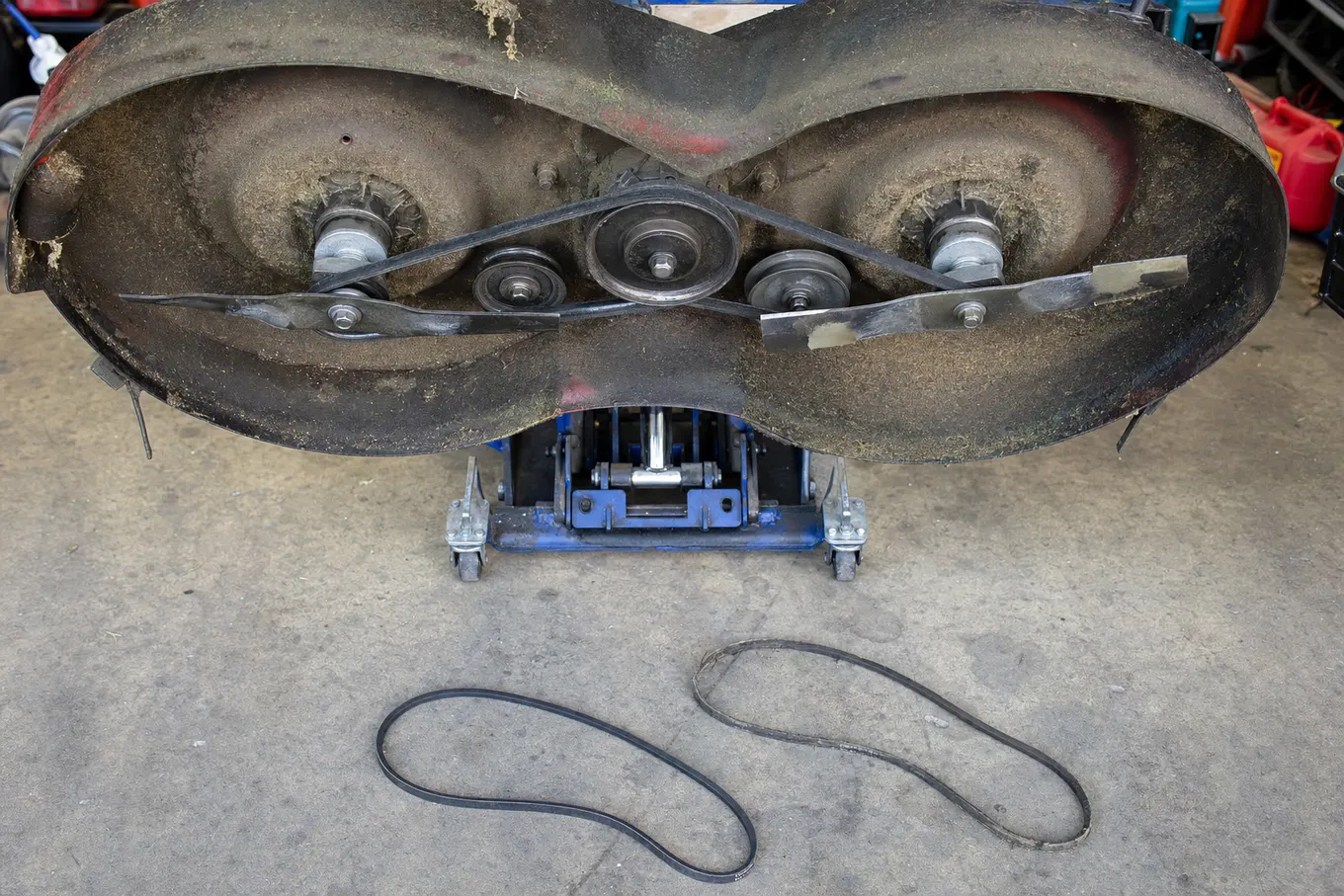
Need lawn mower belt replacement or deck repair near Port Charlotte? This shop handles the whole under-deck system: belts, idler pulleys, tensioners, spindle bearings, deck leveling, rust repair and blade engagement on riding mowers, zero turns and walk behinds. We diagnose the cause, not just the broken part, quote you before touching anything, and can pick the mower up if it cannot travel. Call or text (941) 555-0123.
Your Mower Deck Is a Machine of Its Own
Owners think of the deck as a dumb steel dish. It is closer to a second machine bolted under the first one, with its own drivetrain, its own bearings and its own geometry. Six subsystems do the cutting, and every bad-cut complaint traces to one of them.
Belts
V-belts carry engine power down to the deck and across it, spinning every blade. They transmit surprising horsepower through nothing but friction and tension, which is why their condition decides whether blades hold speed in heavy grass or fade exactly when the cutting gets hard.
Spindles
Each blade bolts to a spindle: a shaft riding in bearings inside a housing bolted through the deck shell. Spindles hold a blade spinning at full tilt in a perfect plane, inches from sand, water and impact. When their bearings fail, you hear it before you see it.
Idlers and tensioners
Spring-loaded arms and smooth pulleys that keep the belt tight, guide it around corners and absorb the jolt of engagement. Their small bearings live the same hard life as spindle bearings but get a fraction of the attention, which suits them fine because they enjoy being misdiagnosed.
Blades and adapters
The business end. Blades mount through adapters or star hubs that key them to the spindle, and several are designed to give way in a hard strike to spare the parts above. A bent blade or crushed adapter turns the whole balanced system into a paint mixer.
The shell and baffles
The deck body is not just a cover. Its curved chambers and internal baffles create the airflow that stands grass up for the blades and carries clippings out the chute. Rust that changes the shape changes the cut, long before anything actually breaks.
The engagement system
A lever and cable on older machines, an electric PTO clutch on most newer ones. It connects engine power to the deck on your command, takes the biggest shock load in the whole system, and produces some of the most misread symptoms on the machine.
The deck also happens to be where Florida hits a mower hardest. Sand blasts it from below, wet clippings glue themselves to it from inside, salt air works on it from outside, and the grass never stops growing long enough for any of it to dry out.
Deck and Belt Symptoms, Translated
Under-deck problems all sound like doom from the seat, but each one leaves its own fingerprints. Match what your mower is doing to the likely suspects, then let the bench confirm it.
| What you notice | The likely suspects |
|---|---|
| Squeal when the blades engage | Glazed or loose belt, sticky tensioner pivot, tired tension spring |
| High scream that fades as you mow | Dry spindle or idler bearing heating up, weeks from failure |
| Blades bog down in thick grass | Stretched belt slipping, dull blades, clippings packed in pulley grooves |
| Belt keeps jumping off | Wobbling idler, bent keeper rod, debris under the covers, wrong belt for the deck |
| Steps or ridges between passes | Deck out of level side to side, mismatched tire pressures, worn hangers |
| Ragged strip behind one blade | That blade dull or bent, its belt run slipping, a spindle going loose |
| Whole machine shakes with blades on | Bent blade, lost blade balance, chunked belt, spindle wobble |
| Weak discharge, clumping clippings | Packed underside killing airflow, nose-high pitch, slow blade speed |
| Scalped crowns and bald patches | Cutting height too low for the lawn, flattened anti-scalp wheels, low tire |
| Burnt rubber smell after mowing | Belt slipping hard, dragging pulley bearing, engagement not fully seating |
| Blades will not engage at all | Snapped or derailed belt, failed clutch or cable, engagement switch |
| Knocking or grinding under the shell | Loose blade hardware, debris trapped above a blade, collapsed bearing |
Two notes on that list. Blades that refuse to engage on an electric-clutch machine can be a voltage problem wearing a mechanical costume, which is why this page and the electrical repair page share custody of that symptom. And any new vibration with the blades running deserves an immediate stop: continuing to mow a shaking machine converts small repairs into big ones at every pass, and it is the one deck symptom with real safety stakes.
Why Mower Belts Fail Fast in Southwest Florida
A deck belt is a friction device asked to move real horsepower through a couple square inches of contact. Everything about our climate conspires against it: heavier grass, more hours, more heat, more grit. Understanding the failure modes tells you what the belt on your machine is about to do.
Glazing: how wet season grass loads cook a belt alive
June through September, an irrigated St. Augustine lawn puts on growth that northern mowers never meet. Every pass through that dense, moisture-heavy grass loads the blades, and the belt either transmits the force or slips trying. Slipping is the killer. A slipping belt skids against its pulleys, friction becomes heat, and heat hardens the rubber sidewalls into a slick glossy surface. Mechanics call it glazing, and it is a one-way trip.
Here is the death spiral: a glazed belt grips worse, so it slips more, so it runs hotter, so it glazes harder. The symptom from the seat is blades that bog and moan in thick patches, a squeal at engagement, and eventually a smell like a burnt pancake. Owners respond by mowing slower, which hides the problem without fixing it, and the belt fails on some future Saturday with half the yard done.
Catching glaze early is easy: the belt's sides shine like polished shoe leather instead of showing dull black rubber. At that stage replacement is a planned, cheap event instead of an emergency. It is one of the first things we look at on any cut-quality complaint.
Stretch: the slow fade that steals blade speed
Belts do not only snap. More often they simply grow. The tension members inside a belt elongate a little with every heat cycle, and the spring-loaded tensioner takes up the slack until one day the spring runs out of travel. Past that point, belt tension falls off and blade speed sags under load even though everything looks intact.
A stretched belt announces itself in small ways. Blade engagement feels soft or delayed, like the deck is deciding whether to participate. Cut quality is fine in thin grass and ragged in thick. The tensioner arm sits at an odd angle compared to where it lived when the belt was young. None of it screams failure, and that is the trap: a stretched belt can slip enough to glaze itself and take a pulley bearing along for the ride.
When a stretched belt comes off at our bench, the tensioner spring and idler arm pivot get checked with it, because a seized pivot mimics a stretched belt exactly and a new belt will not fix a frozen arm.
Shredded belts: reading the wreckage for the real cause
A belt that comes apart violently, rubber flung around the deck, cords unwound like fishing line, almost always died of murder rather than old age. Something in the pulley run was out of order: an idler with a collapsing bearing wobbling out of plane, a belt keeper rod bent in from a stick strike so it saws the belt every revolution, a spindle pulley sitting crooked on a failing spindle, or a chunk of debris riding in a groove.
This is why we treat a destroyed belt as evidence, not garbage. The wear pattern tells the story: fray on one edge points to misalignment, burn marks point to a locked pulley, cover scrubbed off in patches points to an obstruction. Match the damage to the deck and the underlying cause turns up in minutes.
Skipping that autopsy is how a machine eats three belts in a season. If your mower has done exactly that, stop feeding it belts and bring it in with the last carcass if you still have it. The dead belt is worth more to us than to your trash can.
Debris derailment: sticks, sand and the palm frond problem
Florida yards throw things at a deck that lawn engineers apparently never imagined: palm frond stems that spear up between belt and pulley, seed pods that wedge into grooves, sandy clipping paste that packs pulley valleys until the belt rides high on a false floor. A belt riding high loses its wedge grip, slips, and can be levered right off the pulley by the next bump.
The classic call sounds like this: the belt came off, I put it back on, it came off again the same week. The belt is fine. Something under the covers is crowding it. Deck covers hide most of the run from view, so owners rarely spot the culprit from above, and half of quick roadside re-installs route the belt subtly wrong around a keeper, which finishes it off.
Every belt job here includes digging the packed clippings and sand out of the grooves and checking each keeper's clearance. It is five unglamorous minutes that decides whether the new belt stays home.
The wrong belt: why the parts store special keeps failing
From arm's length, a belt is a belt, and the general purpose loop from the hardware aisle is cheaper than the one with your mower brand on the sleeve. The differences are invisible and decisive. Real mower deck belts are built around aramid fiber cords that hold their length under shock loads, with covers compounded to survive engagement slaps and clutch heat. Generic machinery belts stretch sooner, glaze faster and can run slightly narrow or shallow in the pulley groove, which concentrates wear in all the wrong places.
Length tolerance is the sneaky part. Deck tensioners only have so much travel, so a belt half an inch long arrives pre-stretched as far as the system is concerned, and a belt half an inch short may not route at all. Correct fit is a model number question, not an eyeball question.
We fit belts that match the machine's spec, OEM or proven aftermarket equivalents, and we are happy to explain the choice on your quote. The cheapest belt per year of service is rarely the cheapest belt on the shelf.
Routing: the puzzle that catches everyone at least once
Deck belt routing on a multi-blade machine is a genuine puzzle, with the belt snaking around spindle pulleys, idlers, and both sides of the tensioner in a pattern that is obvious right up until the old belt is off. Route it wrong by one pulley face and the belt may still turn the blades, briefly, while it wears against a keeper or runs twisted, and the new belt dies in hours.
If you tackle your own belt, take a phone photo before the old one comes off, and check the underside of the deck or the frame near the tunnel: many brands hide a routing diagram sticker there. If the sticker is long gone and the photo did not happen, the model number pulls up the factory diagram, which beats archaeology.
And if the routing has already gone sideways, no shame in it. Re-routing a belt correctly takes us minutes with the deck on the bench, and it is far cheaper than the second belt.
Spindle Repair: The Scream Always Comes Before the Failure
A mower spindle asks a set of small ball bearings to hold a steel blade dead level at full speed, all day, in a sandstorm, occasionally while being hit with sticks. That they last as long as they do is a small engineering miracle. That they eventually fail in Florida sand is a certainty.
How sand and water get the bearings
Spindle bearings are sealed, but seals are a negotiation, not a wall. Every hour of mowing, the deck breathes fine sugar sand dust, and the blade end of the spindle sits inches above the source. Grit works past the lip seals a particle at a time and turns the grease into lapping compound. Meanwhile our humidity and every rinse-down push moisture at the same seals, and water inside a bearing rusts the races the first week the mower rests. Grease breaks down under the double assault of contamination and August heat, and once metal touches metal, the countdown gets loud.
The noise timeline, from hum to catastrophe
Spindle bearings fail on a schedule you can hear. First comes a low hum or drone under load, easy to write off as normal deck noise. Then a growl that changes with blade speed. Then the signature scream, a dry banshee note that neighbors hear before you do, sometimes fading as the bearing warms and the metal expands, which convinces owners it fixed itself. It did not. Past the scream comes wobble, where the bearing has lost its geometry and the blade starts orbiting instead of spinning true. The end state is a seized or shattered bearing, a blade tip digging turf, a snapped belt, or in the ugliest version, a spindle shaft letting go entirely with a blade attached.
Every step down that timeline multiplies the bill. Caught at the hum, a spindle job is bearings or one assembly. Caught at the wobble, it is often the spindle plus a chewed belt, a grooved pulley, and elongated bolt holes in the deck shell. Caught at seizure, add a destroyed blade, possible shell damage, and a genuinely dangerous failure that happened at ankle height. When a deck starts singing a new note, the cheap moment to act is now.
How we check them, and the rebuild versus replace call
The bench test is simple and merciless. Belt off, plug wire off, and each blade gets rocked by hand: any detectable knock or tick at the blade tips means bearing clearance that should not exist. Each pulley gets spun and listened to, each shaft checked for straightness, each housing inspected around its mounting bolts. Where the design allows it, we press new quality bearings into a sound housing and you save real money over an assembly. Where the housing bore has worn oval or the shaft is grooved or bent, we fit the complete assembly, because new bearings in tired metal is a repair with a countdown timer. You get told which one your deck needs and why, with the worn parts available for show and tell at pickup.
Why a little wobble ruins a lot of lawn
Blade tips on a healthy deck travel close to the speed limits the industry allows, which is what produces a crisp shear cut through tough St. Augustine stems. Give the spindle even a small amount of bearing play and that tip stops tracing a clean circle: it flutters vertically and orbits sideways, so cut height varies within every single revolution. The lawn shows it before the machine does, as a vaguely furry, uneven surface that looks dull-bladed no matter how fresh the sharpening is. If sharpening did not fix the cut, the next suspect is the bearing holding the blade, and that is a rock test away from an answer.
Grease fittings: the trick question
Some spindles carry grease zerks, many are sealed for life, and the internet argues about both. Our position is practical: if the fitting exists, it gets a measured shot of the right grease at service, enough to replenish without blowing the seals out from inside, which over-enthusiastic grease gun work absolutely can do. If the spindle is sealed, no fitting gets drilled and no miracle additive gets sold to you. Sealed units are replaced on condition, and a regular service that includes the rock-and-spin check is what catches their decline early.
Deck Leveling: Where Cut Quality Actually Lives
More bad-cut complaints trace to deck geometry than to any broken part. A deck that sits crooked cuts crooked, forever, no matter how sharp the blades are. Leveling is fussy, measurable work, and it is the difference between a lawn that looks mowed and a lawn that looks striped by a barber with hiccups.
Decks do not stay level on their own. They hang from the frame on links, hangers and pins that wear a little every hour, and one hard encounter with a root or curb rearranges the geometry in a millisecond. Tires lose pressure unevenly and tilt the entire machine, which tilts the deck with it. Florida gives the process a hand: hanger pivots rust in salt air, sand grinds the pin holes into slots, and year-round mowing piles on hours. Here is the procedure a proper leveling follows, and why each step exists.
- Park on a genuinely flat surface. A sloped driveway bakes its slope into every measurement that follows. The shop floor settles the argument before it starts.
- Set tire pressures first, not last. The deck hangs from the chassis and the chassis stands on air. A few pounds of difference between rear tires tilts the blade plane more than most worn parts do. Sidewall pressure, all four corners, before any wrench touches a hanger.
- Measure at the blade tips, not the deck edge. Deck shells warp and rust; what actually meets the grass is the blade. Each blade gets rotated to specific positions and measured from tip to floor, which reads the true cutting plane the lawn will see.
- Level side to side within the machine's spec. Blade tips across the deck should sit within a small fraction of an inch of each other. Beyond that tolerance, every pass leaves a visible step where the passes overlap, the complaint owners describe as stairsteps or ridges.
- Set the front to back pitch. Almost every deck is designed to run slightly nose down, commonly around an eighth to a quarter of an inch depending on the machine, so the leading blade edge does the cutting and the trailing edge does not re-cut the same grass. Correct pitch improves cut, discharge and even fuel use; a nose-high deck beats the clippings and blows power on double cutting.
- Adjust the hangers, then shake the deck. Adjustment nuts move the deck to spec, and then worn links, egged pin holes and loose bushings get found by hand, because a deck that measures level while floppy will not stay level to the end of the driveway.
- Cut real grass and look. The floor test passes machines. The grass test passes lawns. A short test cut confirms what the tape promised, and it is the standard the job actually has to meet.
Leveling pairs naturally with blade sharpening and balancing, since sharp blades on a crooked deck and dull blades on a level deck both lose. Machines that mow the manicured circles of Rotonda West or the golf course lots around Lake Suzy come through for exactly this pairing every season, because on lawns like those, the neighbors notice a ridge before you do.
Mower Deck Rust: Patch It or Replace It, Honestly
Steel decks and coastal Florida have a difficult relationship. Between Gulf air outside and wet clippings inside, a deck here fights corrosion from both faces at once, and eventually every owner faces the same question: is this deck worth saving? Here is how we actually answer it.
Why decks rot from the inside out here
The rust that kills decks rarely starts on the painted outside. It starts under the mat of wet clippings packed against the underside, where moisture sits against bare steel for days at a time. St. Augustine clippings are heavy and damp even in the dry season, and during the summer rains a deck's underside may not be truly dry for months. Grass chemistry makes its own contribution as the clippings break down against the metal.
Add salt. Within a few miles of the harbor, the bays or the Gulf, airborne chloride settles on the machine and rides rinse water into every seam. Salt does not just cause rust, it accelerates it and helps it creep under paint from any small chip, which is why coastal decks blister along edges and seams while inland decks merely dull.
The pattern shows up in what we see from each town: decks from Englewood and Placida arrive with perforated corners years before identical machines from North Port greenbelt lots. Geography is destiny, unless maintenance intervenes.
Surface rust versus structural rot: the screwdriver verdict
Every used deck in this county has rust. The question is whether it is cosmetic or structural, and the test is humble: a screwdriver tip and firm pressure. Sound steel under brown staining shrugs it off. Rotten steel flakes, dents like stale bread, or lets the tip through. We probe the known graveyards: the corners where clippings pack deepest, the seams around baffles, the discharge area, and most critically the flat pan around each spindle mount.
Staining and shallow pitting mean the deck has years left and deserves protection. Flex, flake and perforation mean load paths are compromised, and the conversation changes from cosmetics to structure. The distinction matters because the deck is not decorative: it is the chassis holding spinning blades in a precise plane next to your feet.
When patching a deck makes honest sense
Patching gets a bad reputation from bad patches. Done right, on the right deck, it is legitimate repair: rot cut back to bright steel, plate formed and welded in, seams sealed, the area primed and coated. It makes sense when the rot is localized in low-stress zones, when the rest of the shell tests sound, and when the machine around the deck justifies the labor, a commercial-grade rider or zero turn with a strong engine and drivetrain being the classic case.
A proper patch is not a smear of body filler or a pop-riveted street sign, both of which we have removed from customer decks with a mixture of respect and horror. Filler holds no load and hides the rot's progress; thin riveted sheet traps moisture behind it and doubles the corrosion rate. If a patch is worth doing on your deck, it is worth doing in steel, by weld, with the water sealed out.
When replacement wins, and what replacement means
Some rot ends the patching conversation immediately. Perforation around spindle mounting bolts means the deck can no longer hold blade geometry under load, and welding new plate into a load path surrounded by tired metal is gambling with a spinning blade. The same verdict applies to rotted belt keeper anchors, crumbling hanger brackets and a trailing edge going lacy: once structure is gone in multiple zones, the shell is done as a machine part even if it still looks like a deck.
Replacement then splits two ways. Complete replacement decks or bare shells exist for many popular models, and moving your good spindles, pulleys and hardware onto a new shell can be a sound investment on an otherwise strong machine. When the price of a shell approaches the value of the whole mower, we say so, and the honest answer becomes a different machine. You will get that math from us straight, before any money moves, the same way we handle every repair or replace call in the shop.
Making a deck last: the habits that beat the salt
Deck longevity in this climate is mostly a moisture management problem, and the routine is short. Scrape the underside when clippings build up, because the packed mat is the engine of rot; a plastic scraper and ten minutes after the deck cools does it. If you rinse, dry: run the blades a minute afterward or leave the machine in the sun, since a rinsed deck parked wet in a shed is cleaner and rustier. Touch up paint chips on the top side before salt finds the bare metal. And park the mower on concrete, not on the lawn, where it spends every night drinking ground moisture.
Machines that get this treatment plus an annual look-over genuinely die of something else. The deck outlasting the engine is a fine outcome, and around here it only happens on purpose.
Pulleys, Idlers, Tensioners and Anti-Scalp Wheels
Idler pulleys: the great impersonators
Idlers are the smooth pulleys that guide and tension the belt, and each one spins on a small sealed bearing that lives the same sandy, wet life as a spindle bearing at a fraction of the size. When an idler bearing dries out, it shrieks, wobbles and eats belts, and from the operator's seat it is indistinguishable from a spindle failure. The price difference between those two diagnoses is substantial, which is why every under-deck noise here gets traced to its actual source pulley before anything is ordered. Buying a spindle to silence an idler is a classic and completely avoidable overspend.
Tensioner arms and springs: the belt's suspension
The tensioner is a pivoting arm pulled by a long spring, and it is the reason a belt keeps working as it wears. Around here the pivot is the weak point: it lives low, catches every wash and rain, and rusts until the arm moves grudgingly or not at all. A sticky tensioner under-tensions the belt in one direction and over-tensions it in the other, producing slip, squeal, hot bearings and belt wear that no new belt can outrun. Springs fatigue and stretch too, quietly derating the whole system. On any belt complaint, the arm gets swung by hand and the pivot gets freed and lubricated or replaced. It is a small part with veto power over everything else under there.
Grooved pulleys and bent shafts
A pulley that has run a failing belt long enough develops polished grooves and sharp lips that will chew the replacement belt from day one, and a pulley that took a debris strike can run visibly out of true. Reusing damaged pulleys is the quiet reason some fresh belt jobs fail early. Ours get inspected on the bench with the belt off, spun, sighted and replaced when they have crossed from worn to weaponized.
Anti-scalp wheels: cheap insurance for the lawn itself
The plastic wheels at the deck's edges exist to keep the blades out of the dirt when the ground rolls, and Florida lawns roll more than they look like they do. Wheels worn to flats, seized on rusty axle bolts, or set at the wrong height quietly hand you scalped crowns and dirt-dulled blades, then let the blame land on the blades or the deck. Setting them correctly for your cutting height takes minutes and belongs in every deck service, so here, it is in every deck service.
Zero Turn, Lawn Tractor and Walk Behind Decks Compared
Zero turn decks: stamped, fabricated and worked like rentals
Zero turn decks come in two constructions and it pays to know which you own. Stamped decks are pressed from sheet steel into smooth curves, cut beautifully in residential duty, and carry thinner metal that rust and impacts punish sooner. Fabricated decks, the welded slab-sided type on commercial machines from the likes of Scag, Exmark, Gravely and Bad Boy, are built from heavy plate that shrugs off curbs and stumps, though their spindles, belts and idlers still wear like anything else that runs hundreds of hours a season. Wider decks also mean more of everything: three spindles instead of two, longer belts with more idlers, more anti-scalp wheels, and a deck lift system whose pivots wear into slop that shows up as inconsistent cutting height. Crews running zero turns around here treat deck bearings as consumables and budget accordingly, which is exactly the right mindset.
Lawn tractor decks: hung low and hit often
The classic 42 to 54 inch tractor deck hangs from four adjustable points and gets raised and lowered constantly, so its wear concentrates in hangers, lift linkage and the engagement hardware. It also sits lower to the ground than most owners realize, which is why tree roots and landscape edging keep our welding gloves busy. Everything on this page applies to these decks in full measure, and they make up the bulk of the riding mower work that rolls through the shop.
Walk behind decks: small, but not simple
On a push or self propelled mower the deck is not a component, it is the chassis: the engine bolts straight to it and everything else hangs off it. Steel versions rust at the same corners their bigger cousins do, and once the shell around the engine mount softens, the machine is finished, which makes the scrape-and-dry habit even more valuable here. Aluminum decks refuse to rust and instead crack at stress points, usually around wheel adjusters, and cracked aluminum is a replace conversation, not a welding one, on a mower this size. Self propelled models add a small drive belt running to the transmission, with its own stretch and glazing story, and premium machines carry a blade brake clutch that stops the blade while the engine keeps running, a genuinely great feature with its own cable adjustments and wear parts. All of it is bread and butter on our push mower bench, and a single-blade machine doubles the stakes on blade balance, since there is no second blade to average out a shake.
Blade Engagement: Manual Levers and Electric PTO Clutches
Older tractors and many walk behinds engage their blades mechanically: a lever pulls a cable, the cable moves an idler, and belt tension does the rest. The system is simple and fixable, and it fails in simple, fixable ways. Cables stretch until the lever runs out of travel before the belt is truly tight, producing lazy half-engaged blades that slip under load. Cable housings rust internally in coastal air until the lever fights back like a stiff parking brake. Pivot points wear into slop. Adjustment, lubrication or a new cable restores the crisp snap the system had when new, and it is some of the most satisfying, least expensive work on this page.
Newer riders and every zero turn use an electric PTO clutch instead: pull the yellow knob and an electromagnet clamps the belt drive into motion. The clutch lives a double life, half electrical component and half mechanical one, and its failures split the same way. Weak system voltage makes it slip and cook, its internal bearing can howl like a spindle, and its coil can die outright. The mechanical half of that story, belts and pulleys, lives on this page; the coil, switch and charging half lives with our electrical and starter repair service, and machines with engagement complaints regularly need the two looked at together. That is convenient, because both benches are the same bench.
Either way, engagement is the hardest single moment in a belt's life, the instant stationary rubber meets spinning steel. Machines that spend their lives mowing the big Bahia lots around Arcadia or Babcock Ranch acreage rack up thousands of those moments, and their engagement hardware earns a check with every service, not just when something fails.
Where Blades Fit Into Deck Work
Every part above exists to spin a blade correctly, so blades get a word here even though they have a full page of their own. Two blade problems masquerade as deck problems. A bent blade, souvenir of a root or sprinkler head, throws the cutting plane off on one side and shakes the machine hard enough to loosen hardware and hammer bearings, imitating spindle failure convincingly. And a blade mounted through a worn or cracked adapter can shift on its spindle, cutting at a slight angle and vibrating in a way that no sharpening will cure. Deck jobs here end with the blades checked for straightness, balance and secure mounting at proper torque, because sending a trued-up deck out with a bent blade is washing a car and skipping the windshield.
Blade style ties into deck condition more than most owners expect. High-lift blades pull hard airflow through the shell to throw clippings clear, which works beautifully until a rust-thinned or clipping-packed deck cannot support the airflow, and suddenly the discharge clumps. Mulching blades and mulch kits with their baffle plates recirculate clippings for another chop, a fine idea in moderate growth and a clog machine in wet August St. Augustine, where side discharge usually wins. The point is that blades, baffles and shell act as one air system: change one and you change the others' behavior. When cut or discharge quality drops, we evaluate that system together rather than blaming whichever part was replaced most recently.
How a Deck Job Runs at This Shop
A deck repair here starts with your version of events, because the sentence "it flung the belt twice since Tuesday" points the work differently than "it has squealed since spring." Then the deck comes off or comes up, and it gets the full autopsy regardless of which single part you came in about: belt read for glaze, cracks and stretch, every pulley spun by ear and hand, every blade rocked for bearing play, shell probed at the rot-prone zones, hangers and lift linkage shaken for slop, engagement hardware cycled. Fifteen minutes of inspection is the cheapest part of the whole job and it is why our repairs tend to stay repaired.
You then get one call with an itemized quote: what failed, what is about to fail, what can safely wait, priced separately so you choose. Approve it and the work happens with parts matched to the machine, whether that is any of the brands we see daily, John Deere, Craftsman, Cub Cadet, Toro, Husqvarna, Troy-Bilt and the rest, or the commercial marques. Parts patterns repeat heavily across those names, which keeps availability good even for machines with some gray in their paint. Reassembly happens at proper torque, engagement gets cycled, the blade plane gets measured, and the mower earns its way out of the shop with a test cut rather than a handshake. If something we touched is not right afterward, it comes back and we make it right. That policy is older than the shop sign.
Deck Checks You Can Do, and the Ones to Leave on Our Bench
Safe and worth your time
- The walkaround listen. Once a month, engage the blades from the seat and just listen for ten seconds. New notes, squeals or rhythmic ticks are the deck filing a report. Early reports are cheap ones.
- The belt glance. With the engine off and cool, look at whatever belt run is visible without removing guards. Shine, fray or powdery black dust on the deck top are all findings worth a phone call.
- Underside scraping. Plug wire off, machine stable, plastic scraper. Keeping the clipping mat thin is the highest-value ten minutes in deck ownership, and it doubles as a chance to spot rust and damage early.
- Tire pressure discipline. A cheap gauge and the sidewall number, monthly. It protects your cut quality and makes every future leveling hold true longer.
- Anti-scalp wheel wiggle. Grab each little wheel and check it spins free and its bolt is snug. Thirty seconds, and it saves lawns.
Better left to the shop, and why
Deck work stores energy in ways that surprise people. Tension springs on idler arms are strong enough to relocate fingers when a pry bar slips, and several belts route through spring-loaded paths that fight back during installation. Blade bolts are torqued hard on purpose and often need the blade blocked correctly to break loose, which is where knuckles meet cutting edges when it goes wrong. And any job that means getting under a raised machine belongs on proper equipment: a rider held up by a bottle jack and optimism is the single scariest thing we hear about in customer stories. None of this is gatekeeping. It is just the honest line between maintenance and repair, drawn where the injuries happen.
A deck calendar for a Florida year
Timing matters here because the mowing never truly stops. Before the spring flush, a leveling check, blade service and belt inspection set the machine up for the heavy season, ideally paired with a full tune up. Through the summer rains, scrape more often and take every new noise seriously, because wet season load is when marginal parts declare themselves. In late fall, when growth finally slows, give the deck its recovery service: clean, dry, inspect, touch up paint, and let any borderline bearing get replaced in the calm season instead of failing in the busy one. Seasonal residents get the same list compressed into a departure checklist, and their decks come back in November ready to mow instead of ready to rot.
What Belt, Spindle and Deck Work Costs, and Why
Deck work prices honestly because it itemizes honestly. A belt swap with healthy pulleys is quick, predictable work. Spindle jobs scale with how many spindles need attention and whether bearings or complete assemblies make sense for your deck's design. Leveling is measured, methodical labor. Rust repair varies the most, because cutting and welding steel takes the time it takes, which is exactly why the probe-and-verdict inspection happens before the quote, not after. On every job, you hear the number and approve it before the deck comes apart, and if we open things up and find the idler was the villain instead of the spindle, the quote goes down, not up. Nobody here gets paid extra for guessing expensive.
For context against replacement: a deck full of new belts, bearings and hardware typically runs a small fraction of what a comparable new rider or zero turn costs, and it renews the exact parts that decide cut quality. The day the math tips the other way, usually a structurally rotten shell on a budget machine, you will hear it from us in plain words with the reasons attached. People around here talk to their neighbors, and we like what they say about us. We intend to keep it that way.
Deck and Belt Repair for the Whole 30 Mile Circle
From canal-front lots that rust decks early to ranch acreage that wears out belts by the hour, every town's lawns break mowers in their own style, and we see all of it. Your town's page has the local details, or browse the complete service area. Riding mower stuck with a dead deck? We pick up.
Belt, Spindle and Deck Repair FAQs
How do I know when a mower belt needs replacing?
Read the belt like a tire. Shiny, hard sidewalls mean it has been slipping and cooking itself. Fine cracks across the inner face mean the rubber is aging out. Chunks missing, fraying edges or exposed cords mean you are mowing on borrowed time. Behavior tells on it too: blades that take a long beat to come up to speed, a burnt rubber smell in thick grass, or squealing at engagement are all a belt asking politely to be retired before it strands you.
Why does my new belt keep coming off the pulleys?
Because the belt was never the disease, just the symptom. A belt that repeatedly jumps ship has help: a wobbling idler pulley with a dying bearing, a bent belt guide from a stick strike, a spindle pulley out of plane, debris packed in a groove, or a belt one size off from spec. Installing a third belt without finding the reason is donating rubber. We put a straightedge and a spin test on every pulley in the run before the replacement goes on.
What does a screeching noise from under the deck mean?
High pitched screaming from below is almost always a dry bearing announcing the end, either in a spindle or an idler pulley. The two sound nearly identical from the seat, which catches a lot of people buying spindles when a much cheaper idler was the criminal. Park the machine, and with everything off and the plug wire pulled, spin each pulley and rock each blade by hand. Or skip the detective work, tell us what you heard, and let the bench sort out which bearing is guilty.
Can you rebuild a spindle or does the whole assembly get replaced?
Both are real options and the machine decides. Many spindles come apart and accept new bearings for a fraction of the assembly price, and on quality decks that is money well spent. But once a bearing has run loose long enough to egg out the housing bore or groove the shaft, new bearings will not stay tight in worn metal, and the complete assembly is the honest fix. We measure before we recommend, and we will show you the wear that made the call.
Why does my mower leave a ridge or stripe between passes?
A ridge down the middle of the cut path usually means the deck is pitched wrong front to back or one blade is running lower than its neighbor. Overlapping blades on multi-spindle decks are timed by belt position to miss each other, but cut height between them is set by deck geometry. A leveling session with the blade tips measured directly, plus a look at tire pressures and worn deck hangers, cures most striping complaints in one visit.
My deck has rust holes. Is it worth repairing?
Depends entirely on where the holes live. Rot in the flat top pan away from any load point can often be patched with welded plate and honest expectations. Rot around spindle mounts, belt keeper anchors or the trailing edge is structural, and patching there is throwing good money after bad because the metal around the weld is just as tired. We will tell you which category yours falls in, and when a replacement shell or a different machine is the smarter spend, you will hear that plainly.
How often do mower belts need to be replaced?
There is no honest calendar answer, because belts age by load and hours, not by birthdays. A quarter acre lawn cut on schedule might get many seasons from one belt, while an acre of wet season St. Augustine can chew one up far faster. The better habit is a yearly inspection: check for glazing, cracking and stretch every spring, and any belt that has started slipping goes on the replace-soon list before it fails at the worst possible moment, which is the only moment belts choose.
Do I need the exact OEM belt or will a hardware store belt work?
Deck belts are engineered parts wearing a plain rubber disguise. OEM and quality aftermarket mower belts are built with aramid cord that barely stretches and covers that survive clutch engagement. The look-alike belts sold for general machinery are wrapped differently, stretch more, and run in mower pulleys like a guest wearing the wrong shoes. Length matters to a fraction of an inch because the tensioner has a limited travel. Bring us your model number and the right belt goes on the first time.
What are the small wheels on the edges of my deck for?
Those are anti-scalp wheels, and they are bodyguards, not rollers. They are set to hover just above the ground at your cutting height, touching down only when the deck tries to dip into a low spot or ride over a hump, so the blades do not shave the lawn bald. When the wheels wear flat, seize, or someone sets them carrying the deck's full weight, cut quality goes strange in ways nobody connects to a bracket and a plastic wheel. We check and set them with every deck job.
Why does my mower scalp the same spots in the yard?
Scalping is the deck getting closer to the dirt than you intended, and it has a short suspect list: cutting height set too low for the lawn's contours, anti-scalp wheels worn or misadjusted, uneven tire pressures tilting the whole machine, or a crowned yard that needs a slightly higher setting in those zones. Florida lawns hide surprising rolls and ruts under thick St. Augustine. Sometimes the fix is mechanical and sometimes it is a half inch more cutting height over the humps.
Can hitting a root or pipe damage more than the blade?
A hard strike sends its energy up the chain: blade first, then the blade adapter that is often designed to sacrifice itself, then the spindle shaft and bearings, and on some engines the crankshaft key. Any mower that hit something solid and now vibrates deserves a spindle and shaft check before it mows again, because running a bent assembly hammers the bearings and the deck shell every second the blades spin. The strike is one repair. Mowing with the damage is several.
What is the difference between a spindle and a mandrel?
Nothing but geography. Spindle and mandrel are two names for the same assembly: the housing, shaft and bearings that hold the blade and pulley in line under the deck. Parts catalogs use both words, sometimes for the same drawing. If a parts counter has ever corrected your vocabulary, they were being fancy. Either word gets you the right part here.
Why do the blades barely cut when the grass is thick?
Thick summer growth exposes every weak link in the drive path at once. A stretched or glazed belt slips hardest right when load peaks, so blade speed collapses exactly when you need it most. Dull blades make it worse by tearing instead of shearing, doubling the power the cut demands. And an engine that is down on power from its own issues cannot spin any belt properly. We check belt condition, blade edge and engine health together, because in August they fail as a team.
Do you fix bent decks from running over stumps or rocks?
Often, yes. A deck shell that took a hit can frequently be pulled straight enough to bring the blade plane back true, and bent hangers, brackets and baffles are replaceable. What we will not do is straighten and pray: after any impact repair the spindles get checked, the blade tips get measured through their full rotation, and the deck gets releveled. If the shell is creased somewhere that cannot hold geometry again, we say so before you spend the money.
The shop-wide FAQ answers the broader questions, and a human answers (941) 555-0123.
Hear a Squeal? Seeing Stripes? Say So Here.
Tell us the noise, the symptom or the ugly cut, and include a photo of the deck if you can get one safely. We will come back with what it likely is, what we would check, and a straight quote once we have eyes on it.
- The cause gets fixed, not just the broken belt
- Worn parts shown to you, not just billed to you
- Rather talk it through? (941) 555-0123