
Lawn Mower Carburetor Cleaning & Repair in Port Charlotte, FL
A carburetor is a fist sized piece of aluminum with passages thinner than a pencil lead, and Florida's ethanol gas plugs them for a living. We take carbs apart, clean them in an ultrasonic tank, rebuild or replace them, and hand you back a mower that starts and holds a steady rpm. Price approved by you first.
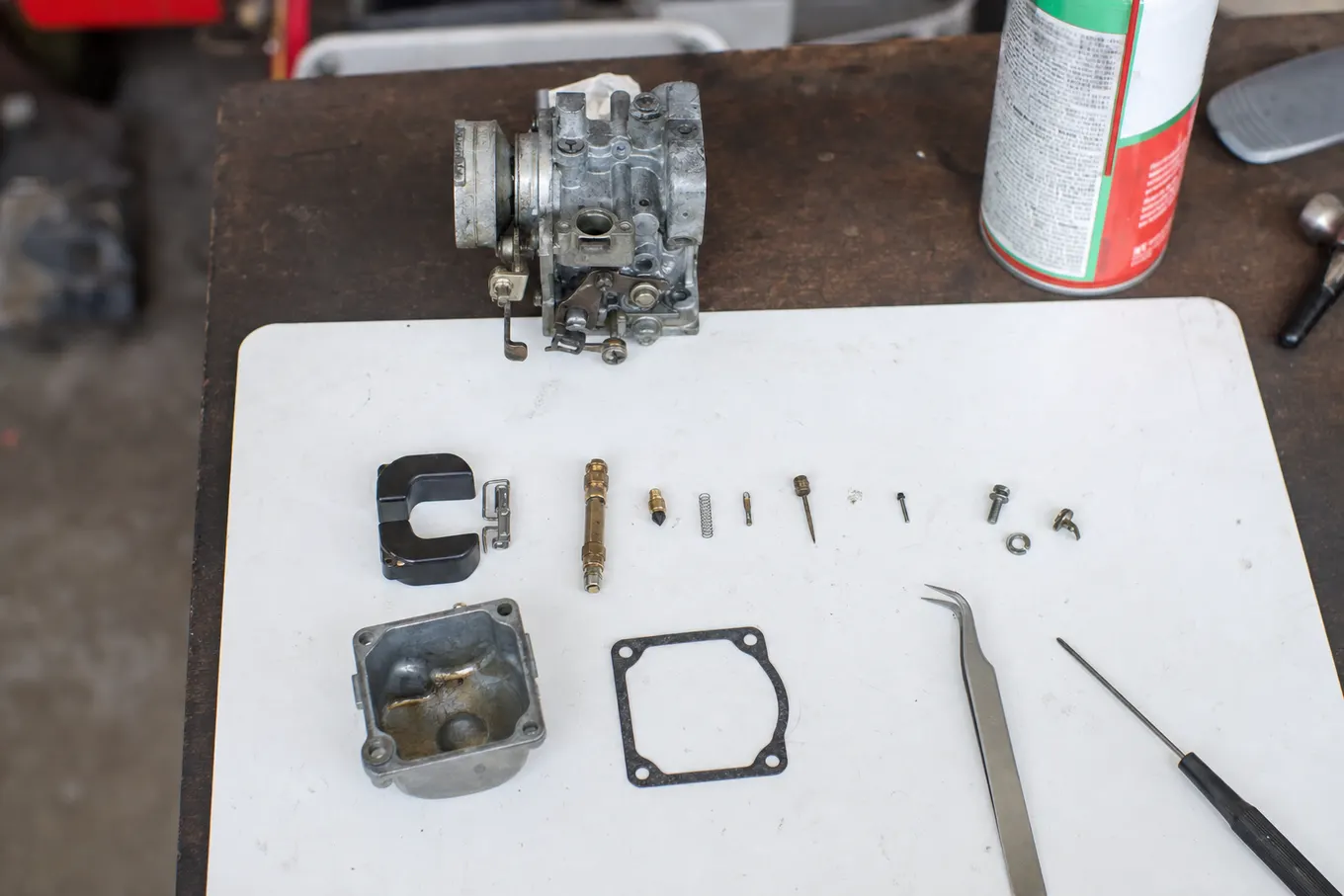
Mower surging, stalling or refusing to start after sitting? In Southwest Florida that trail almost always leads to the carburetor. Joe's Small Engine Repair in Port Charlotte cleans, rebuilds and replaces lawn mower carburetors on push mowers, riders and zero turns, checks the whole fuel system while we are in there, and quotes the job before a wrench turns. Call or text (941) 555-0123, or use the quote form and describe what it is doing.
How a Small Engine Carburetor Works, in Plain English
You do not need to fix your own carburetor, but understanding what the thing does makes every symptom on this page click into place. A carburetor has one job: mix air and gasoline in the right ratio for whatever the engine is being asked to do at that second. It does that job with no electronics, no sensors and no moving parts you would call sophisticated. Just physics, gravity and a handful of holes drilled to precise sizes. Here is the tour, one piece at a time.
The float bowl: a tiny fuel tank with its own shutoff valve
Underneath the carburetor hangs a small metal cup called the float bowl. It holds a standing supply of gasoline, roughly a shot glass worth on a push mower, so the engine always has fuel waiting right next to the intake instead of having to pull it all the way from the tank on every revolution.
The bowl fills itself the same way a toilet tank does. A plastic or brass float rides on the fuel surface. As the level rises, the float lifts a tiny rubber tipped needle into a machined seat and pinches off the flow from the tank. As the engine drinks the level down, the float sinks, the needle opens, and fresh fuel tops the bowl back up. Simple, elegant, and completely dependent on two tiny parts staying clean.
When a grain of debris wedges under that needle, fuel never stops flowing and the carburetor floods: gas out the air filter, gas into the cylinder, gas seeping past the rings into your oil. When varnish glues the needle shut, the bowl runs dry and the engine starves. Half the carb work in this shop starts and ends at that one little valve.
The venturi and main jet: how moving air lifts fuel out of the bowl
The body of the carburetor is a tube the engine breathes through. In the middle, the tube narrows and then widens again. That pinch is called a venturi, and it is the whole trick. Air speeding up through the narrow spot drops in pressure, the same effect that makes a shower curtain drift inward. The fuel in the bowl below sits at normal atmospheric pressure, so it gets pushed up a small passage toward the low pressure zone, where the airstream tears it into a fine mist.
Metering how much fuel makes that climb is the main jet, a brass plug with a calibrated hole in it, often near the width of a human hair on small engines. The engine's entire fuel budget at cutting speed flows through that one opening. Now picture a film of varnish shrinking that hole by a quarter. The mixture leans out, the engine loses power and surges, and eventually it will not run at all. Nothing broke. A hole just got smaller.
The emulsion tube: the mixer nobody has ever heard of
Between the main jet and the venturi stands a part most owners never learn exists: the emulsion tube, a thin brass straw drilled with a ring of pinprick air holes. Fuel rising through the tube gets pre mixed with small streams of air entering those holes, turning solid liquid into a froth that atomizes far better when it reaches the airstream.
Those pinprick holes are the finest drillings in the whole carburetor, which makes them the first place ethanol residue closes up. A blocked emulsion tube produces maddening symptoms: fine at idle, breaks up at full throttle, or rich one minute and lean the next. Spray cleaner through the bowl does not touch it. This is a big part of why we insist on full teardown and ultrasonic cleaning instead of the quick squirt and hope routine.
The idle and transition circuit: tiny holes with short tempers
At idle the throttle plate is nearly closed, so almost no air moves through the venturi and the main circuit goes quiet. To keep the engine alive, the carburetor runs a detour: a separate idle circuit that feeds fuel through even smaller passages to a port on the engine side of the throttle plate. A row of transition holes just past it takes over as the throttle starts to open, bridging the gap until the main jet wakes up.
Because these are the smallest fuel passages in the system, they clog first. A mower that starts fine, revs fine, but stumbles or dies the moment it drops to idle is describing a plugged idle circuit almost word for word. Same for the machine that hesitates and gasps when you throttle up from idle: those transition holes are starving the handoff.
Choke, primer and auto choke: three answers to the same cold start problem
A cold engine needs a much richer mixture than a hot one, because fuel does not vaporize well against cold metal. Carburetor designers solved this three different ways, and your mower has one of them. A manual choke closes a plate ahead of the venturi, starving the engine of air so the mixture goes rich. A primer bulb squirts raw fuel directly into the carburetor throat when you press it, no plate involved. Auto choke systems, common on newer walk behind engines, use a thermostat or vacuum device to do the choking for you and then back off as heat builds.
Each design fails its own way. Choke plates seize on corroded shafts and stick half closed, flooding a hot engine. Primer bulbs crack in Florida sun and lose their squirt, and the little channel they feed gums shut. Auto choke thermostats drift with age until the engine starts rich, runs rough for five minutes, and fouls plugs. When you tell us exactly how the mower behaves cold versus warm, you are handing us the diagnosis.
The governor: why a starving engine surges instead of just slowing down
One more actor makes carburetor problems feel dramatic. Your mower engine runs a mechanical governor, a flyweight or air vane system linked to the throttle whose job is to hold a target rpm no matter the load. When thick St. Augustine grass drags the blade down, the governor opens the throttle to compensate. That is the design working.
Now feed that governor a lean, hesitating engine. Rpm sags, the governor snaps the throttle open, the starved carb briefly catches up, rpm overshoots, the governor closes the throttle, and the cycle repeats a couple of times a second. That rhythmic wah wah wah everyone calls surging or hunting is not the governor failing. It is a healthy governor wrestling a dirty carburetor. Clean the fuel passages and the wrestling match ends.
That is the whole machine: a bowl, a float valve, three fuel circuits, a cold start device and a governor pulling the strings. Every symptom in the next two sections maps back to one of those pieces, which is exactly how we diagnose them on the bench.
What E10 Gas and Florida Humidity Do Inside a Carburetor
Carburetors do not wear out so much as they get poisoned. The poison is the fuel itself: ten percent ethanol gasoline aging in the wettest air in the country. Here is the actual chemistry, minus the lab coat, because once you see what is happening in the tank you will never store untreated gas again.
Ethanol is a sponge: how water gets into a tank you never opened
Ethanol is an alcohol, and alcohols are hygroscopic: they attract and bond with water vapor. Your mower's gas tank is not sealed. It has to breathe through a vent so fuel can flow out, and every breath of Port Charlotte air carries moisture. Day after day, the ethanol fraction in E10 quietly pulls that vapor into solution. Park the mower in an unconditioned shed or under a carport through a wet season and the process runs around the clock.
A little dissolved water actually rides along harmlessly at first, which is the sneaky part. The fuel looks fine, the mower runs fine, and the clock keeps ticking toward the failure described in the next panel. Gasoline without ethanol absorbs almost no water by comparison, which is the entire reason ethanol free fuel stores so much better in this climate.
Phase separation: the day the fuel splits into layers
Ethanol can only hold so much water in solution. Cross that saturation point, and the mixture does something abrupt: the ethanol and water bond to each other, divorce the gasoline, and sink. The tank now holds two liquids. On top floats gasoline that has lost its ethanol and a chunk of its octane. On the bottom sits a corrosive slurry of water and alcohol, and the fuel pickup drinks from the bottom.
An engine fed that bottom layer will not run, and the layer goes to work on metal immediately. This is not a rare laboratory event. It is a normal summer in a Florida shed, and once separation happens no additive on any shelf will remix the fuel. The tank has to be drained, the bowl emptied, and everything the water touched inspected. We pump out separated fuel weekly in season, especially from mowers that sat while their owners were up north.
Varnish and gum: what evaporating gasoline leaves behind
Gasoline is a cocktail of hundreds of compounds, and the lightest ones do the actual work of cold starting. Those light molecules evaporate first, escaping through the tank vent within weeks. What remains is a heavier, duller fuel that ignites reluctantly. Meanwhile the reactive compounds left behind oxidize, link into longer chains, and thicken. Chemists call the result gum. Mechanics call it varnish, because it dries into the same amber shellac you would recognize on old furniture.
Now remember the geography inside your carburetor: a main jet with a hair width opening, an emulsion tube with pinprick air holes, an idle circuit finer than both. Varnish does not need to fill those passages. A coating a few thousandths thick changes their effective size, and the calibration the factory drilled into the brass is gone. Heat accelerates the reaction, and a black mower deck in an August yard is an oven. That is why our carb season never really ends.
White crust and pitting: corrosion eating the aluminum from inside
Carburetor bodies are die cast from aluminum and zinc alloys, metals that hold up fine in gasoline and terribly in water. When absorbed moisture or a phase separated layer sits in the bowl, the metal oxidizes into the white, chalky crust every small engine mechanic knows on sight. It grows like frost around jets, inside threads, and across the machined face where the float needle seals.
Crust is cleanable. Pitting is not. Once corrosion digs actual craters into the sealing surfaces, the needle cannot shut off flow and the jets cannot meter accurately no matter how clean they are. That is the line between a carburetor we clean and a carburetor we replace, and we make that call by inspection after teardown, not by guessing from the outside.
Why Southwest Florida is the worst case scenario for a carbureted engine
Take everything above and stack our local conditions on top. Humidity that lives near the top of the national charts, feeding the ethanol sponge all year. Heat that speeds up every oxidation reaction, turning months of fuel decay into weeks. A cutting season that never truly stops, so mowers get parked with fuel in them at random times instead of winterized on a schedule. And a huge seasonal population whose machines sit idle from spring to fall, exactly the storage window that ruins fuel.
Add the last ingredient: nearly every pump in Charlotte County dispenses E10 unless you seek out ethanol free fuel on purpose. The result is a county where carburetor failure is not a possibility but a schedule. The upside is that a shop seeing this every day gets very good and very fast at fixing it, and very direct about teaching the habits that stop the cycle.
What fuel stabilizer actually does, and what it cannot undo
Stabilizer is not snake oil, but it is widely misunderstood. The chemistry it performs is preventive: antioxidant compounds interrupt the chain reactions that turn fuel into gum, and other ingredients help the fuel resist moisture trouble. Added to fresh gasoline, it genuinely stretches storage life several times over, which is why we tell every customer to dose the can at the pump, not at the shed.
What no bottle can do is reverse reactions that already ran. Varnish that has formed stays formed. Fuel that has phase separated stays separated. Pouring stabilizer into six month old gas is embalming, not medicine, and the marketing on some bottles lets people believe otherwise. Same honest note on the miracle in a can cleaners: run through a lightly dirty system they can help at the margins, but they do not reopen a sealed jet, and we regularly service carbs that drank three bottles of additive on the way here. Prevention is where the chemistry works. After the fact belongs to the ultrasonic tank.
Why your car shrugs off E10 while your mower chokes on it
Fair question, since your car drinks the same gas for years without drama. Three reasons. First, your car's fuel system is sealed and pressurized, with an evaporative emissions system instead of an open vent, so moisture and evaporation barely touch it. Second, fuel injection pushes gas through at pressure and computers trim the mixture continuously, so small changes in fuel quality get corrected invisibly. Third, you drive the car every week, so fuel never sits long enough to age.
Your mower enjoys none of that. Vented tank, gravity fed carburetor with fixed brass calibration, and weeks or months of sitting between uses. The same gallon of E10 that is harmless in a Camry is a slow acting solvent experiment in a mower shed. Different machines, different rules, and the rules for carbureted engines are simply stricter about fuel freshness.
The Carburetor Symptom Ladder, From Annoying to Dead
Carburetor failure is rarely sudden. It is a slide, and the mower announces every stage if you know the language. The ladder below runs from first complaint to full shutdown. The lower on this ladder you catch it, the smaller the bill, because varnish keeps curing and corrosion keeps digging the whole time you put it off.
| What you notice | What is happening inside the carb |
|---|---|
| Hunts or surges at no load | Main circuit slightly lean from early varnish, governor swinging the throttle to compensate |
| Only runs with choke on or repeated priming | Jets restricted enough that the engine needs an artificially rich mixture to stay alive |
| Starts, runs a few seconds, dies | The bowl held one shot of fuel, the clogged inlet or jet cannot refill it in time |
| Long cranking before a cold start | Choke or primer circuit partly blocked, fuel arriving late to an engine that needs it rich |
| Cranks strong, never fires | Passages sealed shut, bowl empty, or the bowl holding water instead of gasoline |
| Black smoke, wet plug, weak power | The rich failures: float set high, needle leaking, choke stuck partly closed |
| Fuel dripping from the air filter or rising oil level | Float needle failed open, gravity feeding fuel through the engine day and night |
The surge: rung one, and the cheapest place to act
Surging gets ignored more than any symptom we see, because the mower still cuts. Owners mow through an entire season of wah wah wah, and some genuinely believe the engine is supposed to sound like that. It is not. Surging means the main circuit is already partly restricted and the governor is covering for it. At this stage a straightforward cleaning almost always restores factory smooth running, no parts drama, no waiting on a kit. Every rung below this one costs more than acting here would have.
Starts then dies: the thirty second mower
This one has a signature so distinct we can nearly diagnose it from the phone call. The engine fires eagerly, runs somewhere between five and thirty seconds, then fades out like someone turned a dial down. What happened: the float bowl had one charge of fuel waiting, the engine burned it, and the restricted inlet or jets could not refill the bowl at the pace the engine drinks. Prime it or choke it and it repeats the trick. The bowl is a buffer, and a buffer that empties faster than it fills always tells the same story. If your mower does exactly this, our full no start guide walks the wider possibilities, but be prepared for the answer to live in the carburetor.
The choke crutch: running rich to outrun a lean problem
Somewhere between surging and stalling lives the mower that runs, but only with the choke partly on or the primer pressed every few minutes. Owners discover this trick by accident and quietly adopt it, sometimes for a whole season. What the trick actually does is force a rich mixture to compensate for jets that are passing too little fuel, which means the engine is now running badly on purpose: washing oil off the cylinder wall with excess fuel, sooting the plug, and carboning up the combustion chamber. When the choke crutch stops being enough, the varnish has usually spread to the point where the carb needs the full teardown instead of the quick clean it would have needed months earlier. If you are riding the choke, the mower is already telling you where this ends.
Cranks and never fires: the top of the ladder
By the time fuel cannot reach the cylinder at all, the passages are sealed, the bowl is empty or holding water, or the fuel itself has aged past the point of ignition. A compression and spark check takes minutes and rules the other systems out, and then the carburetor comes off. Mowers that reach this stage after a long sit usually need the entire fuel path serviced, not just the carb, because whatever sludge closed the jets came from somewhere upstream.
The spark plug as witness
Before any carburetor comes apart, the spark plug gets read, because the plug sits inside the combustion chamber taking notes. A dry plug after long cranking says fuel never arrived, pointing upstream to the bowl, the needle or the delivery path. A plug dripping wet with gas says fuel arrived in floods, pointing at the needle stuck the other way or a choke that never opened. Dry black soot says the mixture has been running rich for a while, the residue of choke crutching or a high float. A clean tan plug on a mower that will not run shifts suspicion away from fuel entirely. Owners who bring us the plug's story along with the mower, even a phone photo of the tip, hand us a head start on the diagnosis.
The flood: failing rich instead of lean
Not every carburetor problem is starvation. When debris or wear holds the float needle open, fuel keeps flowing after shutdown, and gravity does the rest. Mild cases smell like gas in the garage and start hard with black smoke. Severe cases push raw fuel into the cylinder and past the piston rings into the crankcase, where it thins the oil. If your dipstick reads over full and smells like the gas station, stop starting the engine. That oil is no longer protecting anything, and one more mowing session on it can score the bearings. This failure is why a leaking carb is an urgent appointment, not a someday project, and why our pickup service exists for machines that should not be run at all.
How We Decide What Your Carburetor Actually Needs
Three roads lead out of a carb problem, and the right one depends on what the teardown reveals, what the carburetor costs new, and what your mower is worth protecting. We price the options against each other and tell you which one we would pick on our own machine. Here is the logic.
Cleaning wins when the body is sound and the problem is deposits. Varnish and light crust come out completely in the ultrasonic tank, original jets keep their factory calibration, and the carb goes back with fresh gaskets. This is the most common outcome for mowers that ran recently and then went downhill, and it is the cheapest of the three roads.
Rebuilding wins when cleaning solves the passages but the soft parts are past trusting: a needle tip with a groove worn in it, a seat that weeps, o-rings gone hard, a float that drinks fuel. The kit renews every sealing point while keeping the quality original body, which matters on twin cylinder and commercial carburetors where a new unit costs serious money.
Replacement wins in two very different situations. First, when corrosion has pitted the sealing surfaces, because no amount of cleaning restores metal that is gone. Second, on many common single cylinder engines where a new carburetor is inexpensive enough that it competes with the labor of deep service. There is no pride in cleaning a carb that should be swapped, and no wisdom in swapping one that should be cleaned. The teardown tells us which machine you own, and you approve the number either way before we proceed.
What happens on the bench, step by step
- Convict the carburetor first. Quick spark and compression checks come before teardown, because cleaning a carb never fixes a coil, and we refuse to sell you the wrong repair.
- Read the fuel. What comes out of your tank and bowl is evidence: color, smell, water layers, rust flakes, floating debris. It tells us how far the damage likely spread before we open anything.
- Document and remove. Governor linkages and springs have exact homes, and a linkage hooked one hole off makes a clean carb run worse than a dirty one. Photos first, then the carb comes off.
- Full teardown. Bowl, float, needle, main jet, emulsion tube, idle screw, welch plugs where serviceable, and the anti afterfire solenoid on riders. Every passage gets exposed, not just the easy ones.
- Ultrasonic bath. Heated solution, cavitation doing the scrubbing at a scale no brush reaches. This is the difference between our cleaning and a driveway rattle can job.
- Verify every passage. After the bath we prove flow with compressed air and light through each circuit. Clean looking and actually clear are two different claims, and we only trust the second one.
- Reassemble with fresh sealing parts and set the float. Bowl gasket and o-rings are never reused, and float height gets set to spec, since a float a few millimeters off recreates the original complaint.
- Run it like you will. Warm up, idle, full throttle, load. Then a once over of lines, filter, tank and cap so the system feeding the clean carb will not undo the work.
What drives the cost, honestly
We quote before work begins, always, so there is nothing to brace for. What moves the number: how many carburetors your engine has and how buried they are, whether teardown reveals a kit or a replacement instead of a cleaning, what the rest of the fuel system needs so the repair lasts, and parts availability for your specific engine. What does not move the number: drama, upselling, or finding ways to touch things you did not ask about. A carb job runs a small fraction of what a new mower costs, and if your machine is ever the exception where repair math fails, we will say that sentence out loud before you spend anything.
On timing: carburetor work moves fastest early in the week and slowest right after the events that create it in bulk, meaning the first hot stretch of spring, the return of the snowbirds, and the cleanup weeks after a storm. If your mower is limping but still cutting, calling before it fully quits gets you a better spot in the queue and usually a smaller job. If it is already dead in the garage, tell us, and if hauling is the obstacle the pickup route solves that part.
The Rest of the Fuel System Matters Just as Much
A carburetor is the last stop on a journey that starts at the gas cap. Clean the destination and ignore the road, and the same dirt makes the same trip within weeks. Every carb job here includes eyes on the whole path. These are the stops, and how each one fails in Florida.
Fuel lines: ethanol eats old rubber from the inside out
Ethanol is a solvent, and the rubber compounds in older fuel line were never formulated to soak in it. The attack happens on the inner wall where you cannot see it: the lining softens, sheds black specks, and those specks ride the fuel straight into the needle seat and jets you just paid to clean. From the outside the line can look presentable while shedding like a molting snake inside.
Florida heat finishes the job, baking lines until they check, crack and weep at the clamps. Any line that feels gummy, stiff or glassy gets replaced with modern ethanol rated hose during a carb job, which costs little and protects everything downstream. A surprising number of repeat carb complaints trace back to nobody ever changing a thirty inch piece of hose.
The inline filter: a two minute part with veto power over the whole system
Most riders and many walk behinds run a small inline filter between tank and carb. Its job is to catch tank debris before it reaches the needle, and when it fills up it does not apologize, it just stops passing fuel. A filter packed with rust and varnish flakes produces textbook starvation: fine at idle, starves at full demand, or runs until the bowl empties and quits.
The failure everyone misses is the filter installed backward after a well meant driveway repair, flow arrow pointing at the tank. It works, badly, and produces months of mystery symptoms. We check orientation, condition and fit on every fuel job, and we replace filters as cheap insurance rather than reverence for an old part.
Tank trouble: rust, sludge and the debris factory upstream
Steel tanks on older mowers rust wherever water sits, and phase separated ethanol fuel is a water delivery service. The rust does not stay put. It flakes, rides the fuel flow, and reloads your carburetor with grit every time you mow. Plastic tanks refuse to rust but grow their own problem: aged fuel varnishes the walls, and the residue sloughs off in sheets when fresh gas partially dissolves it.
When we find a dirty tank we clean it properly or tell you plainly when it is past saving, because sending a clean carb back to work behind a dirty tank is a comeback with a date on it. Draining the old fuel is part of every job, and disposal is handled here, not poured behind the shed.
The gas cap vent: the invisible fault that imitates a dying carb
Fuel leaving the tank has to be replaced by air, and the way in for that air is a tiny vent in or around the gas cap. Dust, mud dauber work or corrosion can plug the vent, and then the tank pulls a growing vacuum as the engine drinks. Flow slows, the bowl empties, and the mower dies after ten or twenty minutes, then restarts sweetly after a rest, because the vacuum bled off while you were scratching your head.
The pattern is so specific that we test for it deliberately, and you can too: when the mower dies, crack the cap and listen for a whoosh, then see if it runs longer with the cap loose. A vented cap costs nearly nothing, which makes it the happiest diagnosis on this page.
Primer bulbs and primer systems: sun rotted rubber and gummed channels
Push mower primer systems are simple: the bulb is a little air pump that pushes a charge of fuel into the carburetor throat for cold starting. The rubber lives on the outside of the engine, in the sun, in Florida. It crackles, splits and stops sealing, and a split bulb cannot push fuel. The channel it feeds is also a dead end passage that gums up readily since fuel sits in it between uses.
The classic complaint is the mower that needs eight or ten presses instead of the two or three it wanted for years, then one day no number of presses works. Bulbs are cheap and we stock the common sizes. If priming behavior changed, mention it when you drop off, because it points us straight at one corner of the carburetor.
Fuel pumps and anti afterfire solenoids: the riding mower extras
Riders and zero turns often mount the tank lower than the carburetor, so gravity needs help: a small pulse pump driven by crankcase pressure moves the fuel uphill. Its internal diaphragms are rubber, ethanol ages them, and a tired pump delivers a weak dribble that imitates a clogged carb perfectly. We flow test rather than assume.
Bolted into the bottom of many riding mower carbs is an anti afterfire solenoid, a little electric plunger that guillotines the main jet the instant you shut the key off, preventing the shotgun bang from unburned fuel hitting the hot muffler. When the solenoid fails or its wire drops off, the plunger stays shut and the engine acts completely fuel starved: cranks strong, will not run, drives owners to buy carburetors they never needed. It is one of the first electrical checks we make on a rider with a fuel complaint, and finding it saves people real money.
Carburetor Repair by Engine Family: Briggs, Kohler, Kawasaki, Honda
Every carburetor mixes air and fuel the same basic way, but the hardware bolted to your engine has its own quirks, price bracket and repair logic. Knowing which family you own changes the clean versus replace math, so here is how the conversation usually goes for each one.
Briggs & Stratton walk behind singles: simple, sealed and cheap to swap
The engines on most push and self propelled mowers around here are Briggs singles, and their modern carburetors reflect two decades of emissions rules: fixed jets, no mixture screws to fiddle, and on many models an auto choke that leans on engine heat instead of a lever. There is nothing to adjust, which means when they misbehave the answer is cleanliness or replacement, never tuning.
The economics are friendly. These carbs are common, well supported and inexpensive, so when teardown shows corrosion or a worn seat we rarely fight for the original. The judgment call is different on the older metal bodied units, which were built heavier and often clean up beautifully in the tank. Either way the auto choke linkage gets checked during reassembly, because a misadjusted choke on these engines produces the rich, smoky, stumbling start people wrongly blame on bad gas alone.
Riding mower twins: two barrels, a solenoid and higher stakes
The V-twin engines on lawn tractors and many zero turns, Briggs Intek and Kohler most commonly in our area, carry larger two barrel carburetors feeding both cylinders, plus the anti afterfire solenoid described earlier and a fuel pump upstream. More circuits, more sealing surfaces, more ways for one lazy passage to make a big engine run like half of one. A twin running noticeably rougher on one side sometimes traces to nothing more than a partly blocked circuit feeding that barrel.
These carburetors cost enough new that cleaning and rebuilding earn their keep, and the labor picture is different too: on some models the carb hides under shrouds, intake plumbing and control linkages that take real time to remove and set back correctly. This is exactly the tier of machine where our full teardown and ultrasonic process pays for itself, and where parts guessing hurts most. Our riding mower page covers the rest of what these machines need.
Kawasaki commercial engines: carburetors worth fighting for
The Kawasaki twins on better zero turns wear carburetors built to a commercial standard, and their replacement price reflects it. Here the decision tree tilts hard toward service: teardown, ultrasonic cleaning, a quality kit, and careful reassembly almost always beat the cost of a new unit, and the original hardware is usually better made than aftermarket substitutes anyway.
Crews running these machines feel fuel problems as lost income, not inconvenience, so we prioritize honest scheduling talk on commercial equipment. If your Kawasaki powered machine is surging under load or starving at full cut, the earlier we see it the more likely a cleaning alone settles it. Details on the whole machine side live on our zero turn repair page.
Honda GCV engines: precise carburetors that hate stale fuel the most
Honda walk behind engines earned their reputation honestly, and part of how they did it is a small, precisely made carburetor with famously fine jets. The irony is that this precision makes them among the first engines in the neighborhood to protest old gas. The same varnish film that a crude carb shrugs off for another month will stagger a Honda, which is why we see beautifully maintained Hondas towed in every fall over nothing but fuel.
The good news runs the same direction: they respond wonderfully to proper cleaning, parts support is strong, and once fed fresh fuel they go back to being the easiest starting mowers on the street. Newer GCV engines with automatic choke systems add one more linkage to set correctly, and we set it. Owners of these machines get the ethanol free fuel speech with extra feeling, because no engine here rewards good fuel habits more.
Tecumseh and the old guard: parts patience and honest conversations
Plenty of older mowers around Charlotte County still run Tecumseh engines, and their carburetors come from an era of adjustable mixture screws and serviceable everything. We like working on them. The catch is supply: Tecumseh stopped being built years ago, so certain kits and bodies take hunting, and a few are simply gone.
When a part no longer exists we say so early and lay out the real options, which sometimes include adapting a compatible carburetor and sometimes include a frank talk about the machine's future. What we will not do is let an estimate drift while a unicorn part fails to appear. Owners of old iron deserve straight answers most of all, since sentiment is usually part of the repair.
Fuel Habits That Prevent the Next Carburetor Job
We are apparently the only business in town that actively teaches customers how to stop needing us. Carburetor work is good work, but repeat carburetor work on the same mower means the lesson did not land. It is all habit, and the habits are cheap.
- Stabilizer goes in while the fuel is still new. Added to fresh gas it genuinely works. Poured over gas that already aged, it is a prayer, because the chemistry it prevents has already happened.
- Buy small amounts, often. The five gallon can that lasts you all year is a varnish factory. Two gallons a month keeps everything in the system young.
- Consider ethanol free fuel for the mower. Several stations within a short drive of the shop pump it, and canned versions exist for small volume users. For any machine that sits, it removes the water problem at the source.
- Run the mower monthly, under load, to full warm. Fresh fuel gets pulled through every circuit and moisture cooks off. Ten minutes of cutting beats an hour of idling in the driveway.
- Store it right for long sits. Stabilized or ethanol free fuel run through the system before parking, or a professional drain. Half measures leave fuel curing in the exact passages you read about above.
- Shade and a dry floor. Fuel ages by heat and the tank breathes by humidity. A shaded, ventilated spot slows both clocks at once.
One more habit nobody talks about: the can itself. A gas can that lives on a hot garage floor with a loose spout is running the same evaporation and moisture experiment as your mower tank, so the fuel is half spoiled before it ever gets poured. Keep the can sealed tight, out of the sun, off the concrete, and labeled with the fill date in marker. When in doubt about age, use questionable gas in something forgiving and give the mower the fresh gallon. Your carburetor cannot tell the difference between bad gas from the pump and good gas that went bad in the can, and neither failure is covered by wishing.
Seasonal residents get one paragraph all to themselves, because half the carbs on our bench each fall belong to mowers that waited out a summer alone. Before you head north, either run the fuel system down and treat what remains, or let us prep the machine as part of a maintenance visit. The prep costs a fraction of the carburetor rescue you are otherwise scheduling for November, and your first cut back is a pull cord instead of a phone call. A yearly tune up catches the early varnish stage on machines that live here full time, which is how a carburetor gets to grow old without ever meeting our ultrasonic tank.
Carburetor DIY: What Is Safe to Try and Where It Goes Sideways
We fix plenty of carburetors that owners opened first, and we say this with respect: some of those repairs were one small mistake away from succeeding. Here is an honest map of what you can try in the driveway without risk, and the specific traps that turn a free afternoon into a bigger bill.
Safe to try at home, no special tools: replace stale fuel with fresh, test the gas cap vent by running with the cap cracked loose, inspect a clear inline filter for debris and flow direction, press and inspect the primer bulb for cracks, check that the air filter is not soaked or packed, and drain the float bowl on carbs with a bowl drain screw to see what the fuel looks like. Every one of those checks is reversible and each one occasionally solves the whole problem for the price of fresh gas.
Where driveway carb work usually goes wrong: first, linkages. The governor springs and throttle links come off in an order that looks obvious and goes back in five ways, four of which are wrong, and a linkage one hole off produces wild revving or a mower that will not exceed idle. Second, the calibrated brass. Jets look like screws to clean with a drill bit or a strand of wire, and one aggressive pass turns a metered orifice into an uncalibrated hole that can never mix correctly again. Third, over tightening: bowl nuts and float pins live in soft aluminum, and stripped threads or a cracked bowl flange end the carburetor on the spot. Fourth, the parts you cannot see: welch plugs cover half the idle circuit, and a cleaning that skips them cleans half a carb.
There is no shame in either path. If you enjoy the work, drain the bowl, run fresh fuel, and see where you stand. If the mower still surges, starves or floods after the safe checks, that is the line where the ultrasonic tank, the parts shelf and someone who sets float heights weekly start saving you money instead of costing it. Bring the mower in with the story of what you tried, and that history shortens our path to the fix. Not sure the carb is even the culprit? Start with the no start diagnostic guide or just describe the symptom through the contact page and we will point you honestly.
Carburetor Help Across Four Counties
Stale fuel does not respect county lines. Mowers reach our Port Charlotte bench from the beach towns to the ranch land, by drop off or by our pickup and delivery routes. Your town's page has drive times and local details, or browse the whole service area.
Lawn Mower Carburetor FAQs
How do I know my problem is the carburetor and not something else?
The carb owns a specific set of complaints: surging at steady throttle, running only on choke or primer, firing and dying in seconds, black smoke, or gas dripping out of the air filter. If the engine cranks strong and the plug sparks but the behavior changes with fuel, the carburetor moves to the top of the list. We still confirm spark and compression before opening anything, because a quick test always beats a wrong repair.
Can I fix a gummed up carburetor by spraying cleaner into it?
Aerosol cleaner touches maybe a third of the passages that matter. It can revive a lightly dirty carb for a few weeks, which is exactly why the surging keeps coming back. Varnish inside the main jet, the emulsion tube and the idle circuit needs the carb off the engine, apart, and in an ultrasonic tank. Otherwise the deposits stay right where they are.
What does ultrasonic carburetor cleaning actually do?
The carburetor gets stripped to bare metal and submerged in heated cleaning solution. The machine pushes high frequency sound through the liquid, forming and collapsing millions of microscopic bubbles that scrub varnish out of drillings no brush can enter. Think of it as the difference between wiping a window with a rag and pressure washing it. It is why a proper cleaning holds up and a spray can does not.
Is it cheaper to replace a lawn mower carburetor than clean it?
Sometimes, and we say so when it is. Plenty of single cylinder carbs cost little enough new that a quality replacement lands close to the labor of a deep clean. Twin cylinder and commercial carburetors are a different animal, and cleaning or rebuilding usually wins there. Either way you see both numbers before we start.
Why does my carburetor gum up again every single year?
Because the fuel habit never changed. E10 sitting in a vented tank starts to degrade within weeks in our humidity, so a mower that rests between growing seasons quietly pickles its own carb every year. Stabilizer in every can, ethanol free fuel for anything that sits, and a monthly run under load break the cycle. We would rather see your mower for a tune up than for its third carb job.
My mower is leaking gas from the bottom of the carburetor. Is that serious?
Treat it like it is. A drip from the bowl usually means the float needle is held open by a speck of debris, so fuel keeps feeding with the engine off. Past the obvious fire risk, gasoline can siphon into the crankcase and thin your oil until the bearings run on solvent. Shut off the fuel valve if you have one, do not start it, and get it to the shop.
What is in a carburetor rebuild kit, and when is a rebuild the right call?
A kit is the wear and sealing parts: float needle, seat, bowl gasket, o-rings, and sometimes the float and jets. Rebuilding makes sense when the body and its passages are sound but the soft parts are tired, and on better carburetors where a new unit costs real money. If the inside is chalky white from water damage, a kit is lipstick on a corpse, and we will tell you that before you pay for it.
Does the gas I buy really make a difference to the carburetor?
More than any other decision you make about the mower. Ethanol free fuel stores far longer and never splits into layers in the tank. If you run E10, buy it fresh in small quantities, treat it with stabilizer the day you fill the can, and burn it within a month or so. The small premium per can is the cheapest carburetor insurance anyone sells.
How long does a carburetor cleaning take at your shop?
The cleaning itself is measured in minutes on the bench, not days. Real world turnaround depends on the queue in front of you and on parts, since a carb that needs a kit or a replacement waits on the mail like everything else. Call for the real answer that week, and if you need the mower by the weekend, say so up front.
Do riding mowers and zero turns get the same carburetor problems as push mowers?
Same chemistry, higher stakes. The big machines add a fuel pump, longer line runs, twin cylinder carbs with two of everything, and an anti afterfire solenoid that can fail and imitate a clogged jet. Diagnosis takes more steps and so does doing the work right, which is why parts guessing gets expensive fast on riders.
Why does my mower surge only when the blades are off?
With no load, the engine sips such a small amount of fuel that a partly restricted main circuit can almost keep up, and the governor chases the dips by swinging the throttle open and shut. Engage the blades and the heavier fuel demand forces a steadier throttle position that hides the miss. Surging at no load is the early warning. Clean the carb now and the repair stays small.
Can old gas damage anything besides the carburetor?
Plenty. Sour fuel varnishes the tank walls, attacks rubber lines from the inside, plugs the filter, and can leave deposits on the intake valve. Water that drops out of the ethanol rusts steel tanks and pits aluminum. That is why we look at the entire fuel path on every carb job. Bolting a clean carburetor to a dirty tank is how a repair comes back, and comebacks are the thing we hate most.
What is the white powder inside my carburetor bowl?
Oxidized aluminum and zinc, the fingerprint of water that sat in the lowest point of the fuel system. Ethanol carries moisture in, the water settles in the bowl, and the metal slowly turns to crust. A light dusting cleans off in the ultrasonic tank. Deep pitting around the jet threads or the needle seat means the body no longer seals true, and replacement becomes the honest recommendation.
Should I run the carburetor dry before storing my mower?
Running dry beats leaving untreated E10 in the bowl, but it is not the win people think. A run dry carb keeps a thin film of fuel that still turns to varnish, and gaskets can shrink once they dry out. We prefer the opposite: fill the tank with stabilized or ethanol free fuel, run the engine long enough to pull treated fuel through the whole system, then park it. Either habit beats doing nothing by a mile.
The site wide FAQ covers the broader repair questions, and (941) 555-0123 covers everything else.
Describe the Surge, the Stall or the Smell
Tell us what the mower does and how long the gas has been in it. Those two facts start the diagnosis before the machine even arrives, and the quote comes to you for approval before any work starts.
- Ultrasonic cleaning, rebuilds and replacements
- Whole fuel system checked, not just the carb
- Prefer to talk? (941) 555-0123