
Lawn Mower Tune Up in Port Charlotte, FL
The cheapest hour you can buy for your mower: fresh oil in, tired plug and filters out, blades ground to a true edge, and the whole machine inspected by someone who works on mowers all day before Florida asks everything of it again.
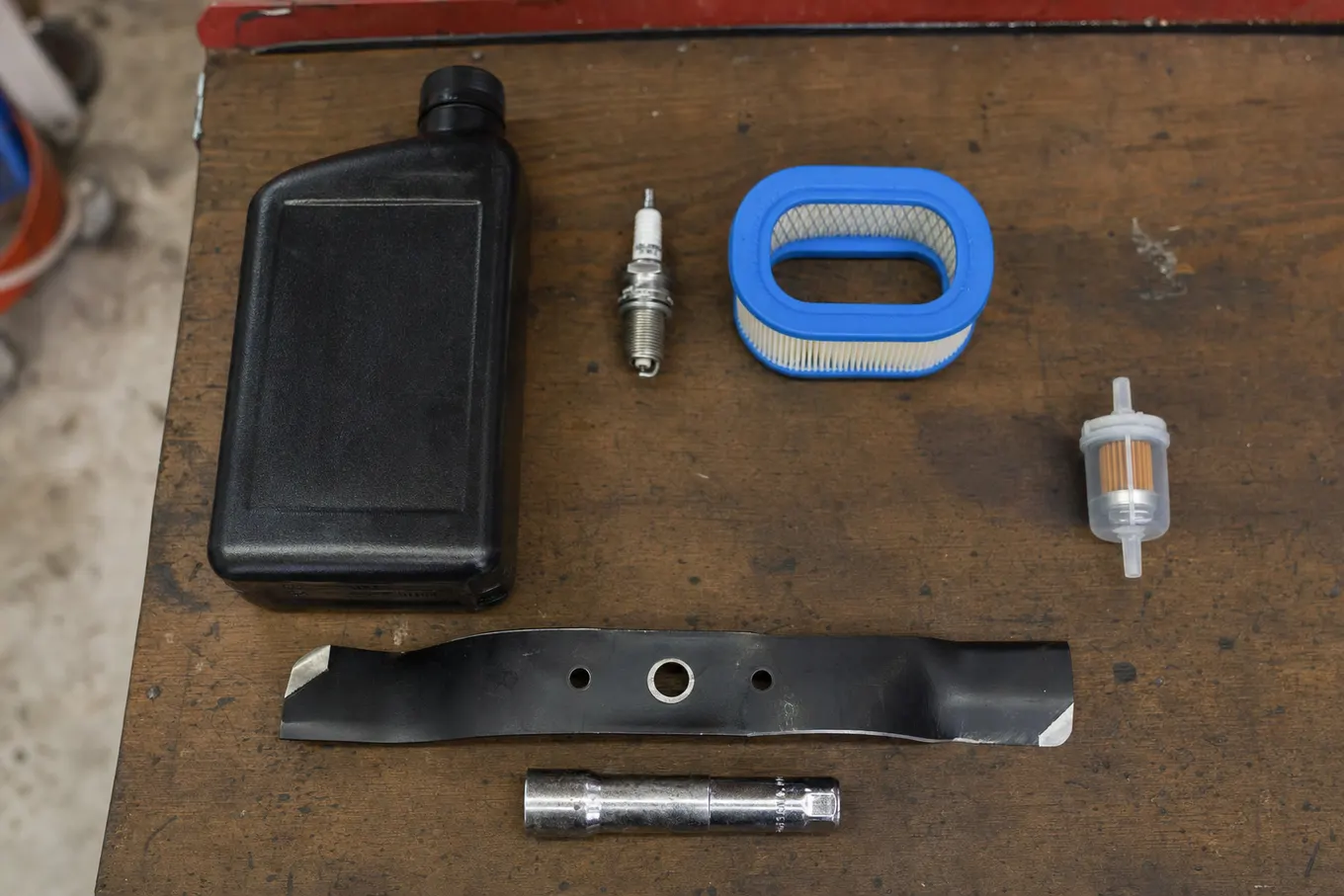
Hunting for a lawn mower tune up near me around Port Charlotte? Bring it to a shop that does nothing but mowers. Our full mower service covers oil and filter, spark plugs, air and fuel filters, blade sharpening and balancing, greasing, belt and battery checks, deck cleaning and a running test, on push, self propelled, riding and zero turn machines. You approve the price up front, before a single part goes on. Call or text (941) 555-0123.
What a Complete Lawn Mower Tune Up Includes, System by System
Plenty of places will sell you an oil change with a new plug and call it a tune up. That combination helps, but it skips the parts of the machine that actually strand people in July: the fuel that went stale, the belt that glazed, the spindle two months from seizing. Our mower service works through every system in a fixed order. Open each one to see exactly what happens on the bench and why it earns its place.
Engine oil and oil filter: read first, then replace
Oil is where the service starts because oil is where engines quietly die. We drain it warm whenever possible, since warm oil carries its suspended grit out with it instead of leaving a layer in the sump. Then we actually look at what came out. Black is normal. Milky gray means water found its way in. Gritty means the air filter stopped doing its job a while ago. A strong gasoline smell means the carburetor has been sneaking fuel past the rings. The drain pan is a diagnostic instrument before it is a disposal chore.
Riders and zero turns usually carry a spin-on oil filter, and it changes with the oil, never separately. A new filter behind dirty oil is a bandage. We refill with the viscosity the engine maker specifies for sustained heat, which in this climate is not always the line of the chart people read up north, and we note the hour meter so the next change lands on schedule instead of on memory.
Air filter and pre cleaner: the sand gate
An engine swallows thousands of gallons of air for every gallon of gasoline it burns, and around here that air carries fine sand lifted off the lawn with every pass. The paper element is the last gate before that grit reaches the cylinder wall. We replace it rather than knock it clean, because banging a filter against a tire opens microscopic tears that turn a filter into a strainer while it still looks fine to the eye.
Foam pre cleaners get washed, dried and lightly oiled the way the engine maker intends, since a dry foam wrapper passes dust straight through. Just as important, we inspect the filter housing itself. A warped cover, a hardened gasket or a missing seal lets unfiltered air detour around the element entirely, which lets sand lap the bore slowly and invisibly. That two minute housing check has saved more engines than any part we install.
Fuel system: filter, lines, tank and cap vent
Everything the gasoline touches gets attention. Inline fuel filters are cheap insurance and get replaced on machines that carry them. Fuel lines get flexed and squeezed along their length, because heat plus ethanol softens the rubber from the inside while sunlight cracks it from the outside, and a line weeping fuel near a hot muffler is not a maintenance note, it is a hazard we fix now. The tank gets checked for water beads and sediment sitting at the pickup.
We also test the cap vent, a part almost nobody thinks about. A plugged vent pulls a vacuum on the tank as fuel is used, starving a perfectly healthy engine and imitating a carburetor failure. What the tune up does not automatically include is opening up the carburetor itself. If your fuel system shows real neglect, we explain what the carburetor work would involve and price it separately, so the decision is made with facts instead of found on an invoice.
Ignition: spark plug replacement and coil check
The spark plug comes out on every service, and like the oil, it talks. Chalk white insulator says the engine runs lean. Dry soot says rich, often a choke or filter problem. A wet, oily plug says the engine is passing oil where it should not. We read the old plug, then fit a new one gapped to spec, because a plug costs pocket change and even a mild misfire taxes every single mow.
While the plug is out we verify spark strength with a proper tester under cranking load, not a casual flash against the block, and we look over the coil, the kill wire and the boot for heat damage and chafe. Twin cylinder engines get both plugs plus a side by side comparison, which is a surprisingly sharp early warning system. Two plugs pulled from the same engine should look like twins, and when they do not, one cylinder is telling on itself.
Blades: sharpened, balanced and torqued, never shortcut
Blades come off the machine for service, not sharpened in place with the deck shading the work. Off the mower we can see hairline cracks near the center hole, thinning at the lift wings, and the lopsided grinding some previous sharpening left behind. Each blade is ground at its factory angle, deburred, then checked on a balancer before it goes anywhere near the spindle. It reinstalls with the bolt torqued to your model’s specification, not to whatever an impact gun felt like that day.
Our sandy ground wears cutting edges faster than the places most mower manuals were written, and a summer of dull blades shows up as browned leaf tips and a lawn that looks exhausted a day after cutting. If you want the full story on edges, angles and balance, the blade sharpening page goes deep.
Deck: scraped to bare metal, inspected, leveled
With blades off, the deck shell gets scraped down to metal. Packed clippings hold moisture against steel for weeks, and on a coast where the breeze carries salt, that damp mat is exactly how decks rot from the underside up while the topside paint still looks respectable. Once the shell is clean we can genuinely inspect it: rust blistering, cracks radiating from the spindle mounts, the state of the discharge chute, the wear on anti scalp wheels.
On riders and zero turns we also measure deck pitch and side to side level. A deck sitting crooked cuts crooked no matter how sharp the blades are, and a quarter inch of slope you would never spot by eye paints a visible stair-step pattern across a St. Augustine lawn. Leveling is a few careful adjustments with the machine on a flat floor, and it transforms the cut.
Belts, pulleys and spindles: the July failure list
Belts almost never snap without warning. They glaze shiny, crack across the ribs, fray at the edges and stretch for months first, and heavy wet season grass speeds all of it up. During a tune up every belt on the machine gets eyes on it, idler pulleys get spun to catch bearing rumble and wobble, and each spindle gets rocked by hand to feel for play that should not be there.
A spindle bearing with a little roughness in October is a screaming failure next July, and July is precisely when you cannot spare the machine. Fittings with grease zerks get greased. Sealed assemblies get judged by feel and sound. Anything marginal gets flagged with an honest read on how long it can wait, and the belt and deck repair page covers what happens when the answer is not long.
Battery and charging system on riders and zero turns
Southwest Florida may be the hardest duty station in the country for a mower battery. Relentless heat evaporates electrolyte and accelerates the corrosion of the plates inside, so batteries here age on a fast clock no matter how the mower is treated. That is why a tune up includes a genuine load test rather than a voltage glance. A failing battery will happily display a healthy reading right up until you ask it to spin an engine.
We clean and protect the terminals, verify the charging system is actually putting current back while the engine runs, and trace the main ground path, which on machines that live near the water is corrosion’s favorite hiding spot. When a battery is on its way out you hear it from us in the fall, not from a silent starter in January. Deeper electrical gremlins move over to our electrical repair bench.
Cables, controls and the safety switch chain
Every cable on the machine gets worked through its full travel: throttle, choke, drive engagement, blade engagement, brake. Humid air wicks into cable sheaths and binds them long before they seize outright, and a sticking choke cable will make a mower start badly for a year while everyone blames the carburetor. We lubricate what can be saved and flag what cannot.
Then the safety circuit gets proven end to end: seat switch, brake interlock, blade switch, reverse logic on machines that have it. These switches live in the wettest, grassiest corner of the mower and they fail in ways that strand you at the worst moment, or worse, get bypassed with a zip tie by a previous owner. Confirming the whole chain works, honestly and safely, is part of every service we run, not an upsell.
Cooling system, tires and the final running test
Air cooled engines live or die by fins and shrouds that Florida grass does its best to plug. We clear the intake screen, clean the fins where the machine’s history calls for pulling the blower housing, and evict whatever decided to nest in there over the wet months. A blocked cooling path never announces itself. It just runs the engine hotter for a season and quietly subtracts years from its life. Tires get set to spec on riders, since pressure is part of cut quality, and loose hardware across the chassis gets snugged.
Last comes the step no checklist can replace. We start it, engage the blades, load the engine and listen. A tune up is not finished when the parts are installed. It is finished when the machine sounds right to somebody who hears healthy and unhealthy mowers all day long.
That is the whole service, and the order is deliberate: fluids and filters first because they touch everything, cutting hardware in the middle because it is the point of the machine, inspection woven through because replacement parts without inspection is just a parts sale. Every item above happens on every tune up, whether the machine is a decade old Craftsman walk behind or a commercial Kawasaki powered zero turn. The difference between machines is only how many of each part the checklist consumes, which is also exactly how the pricing works, further down this page.
Why One Tune Up a Year Is Not Enough in Southwest Florida
Every owner’s manual on the shelf was written around a national average mowing season, something like April to October with the machine hibernating the other half of the year. That assumption produces the familiar advice: service it each spring and forget it. Port Charlotte does not have that year. St. Augustine grass here never truly goes dormant, it only slows down, and from the first June downpour through the end of September it grows faster than most northern grass ever will. A lawn cut from March into December puts close to two seasons of wear on a mower in a single trip around the calendar.
Run the arithmetic on an ordinary quarter acre lot. Weekly cuts through the wet months, a cut every ten days or two weeks the rest of the year, and you arrive at somewhere between 35 and 45 mows annually before you touch an edge trimmer. Engine makers hang their service intervals at roughly 25 to 50 hours of running time. One spring service on a year-round Florida machine means spending the entire back half of the year overdue, with dirty oil thinning out in the hottest months, which is exactly backwards.
Heat then compounds everything the hours started. Oil oxidizes faster at sustained high temperature, and an air cooled engine cutting thick grass in August is about as sustained as high temperature gets. Belts stretch and glaze quicker under wet season loads. Battery plates corrode faster in a 100 degree shed than they ever would in a Michigan garage. Grease thins and migrates out of joints sooner. None of these are defects. They are simply what the climate does, and the service schedule either respects that or pays for it.
| What the manual assumes | What Port Charlotte delivers |
|---|---|
| A five month cutting season with winter storage | Nine to twelve months of active mowing |
| 20 to 25 cuts per year | 35 to 45 cuts on a typical irrigated lawn |
| Mild summer operating temperatures | Long stretches of 90 degree, high humidity work |
| Loamy soil that is gentle on edges | Fine sand scouring the blade on every pass |
| Half a year of cool, dry battery storage | Year-round heat soak in a garage or shed |
| One spring service covers it | A spring service plus a fall service earns its cost |
So the honest local recommendation is a rhythm, not a ritual: a complete tune up in late winter before the growth arrives, and a second service or at minimum a serious inspection in the fall once the wet season has done its worst. The spring service loads the machine with fresh consumables for the brutal stretch. The fall service catches what those months consumed: the belt that glazed, the bearing that loosened, the battery that lost a step, before any of them chooses its moment in the middle of next summer.
Can anyone get away with once a year? Sure. A small lawn, a garage-kept mower, a habit of ethanol free fuel and an owner who checks the oil every few mows can stretch the schedule without drama. We will tell you if that is you. But if the mower works a big lot in Deep Creek, breathes sand in North Port, or sits idle half the year while you are north, twice a year is not a shop trying to sell you something. It is the schedule the climate already decided.
Ten Signs Your Mower Is Overdue for a Service
Mowers rarely demand a tune up outright. They drop hints for months, and the hints are easy to normalize because they arrive gradually. If more than two of these sound familiar, the machine is not being dramatic. It is asking.
- Starting takes more effort than it did in spring. An extra pull here, a longer crank there. Healthy engines light off quickly. A slow slide toward stubborn is fuel, plug or compression drifting, and all three live on the tune up checklist.
- It wants choke longer than it used to. An engine that needs the choke held on while it clears its throat is running lean, and around here that usually means the first film of varnish is forming in the carburetor. Cheap to address now, expensive later.
- The lawn looks pale or tan a day after mowing. That haze is thousands of torn grass tips drying out, the signature of a dull blade. The cut looked fine from the seat. The lawn disagrees by morning.
- Clumping and streaking even in dry grass. Dry St. Augustine should discharge clean. When it ropes and clumps anyway, the blade is not cutting so much as beating, and airflow under a caked deck is half gone.
- New vibration through the handlebars or the seat. Vibration always has a source: a blade out of balance, a bent spindle, a chunked belt. None of them improve with time, and all of them are cheaper this month than next.
- The engine note changes in thick patches. Bogging where it used to power through means the engine is down on breath or spark, or the blade is dragging instead of slicing. Either way, output is being spent on friction instead of cutting.
- A puff of smoke at startup that hangs around. A brief morning puff can be nothing. Smoke that lingers means oil is going somewhere it should not, and a compression check reads the truth in minutes.
- You honestly cannot name the last oil change. If the answer involves counting years on fingers, the oil is not lubricating anymore, it is just occupying space. This one sign outranks all the others.
- The first start of the week hesitates. A battery that thinks about it before cranking is spending its reserve. Heat has been collecting that debt all summer, and it comes due on the first cool morning.
- A squeal when the blades engage. That chirp is a belt slipping across a pulley on its way to glazing, or a bearing announcing its retirement plans. Thirty seconds of listening saves a tow.
None of these symptoms requires a diagnosis appointment on its own. They are exactly what the tune up exists for: one visit that resets all ten at once, then an inspection that verifies nothing deeper is hiding behind them.
What a Tune Up Catches Before It Becomes a Repair
The parts we replace are the smaller half of a tune up’s value. The bigger half is a trained set of hands on every system once or twice a year, finding the failures that are still cheap because they have not happened yet. These are the ones we catch most often.
Valve lash drift, the hidden cause of hard hot starts
On overhead valve engines, the clearance between the rocker arms and valves changes gradually as parts wear and seat. Let it drift far enough and the symptoms creep in: an engine that starts fine cold but fights you when hot, a pull cord that snaps back hard against your shoulder, a starter that groans against compression it should have been spared. Most owners chase these symptoms through batteries and plugs for a year, because the real cause is invisible from the outside.
Caught at a tune up, valve lash is a measured adjustment with a feeler gauge, done in under an hour. Ignored for years, it can burn valves and turn into genuine engine work. This one item, checked when symptoms first whisper, has probably saved our customers more money than any other line on the inspection sheet.
The carburetor’s first whispers, before the full gum-up
A carburetor rarely fails all at once. It sends warnings: the engine wants choke a little longer than it used to, idle develops a faint rhythmic rise and fall, the first start of the week takes an extra pull or two. Those are the sounds of varnish beginning to narrow the smallest passages. At this stage, fresh fuel and a bowl cleaning during the tune up often stop the slide entirely.
Wait until the mower stalls under load or refuses to idle, and the same varnish has hardened through the jets and emulsion tube, which means a full carburetor cleaning or rebuild. The difference in cost between the whisper stage and the shout stage is substantial, and the tune up is where the whisper gets heard.
Belt glaze and cracking, months before the snap
A belt that is about to fail looks different long before it lets go. The sidewalls polish to a shine from slipping, small cracks open across the underside ribs, and the belt rides lower in the pulley grooves as it wears narrow. Each of those is visible to anyone who looks, and the whole point of a tune up is that somebody finally looks.
Swapping a belt on the bench in February is a routine job. The same belt letting go in the far corner of a two acre lot in Harbour Heights in August is a stalled Saturday, a tow back to the garage, and often collateral damage when the flailing belt takes out a pulley or wraps a spindle. Glaze today, strand tomorrow. We would rather catch it today.
Spindle bearing play, while it is still just play
Grab a healthy spindle and it feels like part of the deck: solid, silent, no movement but rotation. A dying one has a personality. A faint click when rocked, a dry rumble when spun, a blade that can be wiggled a hair up and down. Sand working past the seals is usually the culprit here, grinding the bearings from the inside a little more each mow.
At the play stage, the fix is bearings or a spindle assembly, straightforward and reasonably priced. Past that stage, a seized spindle can shred the belt, overheat the housing and chew the deck shell around it, multiplying the bill. The rock-and-spin check takes thirty seconds per spindle during a tune up and is worth more than it costs every single time.
A battery losing capacity, before the silent morning
Batteries here rarely die dramatically. They fade. Each month of heat shaves a little cranking power, and the mower keeps starting anyway because a healthy engine does not ask for much. Then the first cool, damp morning of winter arrives, oil thickens slightly, the engine asks for a bit more, and the battery that was quietly at half strength has nothing extra to give.
A load test during the fall tune up reads the real story a voltmeter hides, and it turns a surprise no-start in January into a planned replacement in November. If the electrical system has deeper trouble, a bad ground or a charging fault, the same test points us there, and the electrical diagnosis starts from evidence instead of guesswork.
Deck rust while it is still surface deep
Every steel deck in this county is in a slow argument with moisture, and the decks within a few miles of the harbor are in a fast one. The argument starts under the paint, at stone chips and weld seams, wherever wet clippings sit packed for weeks. Surface scale at that stage is maintenance: scrape, treat, protect, and the deck soldiers on for years.
Skip the inspections and the same scale quietly becomes pitting, then thinning, then the soft spots and holes that end a deck, and on a walk behind mower usually end the machine. The tune up is when the underside actually gets seen. Nobody flips a running mower over for fun, which is precisely why deck rot so often surprises people who mow every week.
Corroded safety switches, the fake expensive failure
The seat switch, brake interlock and blade switch are humble parts in cruel locations, sprayed with wet clippings and marinated in humidity. When their contacts corrode, the machine produces theater: dead silence at the key, or an engine that dies the instant the blades engage. Owners understandably assume starter, battery or something big, when a corroded plug connector at a switch is faking the entire performance. Our no-start guide is full of these stories.
During a tune up, the whole interlock chain gets exercised and any connector showing green crust gets cleaned and sealed. It is five minutes of unglamorous work that prevents the single most misdiagnosed failure we see, and it keeps the safety systems doing their actual job, which matters on a machine with spinning steel underneath.
Oil consumption trends only a service history can show
A single oil change tells you about today. A series of them tells you where the engine is headed. When the same machine comes back each season, we know whether it arrived a quarter low or a full quart low, whether the plug is wetter with oil than last year, whether the breather is pushing more mist into the air box. That trend line is the honest health record of the rings and valve guides.
The payoff is timing. An engine that starts drinking oil gives you a season or two of warning, and that window is when repair-versus-replace decisions are cheapest to make. Machines that only see a shop when they quit never get that window, and their owners make the big decision at the worst possible moment, in the middle of the grass season with a dead mower on the trailer.
Fuel line rot, the leak you smell before you see
Rubber fuel line in this climate fights a two front war. Ethanol blended gasoline softens and swells it from the inside while ultraviolet light and heat harden and crack it from the outside. The first symptom is usually a whiff of gasoline in the garage that nobody can locate, because the line only weeps where it flexes, and only when the tank is full.
During a tune up the lines get bent between fingers along their whole run, and the ones that feel gummy, checked or crunchy get replaced for the cost of hose and clamps. The alternative script writes itself: fuel dripping onto a hot engine, or air sneaking into the fuel draw and producing a lean stumble that gets blamed on the carburetor. Hose is cheap. Everything that follows failed hose is not.
Loose hardware, the shake that loosens everything else
A mower is a vibration machine that happens to cut grass, and every hour of running is an hour of every fastener being asked politely to back off. Engine mounting bolts, deck hanger hardware, handle bolts on walk behinds, seat and fender fasteners on riders: they all creep. Each loose fastener adds a little more movement, and movement is what loosens the next one. It is a slow chain reaction with a long fuse.
The tune up ends that cycle once or twice a year with a pass over the chassis torque points. It is the least glamorous item on the sheet and one of the most quietly valuable, because the failures it prevents, cracked welds, ovaled bolt holes, an engine walking on its mounts, are the kind that turn a maintenance customer into a repair customer.
Push Mower vs Riding Mower Tune Ups: What Actually Changes
The philosophy stays the same across every machine: consumables replaced, blades trued, every system inspected. What changes is the parts count, the systems involved, and where the trouble likes to hide.
Push and self propelled mowers: small engine, no hiding places
A walk behind tune up is the most compact version of the service. One cylinder, one blade, splash lubrication with no oil filter, and on most models no battery to think about. The catch is that simplicity raises the stakes on what remains. With no oil filter and barely two thirds of a quart in the sump, the oil itself is the entire lubrication system, and it degrades fast when it works hot. With one blade doing all the cutting, a dull edge has no partner to hide behind.
Self propelled models add a drive system to the list: the belt or gearbox, the rear wheel gears that strip and turn a self propelled mower into a heavy push mower, and the drive cable whose slow stretch is why the mower crawls when it used to march. We adjust cable tension, inspect the transmission engagement, and check the wheel gears for the telltale slipping. The recoil starter gets a look too, because a fraying pull rope always breaks on a Saturday. The push mower repair page covers the failures that go beyond a service.
Riding mowers and lawn tractors: triple the systems, triple the checklist
Step up to a rider and the tune up roughly triples. Many carry twin cylinder engines, which means two plugs, more valve train to hear, an oil filter, and a fuel pump that gets its own inspection. A battery and charging system join the list, along with the electrical interlocks that riders depend on. Under the machine, two or three blades have to be sharpened and balanced as a matched set, because one heavy blade in a multi blade deck vibrates the whole machine and wears its spindle on a schedule all its own.
Riders also add the chassis work walk behinds never need: front axle and steering grease points, deck hanger linkage, deck leveling, tire pressures that directly change cut height side to side, and the drive belt path with its idlers and tensioners. It is why a proper lawn tractor service takes real bench time, and why the shortcuts version, oil and a plug in the driveway, leaves so much of the machine uninspected. Bigger mechanical trouble on riders lives over on the riding mower repair page.
Zero turns: everything above, plus the hydraulic drivetrain
A zero turn tune up includes the entire riding mower list and then adds the system that defines the machine: two hydrostatic drives. Depending on the model that means checking fluid level and condition in expansion tanks, inspecting for seepage at the axle shafts, confirming the cooling fans on the pumps are intact and unclogged, and test driving for the subtle one-side-weaker feel that says a drive is aging. Sealed units get evaluated by behavior, serviceable ones by the book. Dampers and lap bar adjustment get attention as well, since sloppy steering on a zero turn makes even a sharp deck cut ragged lines.
Commercial machines cutting for a living deserve one more layer: an hour based schedule tracked off the meter, because a crew can put a homeowner’s whole year of hours on a machine in a month. We service residential and commercial zero turns alike, and the deeper drivetrain work lives on the zero turn repair page.
Tune Up Notes for the Engines and Brands We See Most
A tune up is not generic, because engines are not generic. The service adapts to what is actually bolted to your deck, and after enough of them you learn each family’s personality.
Briggs & Stratton powers more of the mowers in this county than any other name, from bargain push mowers to serious lawn tractor twins. The singles are splash lubricated with a small sump, which makes oil freshness the whole ballgame, and the overhead valve versions reward a periodic lash check. Newer models carry plastic-bodied carburetors that tolerate stale ethanol fuel even less gracefully than the old metal ones did, so fuel condition gets extra scrutiny on these. Parts availability is excellent, which keeps service costs sensible even on machines old enough to vote.
Kohler twins show up under the hoods of a huge share of the riding mowers and zero turns around here. They are stout engines that respond visibly to consistent oil and filter changes, and their fuel pumps and filters are firmly on the checklist. Kawasaki engines dominate the commercial zero turn crowd, and they are built for exactly the hour counts crews pile on, provided the dual element air filtration is maintained honestly and the oil interval is tracked by the meter rather than the calendar. A commercial Kawasaki that gets its services on schedule is close to unkillable. One that does not is just expensive.
Honda GCV and GXV engines, common on premium walk behinds, have a reputation for longevity that is fully earned and fully conditional. They run beautifully on fresh oil and clean filters for years, and their auto choke systems appreciate a fuel supply that has not gone sour in the tank. When a Honda arrives hard starting, the story is almost always fuel that outstayed its welcome, not the engine.
On the mower side of the equation, we service the whole familiar roster: Toro, John Deere, Husqvarna, Craftsman, Snapper, Cub Cadet, Ariens, Troy-Bilt and their relatives, plus the commercial names like Exmark, Scag, Gravely and Hustler. The brand mostly determines the chassis details, where the grease points hide, how the deck comes off, which belt routing diagram applies, while the engine determines the tune up parts. Battery brands like EGO, Ryobi and Greenworks get the cutting-side service described earlier: blades, deck, drive and controls, with honest boundaries around sealed electronics. Whatever badge is on the hood, bring the model number and we will know the machine before it arrives.
Tune Up Timing in Southwest Florida: Two Windows That Matter
The first window is late winter, February into early March. The grass is at its slowest crawl of the year, which means the mower can spare the bench time, and the seasonal rush has not started, which means turnaround is at its best. More important, the service lands right before the spring flush, that stretch when warming soil and lengthening days push St. Augustine and Bahia out of their winter idle and into serious growth. A machine that meets the flush with fresh oil, a new plug, a sharp balanced blade and inspected belts starts the hard part of the year with every advantage.
The second window is fall, October into November, and it exists for two completely different mowers. The first is the machine that worked all wet season: it just spent four months cutting grass that grew faster than any other time of year, in the worst heat, and its belts, bearings, oil and blades carry that summer in them. The fall service is the accounting. The second is the snowbird’s mower that did the opposite and sat idle in a humid garage since April, its fuel aging and its battery self discharging in the heat. Both machines converge on the same month needing opposite things, wear care for one, revival for the other, and a tune up covers both.
If you keep a mower here year round and only want to pay for one service, take the late winter slot. It positions everything fresh ahead of the eight months that do the real damage. If your mower is a seasonal resident like you are, the fall slot matters more, because months of storage create exactly the fuel and battery problems a service is designed to clear. And if a hurricane season cleanup is on the horizon, remember that a mower is part of the recovery toolkit around here. The week after a storm is a terrible time to discover the machine will not start.
Heavy users deserve a third checkpoint in the middle of the wet season. A machine cutting an acre or more every week from June through September will blow past a 50 hour oil interval before the fall window arrives, and mid-summer is when a quick oil service and a blade touch-up pay off most, because that is when the engine works hottest and the grass punishes a dull edge worst. It does not need to be the full checklist twice more, just the consumables that the heaviest months burn through. Tell us your acreage and your cutting schedule and we will tell you honestly whether you are a two service household or a three service one.
The month to avoid wanting a fast tune up is April. Every shop in the region feels the same wave when the first hot week reminds the whole county that grass exists, and queues stretch accordingly. Booking even six weeks earlier puts you ahead of that wave instead of inside it. And if you are reading this in June with a neglected mower, do not wait for a tidy window. A late service beats a skipped one every time, and we will work you in as fast as the bench allows. Check where the queue stands through the contact page or a quick call.
From Your Driveway to the Bench and Back
- Reach out with the basics. Call, text or use the form with your mower’s brand and model and a note about how it has been running. The model number lets us stage the right filters, plug and oil before the machine ever arrives.
- Drop off, or let us come get it. Bring it by the shop in Port Charlotte, or schedule pickup and delivery if hauling a rider is not happening. We run routes across the whole service area.
- Intake and a straight quote. We log the hour meter if there is one, note your concerns, and confirm the tune up price for your specific machine before work begins. Push mower and twin cylinder zero turn are different jobs and are quoted as such.
- The full service, system by system. Everything described above: fluids, filters, plug, blades, deck, belts, battery, cables, cooling, hardware. The inspection findings get written down as we go.
- A call before anything extra. If inspection turns up a problem beyond the tune up, you get the findings and a separate price while the machine is still on the bench. Approve it, decline it, or schedule it for later. No surprises at the counter.
- Test run, then home. The mower runs and cuts before it leaves us. Pick it up when convenient or we deliver it back, ready for the season instead of ready to be discovered.
What You Can Do Yourself, and Where the Shop Earns Its Keep
Some of a tune up is genuinely driveway friendly, and we would rather teach you those habits than bill you for them. Checking the oil before every few mows costs nothing and catches the low-oil situations that destroy splash lubricated engines. Popping the air filter cover monthly in season and holding the element up to the light tells you plenty. Keeping fuel fresh, scraping the deck after wet cuts, and keeping battery terminals clean are all well within any owner’s reach, and our maintenance page lays out the full between-service routine month by month.
Where the shop earns its keep is the work that needs tools, torque specs and a calibrated sense of wrong. Blade balance is invisible without a balancer, and an unbalanced blade punishes spindles every minute it spins. Valve lash needs feeler gauges and a procedure. Load testing a battery, reading a plug accurately, judging whether a belt has a season left, measuring deck level, greasing without blowing seals: individually small skills, collectively the difference between a machine that was serviced and one that was inspected by someone who knew what they were looking at.
There is also the unglamorous matter of disposal. A proper service produces used oil, old fuel, a dead filter and sometimes a battery, all of which have legal and environmentally sane disposal paths that do not involve the back corner of a garage. When the shop does the service, all of it leaves in our waste stream, not yours. Add it up and the honest answer is the one we give at the counter: do the weekly habits yourself, and let a bench with the right tools do the twice-yearly deep pass.
What a Mower Tune Up Costs, and What Moves the Number
Tune up pricing follows the machine, so the honest way to talk about mower tune up cost is to name the factors instead of throwing out a number that fits nobody. Cylinder count is the big one: a twin needs two plugs and more oil than a single. An oil filter adds a part. A three blade deck triples the sharpening work of a single blade walk behind. A fuel filter, a fuel pump, a battery to test, grease points to hit: each is a real difference between machines, and each is why a zero turn service and a push mower service are not the same job or the same price.
Condition moves the number too, in ways we always clear with you first. Blade bolts rusted solid take shop time to free. A deck packed with a year of concrete clippings takes longer to clean than one scraped in the spring. A mouse apartment under the blower housing is an eviction we did not plan. None of these become charges without a conversation, and that is the standing policy on everything here: you hear the number, you approve the number, then the work happens. Call (941) 555-0123 with your model and you will have your exact quote in one conversation.
Against those factors, weigh what the service prevents. The expensive failures on the earlier list, burned valves, seized spindles, stranded summer weekends, are overwhelmingly failures of neglect rather than bad luck. A tune up is the cheapest insurance this hobby sells, and unlike actual insurance, you collect on it every time you mow.
One more piece of honest arithmetic. A serviced mower does not just fail less, it lasts longer, and lifespan is where the real money hides. The difference between a machine replaced every four or five years and one that runs well past a decade is rarely the brand or the luck of the draw. It is oil that stayed fresh, filters that stayed clean, and small problems that got caught at inspections instead of compounding in the dark. Spread the cost of two services a year across the extra years of machine life they buy and the tune up stops looking like an expense at all. It is the difference between owning a mower and renting one from the repair gods on unfavorable terms.
Tune Ups Across Four Counties of Lawns
Mowers arrive at our Port Charlotte bench from all over the region, on trailers, in truck beds, and on our own pickup routes. Every community below has its own page with drive times and local details, and the service area map shows the whole thirty miles.
Lawn Mower Tune Up Questions, Answered Straight
How long does a lawn mower tune up take?
The bench work itself is a half day once your mower is up. Door to door, most tune ups are back to you within a few days, quicker when you call ahead so we can slot you in. Spring is the crunch: half the county remembers the mower the same week the grass wakes up, so a February booking beats an April one every single year.
What is the difference between a tune up and a repair?
A tune up is scheduled care for a machine that basically runs: fluids, filters, plugs, sharpened blades, adjustments and a full inspection. A repair is fixing something that already failed. The two overlap on purpose, because the inspection half of a tune up exists to catch almost-failed parts while they are still cheap to deal with.
Do you tune up zero turns and commercial mowers?
Yes. Twin cylinder zero turns get the complete treatment: both plugs, oil and filter, fuel and air filters, spindle and deck checks, tire pressures and a look through the hydro drive system. If you run machines for a living, an hour-based schedule makes more sense than a calendar one, and we are glad to help you set that up.
Will a tune up fix my mower’s surging or hard starting?
Often, because fresh fuel, a new plug and clean filters cure the mild cases. What a tune up cannot reach is varnish already baked inside the carburetor. If we find that, you hear about it before we start, and the carb work gets quoted as its own job so you are never paying for two services blind.
Does a brand new mower need anything in its first season?
One thing above everything: the break-in oil change, done early. A new engine sheds fine metal as its parts seat, and that first fill of oil carries all of it. Most engine makers want it swapped within the first five to ten hours of use. Skipping that change is the most common new-mower mistake that rolls through our door.
Which parts get replaced during a tune up and which just get checked?
Replaced as a rule: engine oil, the spark plug, the air filter, and the fuel filter where one is fitted. Sharpened and balanced: the blades. Inspected and adjusted: belts, cables, spindles, tires, battery, cooling fins and safety switches. Anything that fails inspection gets its own quote before we touch it, so the tune up price stays the tune up price.
Can you service a battery powered mower?
The cutting side, absolutely: blade sharpening and balancing, deck cleaning, wheel and drive service, handle hardware and switch checks. There is no oil or carburetor to fuss with, which is the whole appeal of those machines. Sealed packs and controllers are manufacturer territory, and we will say so plainly rather than experiment on your dime.
When should I book a tune up in Port Charlotte?
Two windows earn their keep. February into early March, ahead of the spring growth and ahead of the seasonal rush. And October into November, right after the wet season has finished working every mower in the county over. If you only take one, take the late winter slot, because it preps the machine for the eight hardest months.
My mower sat all summer while I was up north. Tune up or repair?
Book it as a tune up and let the bench decide. A stored mower usually needs exactly what the service already includes: fresh oil, fresh fuel, a plug, filters and a sharp blade. The wildcard is the carburetor. If the gas soured inside it, we will find that during the service and call you with a number before doing anything extra.
Should I clean my mower before I bring it in?
No, and honestly we would rather you did not. A caked deck tells us things: how wet you have been mowing, whether the discharge is choking, where moisture likes to sit. Deck cleaning is part of the service anyway. Keep your Saturday.
Is blade sharpening included in the tune up?
Always. Sharpening and balancing are built into every tune up we do, because a refreshed engine spinning a dead edge is half a service. If a blade turns out to be bent, cracked or ground past its useful life, we show you why and quote a replacement instead of sharpening steel that has earned retirement.
What happens if you find a bigger problem during the tune up?
You get a phone call, not a padded invoice. We finish the work you agreed to, explain what we found, and hand you a separate number for the extra job. Plenty of folks take the information, run the season, and book the bigger work for the slow months. Your machine, your call, always.
Is a tune up worth doing on an inexpensive push mower?
Usually yes, once a year at minimum. Even a budget machine will hand you years of extra service when the oil stays fresh and the filter stays clean, and annual care costs far less than buying a new mower every third season. Our honest line: when the repair list stacked on top of a tune up starts approaching replacement money, we tell you to keep your wallet shut.
How many hours between tune ups if my mower has an hour meter?
A working rule for this area: full service every 50 hours of cutting or twice a year, whichever arrives first. A Port Charlotte lawn cut nearly year round stacks hours on a mower at a pace the owner’s manual never planned for, which is exactly why the once-a-year habit imported from up north falls short down here.
Broader questions about the shop live on the main FAQ page, and the fastest answer is always a call or text to (941) 555-0123.
Get on the Bench Before the Grass Gets Going
Send the make, the model and a sentence about how it has been running. You will get a straight price and a slot, and your mower will meet the season ready instead of surprised.
- Exact quote for your machine before work starts
- Blades sharpened and balanced with every service
- Pickup and delivery across the service area
- Or skip the form: (941) 555-0123