Troy-Bilt Mower Repair in Port Charlotte, FL
Troy-Bilt mowers are common around Port Charlotte because they make sense for a lot of yards: practical, familiar, and usually worth checking before you give up on them. We see Pony and Bronco tractors, TB-series walk-behinds, self propelled units, and plenty of machines that sat through a Florida summer with old fuel in the bowl. Bring it to a mowers-only shop and you get a straight diagnosis instead of a parts cannon.
Independent repair shop. Not affiliated with or authorized by Troy-Bilt; the name is used only to describe the machines we service.
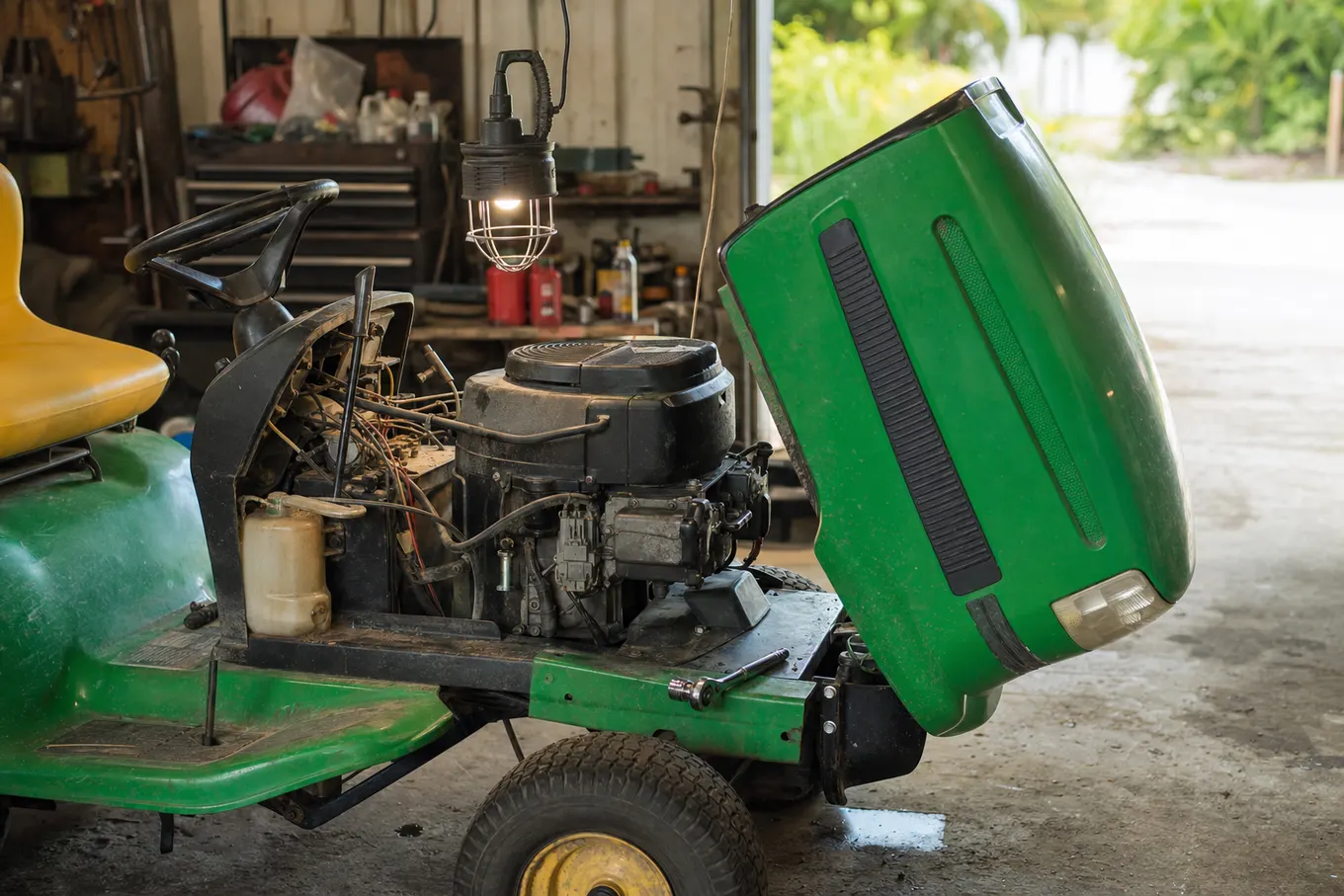
Need Troy-Bilt mower repair in Port Charlotte? We service Troy-Bilt riding mowers, lawn tractors, self propelled mowers, push mowers, and battery-start machines for owners across Charlotte County and the nearby 30 mile area. The process is simple: we inspect the mower, explain what failed, and get your approval before repair work starts. Pickup may be available if the mower is too heavy, too dead, or too awkward to move safely. For a Troy-Bilt that will not start, will not drive, cuts unevenly, or keeps throwing belts, call or text the shop.
What a bench mechanic actually knows about Troy-Bilt machines
Troy-Bilt is one of those brands where the name means different things depending on the machine in front of you. A Pony tractor is not the same conversation as a TB walk-behind. A Bronco that has pulled a cart, bumped roots, and mowed every week in summer needs a different inspection than a self propelled mower that mostly trims around a Port Charlotte yard. The useful answer is not brand praise or brand bashing. The useful answer is knowing what the platform is, what it was built to do, and where to stop spending money.
That is the advantage of a mower-focused shop. We are not trying to sell you a new unit. We are also not trying to turn a worn value mower into a forever machine. We look at the engine, deck, drive, steering, cables, belts, safety switches, and the rust or sand damage that tells the real story. If the mower has a clear repair path, we say so. If the machine is near the point where each fix will uncover the next one, we say that too.
Platform and series realities
Most Troy-Bilt machines we see fall into a few familiar groups. Pony and Bronco tractors are light residential riders built for homeowner mowing, not commercial abuse. TB-series walk-behinds cover the everyday push and self propelled work many owners use for smaller lots, fenced yards, and trim areas. Some are simple enough that a good diagnosis saves a lot of guessing. Others have enough cable, drive, starter, and safety hardware that the first symptom can be misleading.
The frame matters. On a riding mower, a no-drive complaint might be a belt, pulley, idler, transaxle control, brake linkage, or something as ordinary as a loose spring. On a walk-behind, the same owner description often means a stretched drive cable, worn front drive gear, contaminated belt area, or wheels that are rounded off inside. That is why we do not diagnose Troy-Bilt work from one sentence over the phone. We can narrow the likely problem, but the bench tells the truth.
For broader mower symptoms, our main lawn mower repair page explains how we sort start, cut, drive, and fuel issues across brands. Troy-Bilt follows many of the same rules, but the platform decides which checks happen first.
Watch-points a mechanic checks first
On Troy-Bilt walk-behinds, the carburetor and fuel system usually get attention early. Florida heat cooks fuel fast, and ethanol gas can leave varnish in the float bowl, idle passages, and main jet. A mower may fire for a second on prime, run only with choke, surge, or die as soon as the blade loads the engine. That is not a mystery. It is the kind of fuel problem that looks dramatic but often starts with a tiny restriction.
On riders, we look at the belt path before blaming the biggest part. Troy-Bilt tractors can act like the transmission failed when the belt is glazed, stretched, off a pulley, or riding the wrong side of a guide. Deck engagement issues get the same treatment. A squeal, slap, or burning smell can come from an idler, spindle, brake pad, belt guard, or pulley bearing. The goal is to find the failed part, not replace the entire neighborhood around it.
Safety switches also deserve a calm check. Seat switches, brake switches, blade engagement switches, and starter circuits can make a good engine seem dead. That does not mean every switch is bad. It means we test instead of jumping wires and hoping nothing bites later.
Build-quality truths without the drama
Troy-Bilt sits in the practical homeowner lane. That is not an insult. A lot of owners do not need a heavy commercial mower to cut a residential yard. The tradeoff is that light decks, cable-driven controls, plastic trim pieces, smaller tires, and value-line hardware do not enjoy rough handling, deep sand, tall wet grass, or long storage with stale fuel. Used within reason, many of these machines do their job. Pushed hard, they show it.
The fair question is not whether Troy-Bilt is good or bad. The fair question is whether your particular mower has a repair that fits its remaining life. A clean Pony with a fuel problem and a healthy deck is a different case from a tractor with deck shell rust, sloppy steering, a weak battery, old belts, and dry-rotted tires. The first one may be a sensible repair. The second may need a careful conversation before you spend on it.
That same thinking applies to riding lawn mower repair. The engine might be worth saving while the deck is not. The drive system might be fine while every cable is tired. A good estimate separates those pieces so you are not guessing in the driveway.
Parts availability and what it really means
Many Troy-Bilt parts are findable because the machines share common MTD-family architecture. Belts, blades, cables, carburetors, pulleys, wheels, solenoids, filters, and ignition pieces are often available through normal parts channels. That helps keep straightforward repairs straightforward. It does not mean every older part is sitting on a shelf nearby, and it does not mean every repair makes financial sense.
Model and serial information still matters. Two machines can both say Troy-Bilt on the hood and use different belts, blade lengths, control cables, or deck parts. Owners often bring in a belt that is close enough to install but wrong enough to slip, slap, or burn. A few inches of belt length can turn a simple repair into a repeat failure. On walk-behinds, cable ends and wheel drive parts can look similar while fitting differently.
For engines, the brand on the mower is only part of the story. Troy-Bilt machines may carry engines from common small engine families, so the engine model guides carburetor, ignition, starter, and fuel parts. Our small engine repair work starts by identifying the engine and failure pattern before ordering anything.
How Troy-Bilt machines age in Southwest Florida
Southwest Florida is rough on mowers because there is barely an off-season. Heat bakes belts. Humidity corrodes electrical connectors. Salt air near the coast gets into cables, hardware, battery terminals, and deck edges. Sugar sand works like grinding compound around wheels, spindles, pulleys, and control pivots. Grass grows fast after rain, so a mower that was already tired gets asked to chew through wet, heavy growth.
Storage is just as important as mowing. Snowbird schedules are hard on Troy-Bilt fuel systems because a mower may sit for months with gas in the tank and carburetor. When the owner comes back, the engine might crank, pop, surge, or run only long enough to tease you. Battery-start riders have their own version: weak battery, corroded cables, sticky solenoid, then a starter complaint that is really a whole starting circuit complaint.
Zero-turn owners are not left out. Troy-Bilt zero-turn machines still need belt, spindle, pulley, deck, battery, and safety-circuit checks, even when the steering system changes the conversation. If that is the platform you have, our zero-turn mower repair page covers the wider set of checks we make on residential zero-turns.
The pattern is simple: heat, sand, salt, and sitting all shorten the distance between "it was fine last month" and "it will not mow today." A good repair plan includes the failed part and the reason it failed, because prevention is cheaper than seeing the same mower back with the same complaint.
The Troy-Bilt jobs that roll through our door
Most Troy-Bilt repair tickets start with a simple owner sentence: it will not start, it cuts ugly, it stopped pulling, it clicks, or it throws the belt. Those sentences are useful, but they are not a diagnosis. The same symptom can come from fuel, air, spark, compression, safety switches, cables, pulleys, deck damage, or a maintenance gap that finally caught up. We work symptom-first because that is how real mowers fail.
It cranks, pops, then dies
The owner usually says the mower ran last season, starts for a second, then quits. Sometimes it runs only with the choke partly on. Sometimes it surges like it is hunting for fuel. On Troy-Bilt walk-behinds and tractors that sit in Port Charlotte heat, the usual suspects are stale fuel, varnish in the carburetor, water in the tank, a restricted jet, a brittle fuel line, or a dirty air filter making a fuel problem look worse.
We start with basics: fresh fuel flow, air filter condition, spark, plug condition, and whether the carburetor is actually metering fuel instead of just holding it. If cleaning is enough, we clean. If the carburetor is corroded, damaged, or not worth fighting, we explain that before replacing it. The prevention is boring but effective: run fresh fuel, do not store the mower with old gas sitting in the bowl, and deal with surging before it becomes a full no-start. Our lawn mower will not start page goes deeper into that first round of checks.
It runs, but the yard looks chewed
Cut complaints usually sound like this: the mower leaves ridges, tears the grass, scalps one side, leaves strips, or vibrates more than it used to. On Troy-Bilt decks, we check blade condition first, but we do not stop there. A dull blade is common. So is a bent blade, wrong blade, loose spindle, deck packed with wet grass, uneven tire pressure, bent hanger, worn deck wheel, or belt that is slipping under load.
The repair depends on what the deck is telling us. We sharpen or replace blades as needed, scrape packed buildup, inspect spindles and pulleys, level the deck where the design allows it, and correct belt routing or tension problems. Prevention means keeping blades sharp through sandy mowing, avoiding stump and root hits, and not mowing tall wet growth at full speed. If the carburetor is surging at the same time, cut quality can suffer because blade speed is not steady. That is where lawn mower carburetor repair and deck work sometimes meet.
It will not pull, drive, or keep the deck belt on
For self propelled Troy-Bilt mowers, owners often say the mower got heavy overnight. The engine runs, but the wheels quit helping. That can be a stretched drive cable, worn wheel gears, belt contamination, a seized pulley, or a drive control that is not moving its full travel. For Pony and Bronco tractors, the complaint might be no movement, slow movement, a burning rubber smell, or a deck belt that comes off every time the blades engage.
We inspect the belt path, pulley alignment, idlers, springs, guides, cable travel, brake release, and debris around the drive system. A belt that keeps coming off has a reason. Installing another belt without finding the reason wastes time and can chew up new parts. Prevention is mostly about keeping the deck and belt areas clean, replacing cracked belts before they fail, and stopping when you smell rubber instead of finishing the yard anyway. For this symptom family, see our lawn mower belt and deck repair page.
It clicks, drains batteries, or acts older than it is
Troy-Bilt riders with electric start often come in for a click, slow crank, no crank, or battery that will not stay charged. The battery may be weak, but we also check cable ends, ground points, solenoids, key switch behavior, starter draw, fuse condition, and the safety circuit. Corrosion can hide under a terminal that looks acceptable from above. A loose ground can mimic a bigger failure. A tired battery can expose every weak connection in the system.
We test the starting circuit in order instead of guessing. If it is a battery, we say battery. If the solenoid is clicking but not passing current, we show that. If a safety switch is preventing crank, we find out why before condemning parts. Prevention means keeping battery terminals clean, charging the battery during long storage, washing less aggressively around electrical areas, and fixing slow-crank symptoms early. More detail is on our lawn mower electrical repair page.
Repair versus replace matters with Troy-Bilt because many of these are sensible value machines. A fuel cleaning, belt correction, blade service, cable repair, starter circuit fix, or deck adjustment may give the mower plenty of useful life. A machine with a tired engine, rusty deck, worn drive, failing electrical system, and neglected maintenance deserves a more cautious answer. We quote before work because the right repair is the one you would still approve after hearing the whole story.
What We Service on Troy-Bilt Machines
Full diagnosis and repair
Any symptom, tracked to its actual cause before a single part goes on.
Full guideTune ups
Oil, plug, filters, blades and a complete go-over on the Florida schedule.
Full guideCarburetors and fuel
Ethanol varnish is brand-agnostic. Cleaning, rebuilds and replacements.
Full guideElectrical systems
Batteries, starters, solenoids, charging and safety switches.
Full guideBelts, decks and spindles
Cut quality lives under the machine. We keep it true.
Full guidePickup and delivery
Dead machines ride free of drama. We come get them.
Full guideTroy-Bilt Owners Across Four Counties
Based in Port Charlotte, serving the whole 30 mile circle. See the full service area.
Asked at the Counter
Is a Troy-Bilt mower worth fixing?
Often, yes, if the mower has one clear problem and the deck, engine, and drive system are still solid. A Troy-Bilt with stale fuel, a bad belt, dull blades, cable trouble, or a starter issue can make sense to repair. If several major systems are worn at once, we will tell you before work starts.
Can I get Troy-Bilt mower repair without going to a dealer?
Yes. An independent mower shop can handle many Troy-Bilt repairs, including fuel problems, belts, blades, cables, electrical starting issues, deck complaints, and routine service. Factory warranty work is different and belongs with the warranty channel. For normal owner-paid repair, we inspect the mower and quote the repair before starting.
Why does my Troy-Bilt mower start and then shut off?
That pattern usually points toward fuel delivery, especially after the mower sat with old gas. The float bowl may have enough fuel for a short fire, then the carburetor cannot keep up. A restricted jet, stale gas, water in the tank, clogged filter, or blocked vent can all create the same frustrating start-and-die routine.
Do you service Troy-Bilt Pony and Bronco riding mowers?
We work on Troy-Bilt Pony and Bronco style residential tractors for common repair needs like no-start complaints, belts, deck issues, blade problems, starter circuits, pulleys, cables, and maintenance. We still inspect the individual mower first because age, rust, deck condition, and prior repairs matter more than the name on the hood.
Why did my Troy-Bilt self propelled mower stop pulling?
The usual story is cable stretch, worn drive wheels, belt slipping, debris around the drive, or a pulley that is not moving freely. Sometimes the engine is fine and the mower simply stopped transferring power to the wheels. We check the drive engagement, belt area, wheel gears, and control travel before recommending parts.
Are Troy-Bilt mower parts still available?
Many common parts are available because a lot of Troy-Bilt machines share MTD-family designs. Belts, blades, cables, filters, carburetor parts, wheels, pulleys, and electrical pieces are often findable. The model and serial information still matter because similar-looking machines can use different belt lengths, blade sizes, and cable ends.
What is the most common Troy-Bilt mower problem in Port Charlotte?
Fuel trouble is high on the list because heat and ethanol gas are hard on carburetors. After that, we see dull blades from sandy mowing, deck buildup from wet grass, belt wear, battery and cable corrosion, and self propel problems on walk-behinds. Storage during long stretches away from Florida can make all of those worse.
Should I repair an older Troy-Bilt or replace it?
Start with an inspection instead of guessing. If the mower needs one reasonable repair and the deck, engine, drive, and frame are healthy, repair may be the practical choice. If the machine has stacked problems across several systems, replacement may be smarter. We give that answer plainly because value mowers need honest math.
Get Your Troy-Bilt Back on the Lawn
Describe the symptom and we will give you the straight answer: what it likely is, what it costs, and how fast.
- Quotes approved by you before any work
- Pickup and delivery available
- Or call now: (941) 555-0123